
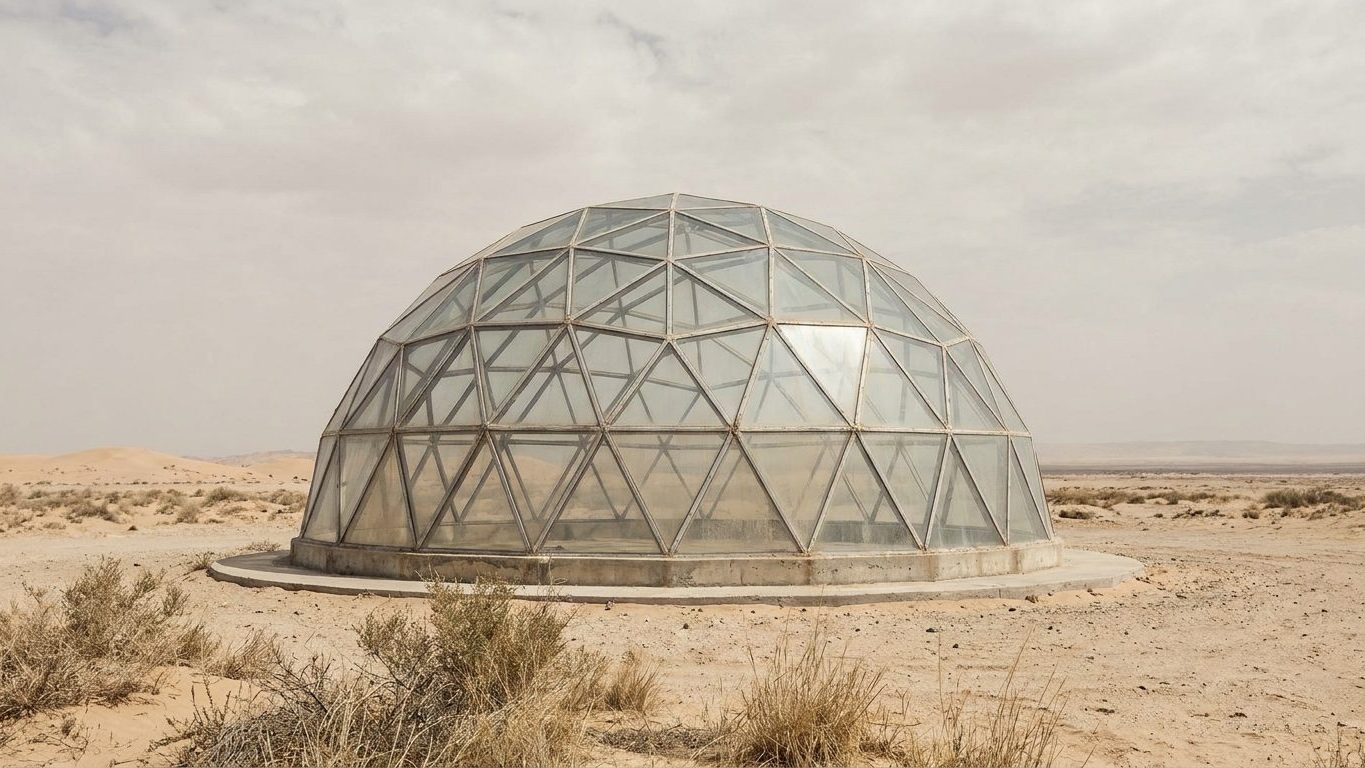
A bubble of glass and steel planted in the Sonoran Desert, in Arizona. Eight people sealed inside for two years, with no incoming air, water, or food from the outside. And somewhere in the depths of this structure, a phenomenon no one had anticipated: the oxygen was disappearing.
On September 26, 1991, eight people including physician Roy Walford, Jane Poynter, Taber MacCallum, and Mark Nelson entered the structure, and the door closed behind them for two years. Named Biosphere 2, the facility replicated under a single glass roof several Earth ecosystems. It housed five wild biomes, a tropical forest, an ocean with a coral reef, a mangrove area, a savanna and a desert, along with an agricultural zone where the crew grew their food and a human habitat. The stated objective? To verify whether humans could live in total self-sufficiency inside a closed system that recycles its own water, air, and a large portion of its food.
The eight “biospherians” produced 83% of their own food and recycled their water and air. They called themselves this, proud of this unprecedented experiment. But very quickly, things began to go awry.
- Oxygen in Biosphere 2 dropped from 21% to 14.2% in sixteen months, causing fatigue and sleep apnea among the eight occupants
- Excess microbial respiration of soil rich in organic matter consumed oxygen and produced carbon dioxide
- The concrete walls absorbed CO2 through carbonation, forming calcium carbonate and sequestering carbon
- In January 1993, the team had to inject pure oxygen from outside to save the interior
An air that dwindles without explanation
The problem began almost immediately: within a few months, the oxygen level inside the habitat began a slow and mysterious decline, starting from a normal 21%. Week after week, the drop continued, imperceptible day by day but relentless over time. Oxygen kept falling, slipping by about a quarter of a percentage point each month—from about 20.9% down to 14.5%.
The consequences for the bodies were real. In 1993, the level dropped to 14.2%, the equivalent of living at an altitude of roughly 13,400 feet, and the crew suffered from chronic fatigue, shortness of breath, and sleep apnea. Climbing stairs became a trial. A sentence remained unfinished, cut off for lack of breath.
No one knew where the oxygen was going. That was the odd part: in a closed system, matter should not vanish. It must be somewhere. Yet carbon dioxide measurements did not rise at the pace expected. The equation didn’t add up.
Two culprits identified in the soil and in the walls
The answer came from scientific publications dedicated to the experiment, notably a 1994 study in Eos, Transactions American Geophysical Union. The researchers showed that the loss of oxygen—from 21% to 14% in sixteen months—caused health problems for the crew and was driven by microbial respiration of an excessive amount of organic matter incorporated into the soils of the experiment, the CO2 produced then reacting with the concrete of the structure to form calcium carbonate.
The first mechanism operated beneath the biospherians’ feet. Biosphere 2’s soil, particularly in the tropical forest and savanna zones, was abnormally rich in organic matter, and the microbes metabolized this matter at an abnormally high rate, consuming substantial oxygen and producing large amounts of carbon dioxide. The designers had enriched the soils to promote plant growth. This move backfired on them.
The second mechanism lurked in the walls. A large part of Biosphere 2 was built with concrete, which contains calcium hydroxide, and instead of being consumed by plants to produce more oxygen, the excess carbon dioxide reacted with this calcium hydroxide in the concrete walls to form calcium carbonate and water. This process, carbonation, is typical in fresh concrete. No one had measured its extent in the scale of an entire sealed building.
The result of this double drain was striking. The carbonation of the concrete absorbed about 750 ± 250 kilomoles of CO2, balancing the respiratory losses, while photosynthesis couldn’t keep up with respiration, outpacing it by roughly a factor of two. The oxygen left the lungs of the soil microbes. The carbon, meanwhile, literally locked itself into rock.
Emergency injections from outside
Faced with deteriorating living conditions, the project leaders had to make a hard call. In January and again in August 1993, the team ultimately yielded and pumped pure oxygen from the outside to protect the crew’s safety. A decision with heavy implications: it meant breaking the very seal the experiment was meant to demonstrate.
Sixteen months after the start of the experiment, as they were more than halfway through, the decision was made to bring in oxygen, arriving in refrigerated trucks on January 14, 1993. The effect was immediate on the exhausted bodies. After months of lethargy and slow movements, as oxygen poured in, people began to run and laugh again.
This intervention stirred controversy. In January 1993, criticisms arose because the managers of Biosphere 2 injected oxygen from outside, calling into question the notion of testing a closed system, while supporters argued that it was an experiment, not a guaranteed demonstration of autonomous results. The experiment was no longer fully autonomous. Yet it continued to yield valuable data.
On September 26, 1993, the four men and four women finally emerged from two years of isolation in this futuristic desert ecosystem. Emaciated, marked by constant dietary deprivation, they nonetheless completed the planned duration. The crew had felt hunger virtually the entire time, losing an average of 16% of their body weight.
Thirty-five years later, the structure still stands in the Arizona desert. The site is now used by the University of Arizona as a Earth science research center, employed for controlled environmental experiments rather than sealed human habitation. A lesson endures that goes beyond a mere scientific curiosity: even an ecosystem designed in minute detail can hide a leak—whether in its concrete or beneath its roots—that no one anticipated.
Sources: agupubs.onlinelibrary.wiley.com | ecoticias.com
