
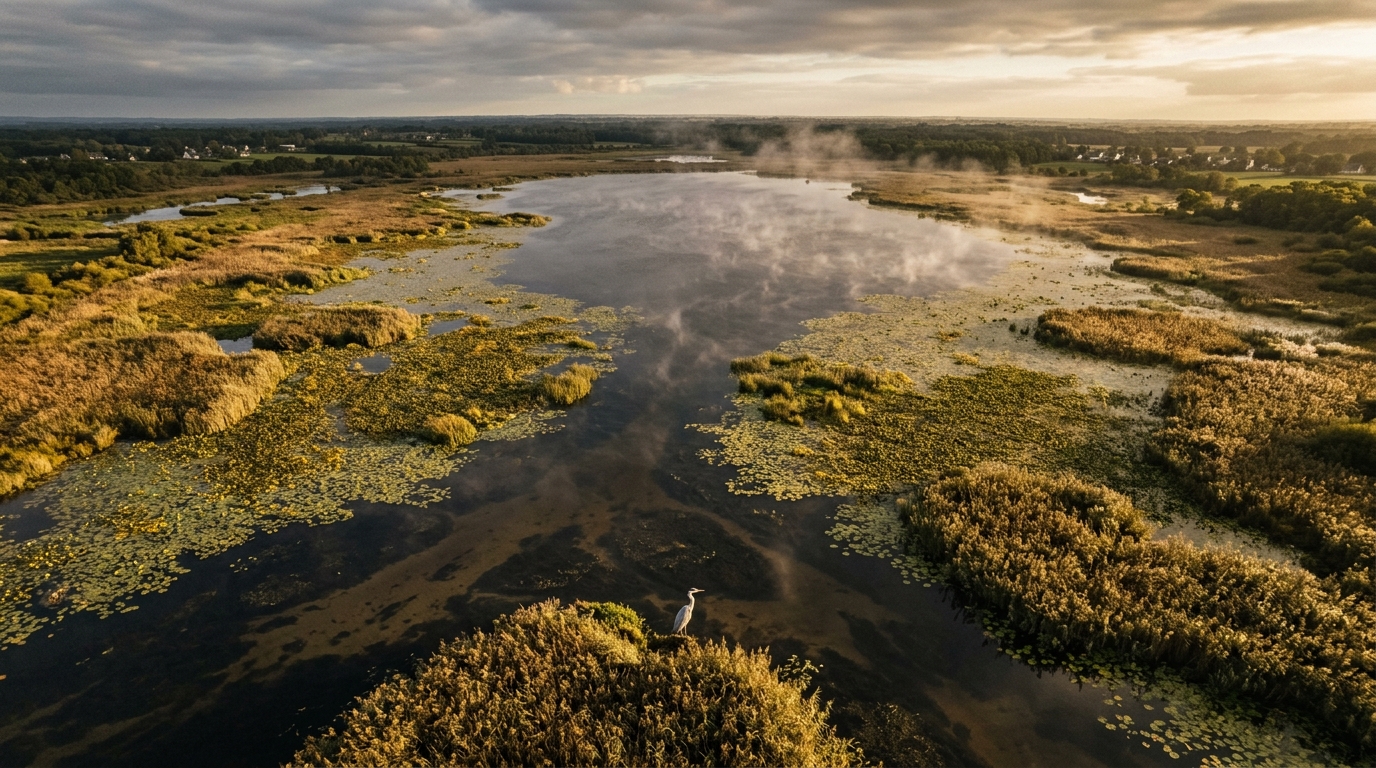
A landscape that seems frozen for centuries, yet is changing before our eyes in a way that no one can truly stop: this is the paradox of Lake Grand-Lieu. This vast body of water in the south of Loire-Atlantique loses a little depth each year, a victim of a phenomenon as discreet as it is relentless.
- The Lake Grand-Lieu, whose surface ranges from about 6,300 hectares in winter to 2,200 hectares in summer, never exceeds 3.5 meters in depth, making it highly vulnerable to silting caused by intensive farming in its watershed.
- This siltation threatens a unique ecosystem that shelters grey herons, white spoonbills, and numerous migratory birds, with a risk of gradually turning into marshland and then damp meadow.
- Dredging being ruled out, preferred solutions rely on the agricultural transition (hedgerows, cover crops), restoration of waterways, and hydraulic management, without totally stopping the phenomenon.
- A water giant losing depth every year
- When agriculture feeds the lake… with sediments
- A unique ecosystem under pressure
- Saving Grand-Lieu: the avenues that could still work
A Water Giant Losing Depth Every Year
About twenty kilometers south of Nantes lies the Lake Grand-Lieu, often presented as the largest flat-water lake in winter in France. Its surface astonishes with its seasonal swing: it ranges from around 6,300 hectares during the cold season to only 2,200 hectares in summer, depending on rainfall and evaporation. But what stands out most is its shallow depth, which never exceeds 3.5 meters in winter and can drop to as little as 1.5 meters when the sun is strong.
This characteristic, far from being merely anecdotal, makes the lake extremely sensitive to any change. In such a shallow body of water, a simple rise in the bottom by a few centimeters can disrupt the entire ecological balance. The phenomenon results from two forces that constantly oppose one another: sedimentation, which gradually deposits particles on the lakebed, and erosion, which can temporarily reverse the trend. But in the long run, it is the filling that gains ground, year after year, century after century.
When Agriculture Feeds the Lake… with Sediments
This silting phenomenon is not mysterious once you look at what feeds the lake. Grand-Lieu receives waters from a catchment of 850 km², spread across 42 communes, a territory largely dominated by agriculture. Two rivers play central roles in this input: the Ognon and the Boulogne, which traverse lands where intensive practices, notably maize farming, often leave soils bare during winter.
Without hedgerows or shelter belts to curb runoff, rainfall carries a substantial amount of soil into the rivers, which then deposit it at the lake’s bottom. On top of that come massive inputs of nitrogen and phosphorus from fertilizers, fueling a well-known ecological phenomenon: eutrophication. The water becomes nutrient-rich, algae proliferate, and the lake thickens from the inside. A specific structure, the Bouaye sluice, located at the mouth of the Acheneau, helps regulate water discharge and directly influences the rate at which these sediments accumulate.
A Unique Ecosystem Under Pressure
This slow silting is not merely a geological curiosity; it directly threatens one of Europe’s most valuable natural sites. Grand-Lieu is indeed a major birds’ area, where grey herons, white spoonbills, and a multitude of migratory birds seek refuge in its free-water expanses. If filling continues unchecked, the lake could gradually transform into marshland, then damp meadow, thereby reducing the habitat available for this exceptional biodiversity.
Eutrophication further worsens the situation: the accumulation of nutrient-rich sediments fuels the proliferation of algae, which consume the oxygen available and gradually suffocate the aquatic environment. This phenomenon is not new, as researchers have long documented the lake’s silting and the blockage of its tributaries since prehistoric times. Proof of this antiquity is that the organic matter accumulated over centuries gave rise to peat, a fossilized rock that served as fuel for heating in winter up until the 1950s.
Saving Grand-Lieu: The Avenues That Could Still Work
In the face of this threat, massive dredging, often cited as an obvious solution, is in reality ruled out by local stakeholders. Such an operation would seriously disrupt the local fauna and could stir up pollutants buried for decades at the lake’s bottom. The solutions under consideration thus favor a gentler approach, acting at the source of the problem rather than its consequences.
Among the levers being put to work is the agricultural transition: replanting hedgerows, maintaining winter cover crops, and restoring pastures would help retain soil before it runs toward the rivers. The restoration of waterways, with the recreation of meanders and buffer zones on the Ognon and Boulogne, also aims to trap sediments upstream. Finally, hydraulic management, via the Buzay canal that connects the lake to the Loire, allows regulating water levels and flushing part of the suspended particles during floods. The site today holds the status of a nature reserve, where boat use is prohibited, except for a small number of licensed professional anglers, which greatly limits direct human interventions in the environment.
Between the inputs from a sprawling agricultural watershed and a long-standing natural dynamic of filling that stretches back millennia, Lake Grand-Lieu finds itself caught in a trap that is difficult to reverse completely. The current measures, however promising they may be, slow the process more than they stop it. The question remains, one that goes far beyond this corner of Loire-Atlantique: how far are we willing to rethink our farming practices to preserve these ecosystems that, quietly, disappear beneath our feet?
