
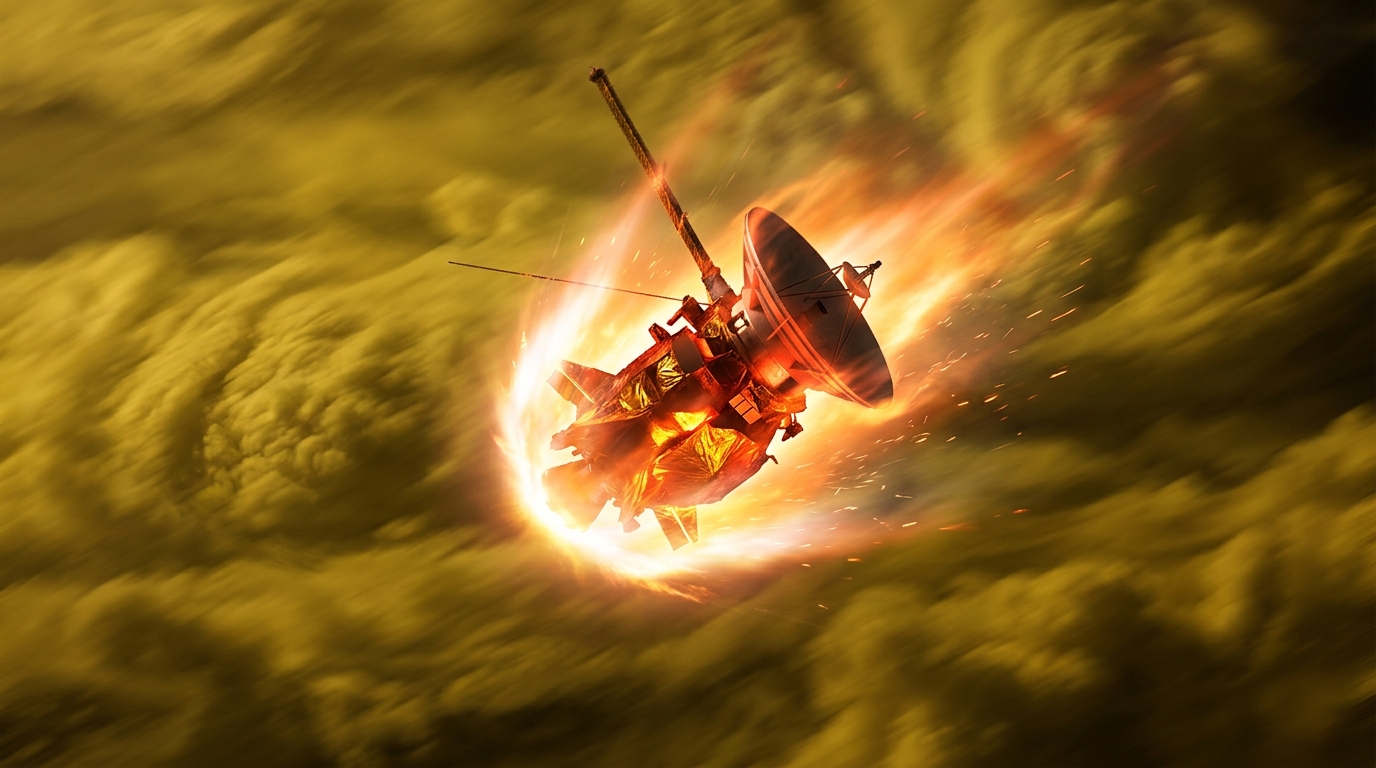
Picture the scene: a multi-ton spacecraft, the product of twenty years of work and billions invested, hurtling deliberately toward its own destruction at a speed nearly a hundred times faster than a commercial airliner. This isn’t the plot of a disaster movie, but the deliberate ending of the Cassini probe, plunging into Saturn’s clouds on a September day in 2017. The strangest aspect of this story is that NASA did not lose control of its probe: it sacrificed it willingly, fully aware of the risks. And the reason for this gesture, almost counterintuitive, rests on two names: Enceladus and Titan, two moons that Cassini itself had just revealed as serious candidates for habitability.
- Low on fuel, NASA could no longer guarantee Cassini’s trajectory, raising fears of an accidental collision with Enceladus or Titan.
- These two moons, revealed by Cassini as potentially habitable (subsurface ocean on Enceladus, hydrocarbon lakes on Titan), needed protection from any terrestrial contamination.
- On September 15, 2017, after a final flyby of Titan that redrew its trajectory, Cassini disintegrated in Saturn’s atmosphere at 113,000 km/h, transmitting data until the last moment.
- Why Cassini Had to Die for Science to Continue
- Enceladus and Titan, the two worlds too precious to approach
- The Grand Finale, a dive calculated to the second
- Cassini’s Legacy, what its end teaches us about the future of space exploration
Why Cassini Had to Die for Science to Continue
After nearly twenty years traversing the Saturnian system, the Cassini mission was nearing its end, not because its instruments were failing, but simply because it no longer had enough fuel to continue adjusting its path. A technical detail that, at first glance, seems minor, but which posed a problem of paramount importance in the eyes of NASA and ESA engineers. With no possibility to pilot the spacecraft precisely, there could be no further guarantee about its future trajectory.
The risk, even if small, was that a Cassini left to drift would eventually crash one day into Enceladus or Titan, two moons whose data transmitted by the probe had just revealed a potentially prebiotic or habitable environment. Such a collision could introduce terrestrial micro-organisms into these unique environments, thereby compromising all future scientific investigation into possible extraterrestrial life. This principle, called planetary protection, guided the final decision: it was better to destroy the probe properly than to let it drift indefinitely around Saturn.
Enceladus and Titan, the two worlds too precious to approach
To understand the scale of this precaution, one must measure what Cassini had discovered along its mission. Enceladus, this small icy moon with a pristine surface, hides beneath its crust an ocean of liquid water that vents outward in spectacular geysers. These plumes contain complex organic molecules, as many ingredients associated with the emergence of life on Earth. As for Titan, Saturn’s largest moon, it features a thick atmosphere and lakes of liquid hydrocarbons, a landscape that evokes, to a degree, a frozen and exotic version of our own planet in its early days.
Faced with such troubling clues, it became unthinkable to take any risk. It wasn’t about responding to confirmed contamination, since no living bacteria has ever been detected on Cassini, and an impact with Enceladus remained highly unlikely anyway. But in science, prudence often takes precedence over certainty: we protect not only against what is probable, but also against what could one day undermine decades of research.
The Grand Finale, a dive calculated to the second
The mission’s end for Cassini was not improvised. Properly named the Grand Finale, this final phase began with a series of unprecedented weekly plunges into the narrow space of roughly 2,000 kilometers separating Saturn from its rings. A region no other spacecraft had ever explored, yielding scientists a harvest of unique data about the giant planet’s composition.
On April 22, 2017, one last Titan flyby allowed Cassini to use the moon’s gravity as a true cosmic billiard cue, reshaping Cassini’s trajectory to carry it through Saturn’s icy rings. Several end-of-life scenarios had been considered, such as a controlled impact on a frozen satellite or on the main ring, before teams ultimately chose a direct plunge into Saturn’s atmosphere. On September 15, 2017, at a vertigo-inducing speed of 113,000 km/h, Cassini disintegrated, continuing to transmit data until the very last moment of its existence.
Cassini’s Legacy, what its end teaches us about the future of space exploration
Nearly a decade later, this maneuver continues to resonate as a model of scientific rigour. Cassini’s disappearance was not felt as a failure; quite the opposite: it marked the logical culmination of an exemplary mission, where even the final moment was exploited to collect valuable data. This approach has, moreover, influenced how space agencies today conceive the end-of-life for their probes, particularly when they operate near worlds that could harbor life.
As new missions are being planned to study Europa, Jupiter’s moon, more closely, or to return to explore Enceladus and Titan, Cassini’s sacrifice remains a defining reference. It reminds us that space exploration is not merely about discovery, but also about responsibility: the obligation to preserve the integrity of the worlds we study, so as not to bias the answers to humanity’s most fundamental questions about our origins and the possibility of life elsewhere.
Ultimately, Cassini’s end illustrates a simple but powerful idea: sometimes, to keep advancing in knowledge, one must be willing to relinquish. By choosing to destroy its own probe rather than risk compromising two fascinating worlds, NASA made a gesture that goes beyond mere technical prowess. A question remains that continues to fuel the imagination of astronomy enthusiasts: what if, someday, a future mission confirms what Cassini only hinted at beneath Enceladus’ ice?
