
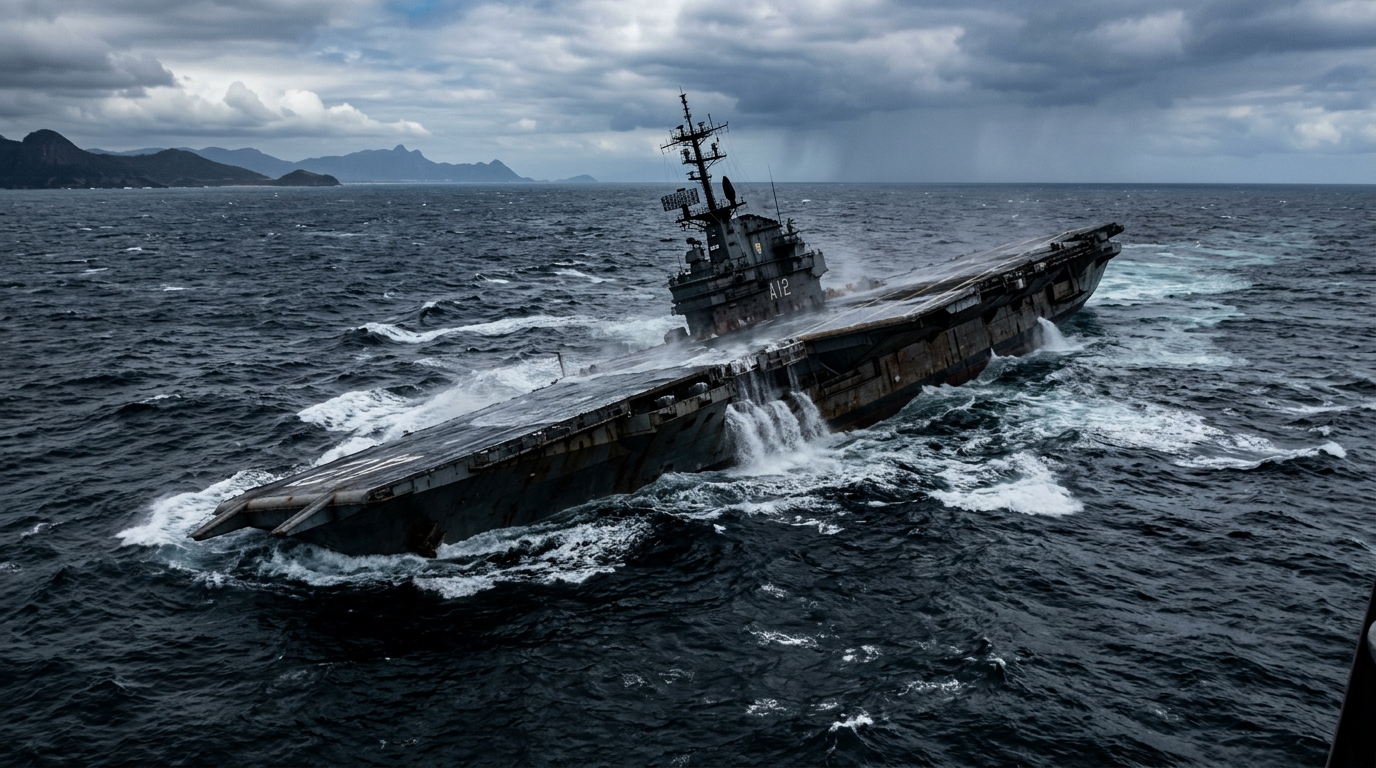
Important note before plunging into this extraordinary story: it was neither a storm, nor a technical failure, nor even a live-fire drill that sent this sea giant to the bottom. It was a carefully considered decision, taken after months of total stalemate. A aircraft carrier built in France, sold to Brazil, tossed from one continent to another with no country willing to host it, ended its journey 5,000 meters beneath the surface of the Atlantic. A life ending worthy of a nautical adventure novel, except that everything that follows is entirely authentic.
- Built at Saint-Nazaire and sold to Brazil in 2000 under the name São Paulo, the former Foch was rejected by Turkey in 2022 because of its 9.6 tonnes of asbestos and 644 tonnes of toxic substances
- Drifting at sea without a destination after Brazil refused to allow it into its waters, the ship threatened to capsize in an uncontrolled manner near the coast in January 2023
- On February 3, 2023, the Brazilian Navy deliberately scuttled the aircraft carrier about 350 kilometers from the coast at a depth of 5,000 meters, a decision denounced by NGOs as a violation of at least three international environmental treaties
- A French aircraft carrier turned into an international hot potato
- Asbestos on board: why no shipyard wanted to touch it
- The radical Brazilian choice: sink rather than manage
- What this sinking reveals about the naval dismantling industry
A French Aircraft Carrier Turned into an International Hot Potato
Everything begins in Saint-Nazaire, where the vessel was born in the late 1950s under the name Foch. For 37 years, it proudly served in the French Navy, taking part in numerous missions before being deemed too costly to maintain. In 2000, France ceded the ship to Brazil, which renamed it São Paulo and integrated it into its fleet. But the story does not end there: worn by years and by maintenance deemed insufficient, the ship was ultimately decommissioned in 2017-2018, unable to return to sea under safe conditions.
Thus began a true maritime odyssey. In 2021, Brazil sold the wreck to a Turkish company tasked with dismantling it. The ship left Brazilian shores, crossed the Strait of Gibraltar toward Turkey, but the promised reception turned into a categorical refusal. By late August 2022, Turkish authorities canceled the dismantling permit, officially citing an asbestos quantity deemed far too large aboard. The giant of 32,000 tonnes and 266 meters in length found itself without a home port, forced to turn back toward South America.
Asbestos on Board: Why No Yard Wanted to Touch It
The Turkish refusal was not merely a bureaucratic precaution. According to Brazil’s federal public prosecutor’s office, the aircraft carrier contained no less than 9.6 tonnes of asbestos, a highly carcinogenic material whose handling requires specialized facilities and very strict protocols. In addition, around 644 tonnes of inks and other dangerous substances formed a toxic cocktail that made any conventional demolition operation extremely risky for workers and the local environment.
Toward September 2022, the ship was towed toward Brazil, only to have the door slammed shut once more: Brazilian authorities simply refused entry of the hull into their territorial waters. The São Paulo thus became a ghost ship, drifting at sea, with no destination possible. No shipyard in the world was willing to take charge of this contaminated colossus. The situation worsened in January 2023, when the hull, weakened by a double Atlantic crossing, began to threaten seriously to capsize on its own, this time in a completely uncontrolled manner, near Brazilian shores.
The Radical Brazilian Choice: Sink Rather Than Manage
Faced with this impasse, the Brazilian Navy took a decisive stance. On February 3, 2023, it announced that it had deliberately scuttled the carrier in mid-ocean, about 350 kilometers off the coast. The ship now lies at a depth of nearly 5,000 meters in the Atlantic Ocean, carrying with it its load of asbestos, lead, and toxic paints. To justify this spectacular decision, military authorities cited the major risks of a prolonged tow of a hull in advanced decay, stating that they had “no other choice” than to proceed with a controlled sinking rather than let the vessel sink in an unpredictable manner, potentially close to shorelines.
This official version, however, did not convince everyone. Several environmental organizations immediately denounced a genuine environmental crime, pointing to a violation of at least three international treaties dedicated to ocean protection. Deliberately sending tons of toxic materials to the seabed, in a still largely unknown marine ecosystem, remains a move with consequences whose magnitude will likely take years to be fully assessed.
What This Sinking Reveals About the Naval Dismantling Industry
Beyond the tragic fate of this former flagship of the French Navy, this affair highlights a far broader problem: the dismantling of large warships at the end of their life. Very few shipyards worldwide possess the infrastructure needed to safely handle the massive quantities of asbestos and other toxic materials accumulated over decades of use. As a result, these steel giants become diplomatic headaches that nobody wants to bear, caught between exorbitant decontamination costs and real health risks for workers.
The São Paulo case is not isolated in its turbulent history: under Brazilian flag, the ship had already endured six fires, one of which claimed the lives of four sailors, not counting recurring maintenance problems that betrayed the vessel’s advanced wear. This accumulation of incidents likely made its salvage increasingly illusory, and its scuttling almost inevitable, in the absence of a credible alternative.
This story ultimately raises a question that goes far beyond the isolated case of the ex-Foch. What should be done with aging military behemoths when no one wants, or can, manage the pollution inherited from another era? Between still-ambiguous international regulations and a lack of suitable infrastructure, the fate of the São Paulo could well presage that of other ships in the decades to come, until the naval dismantling industry finds a durable solution to this toxic puzzle.
