
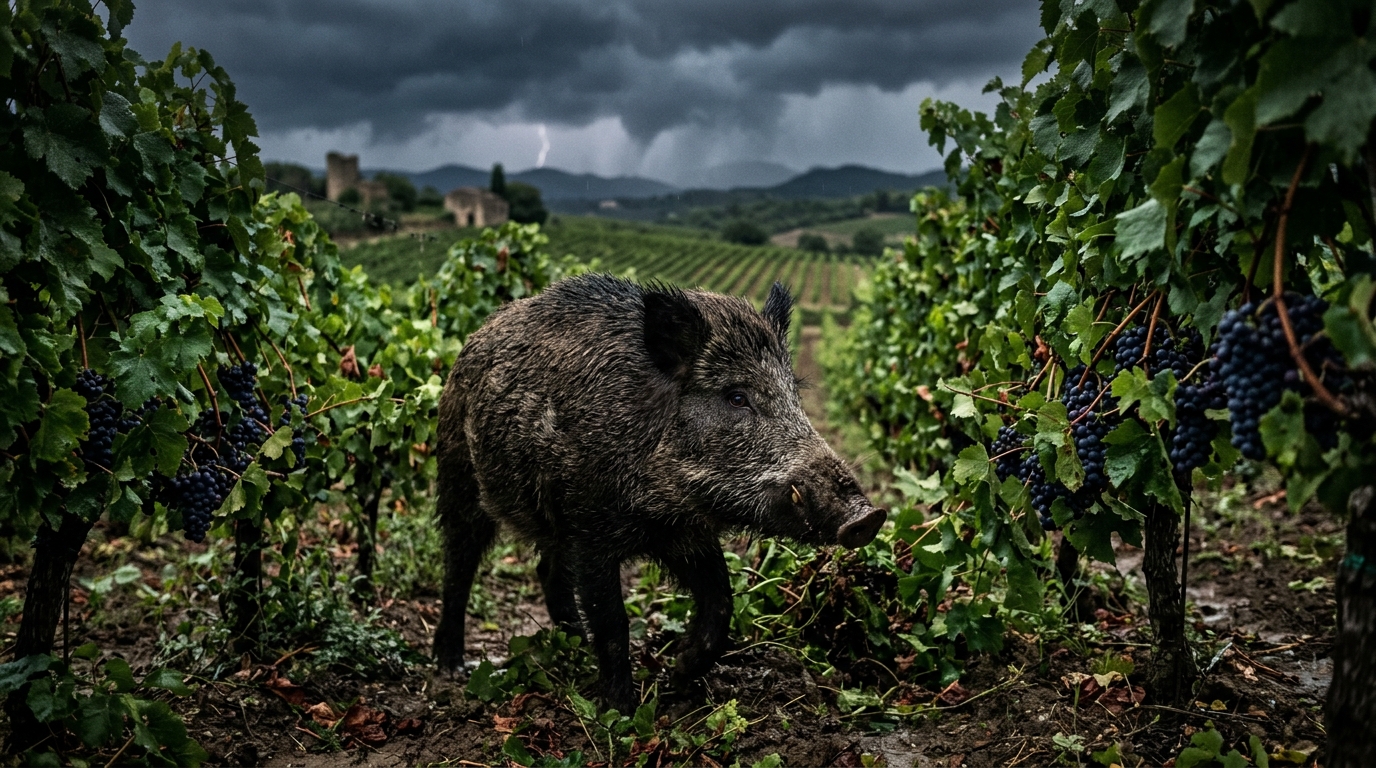
One might have thought the main danger when biting into a terrine of wild boar made from local game would be little more than high cholesterol or traces of pesticides from neighboring vineyards. The reality is different, and considerably more worrying. In the midst of hunting season, as the undergrowth of the Aude once again resounds with the first drives, analyses conducted in the Orbiel valley reveal an arsenic contamination that has nothing to do with the surrounding rows of vines. The source of the problem lies not in the fields but underground, a silent legacy of an industrial activity that stopped more than twenty years ago.
- The former Salsigne mine left more than 800,000 tonnes of arsenic buried, continuing to contaminate the soils of the Orbiel valley
- Digging the earth to feed itself, the boar ingests and accumulates arsenic in its tissues, notably the liver, kidneys, and flesh
- Wild game escapes sanitary controls imposed since 1997 on water and vegetables, exposing consumers to undetected contamination
- The industrial ghost that still poisons the soils of Aude
- How the boar turns polluted soil into a concentrated poison
- Arsenic levels that worry health authorities
- Hunters, consumers: what this contamination really reveals
The industrial ghost that still poisons the soils of Aude
To understand the origin of this contamination, one must go back to the history of the Salsigne mining site, in the Aude. This deposit long bore the not-so-envied title of Europe’s largest gold mine, but also the darker one of being the world’s leading producer of arsenic. The exploitation continued until 2004, leaving behind a colossal legacy: more than 800,000 tonnes of arsenic still lying in the form of waste, buried under the hills that overlook the valley.
Despite confinement work, vegetation restoration, and the construction of retention basins begun in 1999, at a cost of around 45 million euros, pollution continues to spread. The wind, rain runoff, and floods of the Orbiel relentlessly disperse these toxic dusts into nearby soils and sediments. At the Gué de Lassac site, on the outskirts of the old mining district, arsenic concentrations reach up to 74 times the local geochemical background, a figure that rises to 1000 times in a tributary, the Grésillou. It is easy to understand why the valley locally earned the unflattering nickname valley of arsenic.
How the boar turns polluted soil into a concentrated poison
This is where an animal enters the scene whose dietary behavior unknowingly acts as a real toxin pump. The boar is a digger: to feed on roots, tubers, and earthworms, it relentlessly overturns the soil with its snout, sometimes to depths of several tens of centimeters. In a zone where soils are saturated with arsenic, this natural behavior becomes a mechanism for direct and repeated ingestion of the poison.
The arsenic thus ingested does not vanish: it gradually accumulates in the animal’s tissues, with a particularly marked concentration in the liver and the kidneys, but also, to a lesser extent, in the muscle flesh itself. This phenomenon, bioaccumulation, literally turns the boar into an ambulant concentrate of the soil pollution it frequented. A similar signal had already been observed in pet dogs living in the area, whose hair analyses showed arsenic levels markedly higher than those of control animals outside the contaminated zone. The boar, a wild and ubiquitous animal in these woodlands, appears to follow the same toxic trajectory, at a scale that remains still underdocumented.
Arsenic levels that worry health authorities
This is not the first time the Orbiel valley has drawn the attention of public health services. As far back as 1997, a biosurveillance study of 681 residents already showed a slight overexposure to arsenic, accompanied by explicit health recommendations, including a caution to avoid consuming locally produced wine. Since that date, the cultivation, sale, and consumption of garden vegetables, as well as the use of private well water and the water from the Orbiel, have been strictly prohibited in the valley.
Subsequent analyses also revealed worrying arsenic levels in the urine of several dozen children living in the area, confirming that contamination extended beyond soils and waters to the population itself. In this already heavy context, the idea that wild game could represent a new contamination route truly changes the picture. While vegetables, water, and vines had been under close watch, it is finally the meat of the boar, long considered an irrefutable terroir product, that reveals the scale of the problem.
Hunters, consumers: what this contamination really reveals
For hunters who roam these woods from the opening of the season, this discovery poses a concrete and immediate question. Unlike garden vegetables or well water, whose prohibition has been clearly posted for nearly thirty years, wild game largely escapes the usual controls. A boar shot on a slope contaminated in the region can easily end up in a pot without any prior analysis, potentially exposing consumers to chronic arsenic ingestion—a recognized cancer and metabolic disorder risk in the long term.
Regional authorities, led by the Aude prefecture, already regularly impose restrictions on products from this specific geographic area. Yet wildlife, inherently mobile, makes the task particularly complex: a contaminated boar in the Orbiel valley could be shot several kilometers away, blurring the boundaries of a pollution once thought confined. This situation illustrates how an industrial heritage, even officially closed for more than two decades, can continue to reinvent itself in unexpected forms, migrating from soil to wildlife and then potentially to our plates.
This silent contamination is a reminder of an obvious truth too often forgotten: the closure of an industrial site never marks the end of its influence on the environment. Between the vineyards of Languedoc, long singled out for their phytosanitary treatments, and the wooded hills of the Orbiel that harbor a much older poison, the entire terroir deserves closer scrutiny. It remains to be seen how many other French regions, marked by mining or industrial histories, still hide similar surprises beneath landscapes that appear preserved.
