
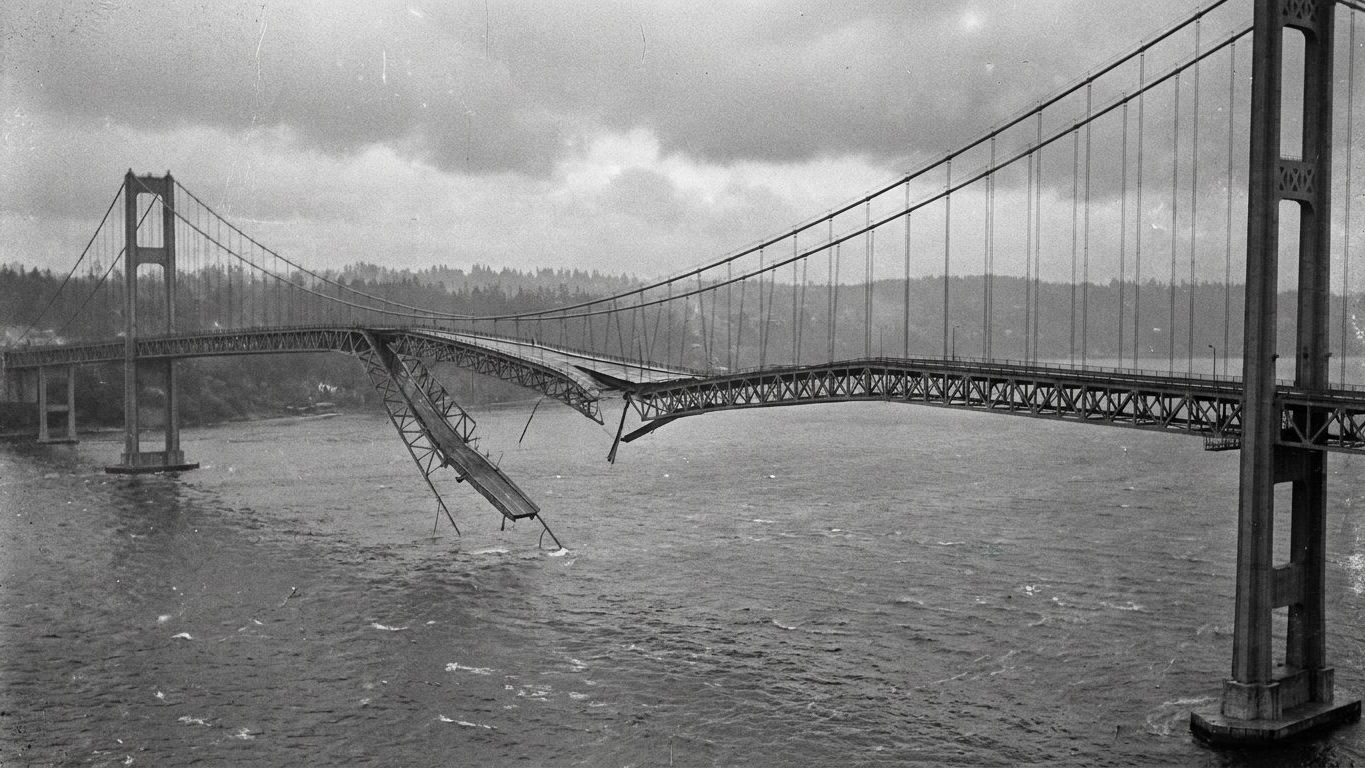
On July 1, 1940, a brand-new suspension bridge opened to traffic in the state of Washington. Four months later, it lay at the bottom of Puget Sound. Neither a tropical storm nor a cable severed by malice: an ordinary gust of wind was enough to topple one of the longest suspension bridges in the world at the time, witnessed by several onlookers and captured on camera.
- The Tacoma Narrows Bridge collapsed on November 7, 1940, under winds of 65 km/h, well below its theoretical capacity.
- The deck shifted from vertical oscillations to extreme torsional motion, twisting at 38 cycles per minute for 45 minutes.
- The light design by Leon Moisseiff and the ignorance of aeroelastic coupling transformed ordinary gusts into a destructive force.
A deck that fluttered even before its inauguration
Construction began in September 1938, and as soon as the deck was assembled, vertical motions were observed under the wind. This behavior quickly earned it a nickname that would endure in the history of engineering: Galloping Gertie. The bridge became renowned for its vertical oscillations; it earned the nickname because it already swayed in winds as low as 5 to 6 km/h.
Far from alarming, this motion drew people in. Motorists detoured to feel the sensation of the deck rolling beneath their wheels, like a free attraction. The oscillations continued after the bridge opened to the public, despite several devices intended to dampen the phenomenon. Tie-down cables were installed to limit movements at the ends. Yet that proved insufficient.
Even if the tie-down cables reduced end oscillations, the center continued to move up and down. A warning signal, left without immediate action.
November 7, 1940: the morning when everything changes
That Thursday did not announce any meteorological disaster. In the morning, strong winds swept across the strait from the southwest, beating Gertie against the solid side of the deck. The bridge began to undulate, to “gallop,” with waves ranging from 60 to 150 centimeters high; at 7:30 a.m., the wind measured 61 km/h.
Nothing extraordinary for a bridge expected to withstand much stronger gusts. The wind speed was about 65 km/h. An engineer, Clark Eldridge, even traversed the structure around 8:30 a.m. without undue alarm: the deck performed its usual waviness, less pronounced than on other days.
Then everything changed in nature. While the bridge had been behaving with its habitual vertical motion, the character of the movement suddenly shifted from pure vertical to pure torsional motion. The deck no longer rose and fell: it twisted, one edge rising while the other sank, in a corkscrew-like motion. The bridge rotated at about 38 oscillations per minute, with the deck tilting at extreme angles.
This deadly ballet for the structure lasted nearly an hour. The violent twisting motion persisted for about 45 minutes, alternating between knot-like torsion and non-torsion phases, before the bridge collapsed. At 11:10 a.m., it was over: the heart of Galloping Gertie sank beneath the waves, coming to rest on the bottom of Puget Sound.
The scene was filmed by a University of Washington professor who had come precisely to study the structure’s behavior. These grainy, sepia-toned images show an entire bridge undulating like a ribbon before disintegrating section by section. They still circulate today in civil engineering courses around the world, projected as a rite of passage for future engineers.
A deck too thin, too light, designed for the wrong kind of wind
The investigation reports that followed the disaster point to a design flaw rather than a weather accident. An inquiry reveals that the section formed by the roadway and the plate-girder stiffeners (instead of open trusses) failed to absorb the turbulences of gusts; at the same time, the two-lane roadway gave the span a high degree of flexibility.
The bridge’s designer, Leon Moisseiff, had a solid reputation in the field: he had notably worked on the Golden Gate Bridge. But his design philosophy, the deflection theory, pushed lightness to the extreme. Moisseiff had developed the “deflection theory,” according to which bridges could be lightened and made more economical by letting them bend under wind forces rather than resisting them rigidly.
The engineers’ calculations of the time harbored a blind spot. The bridge had been sized to resist wind but only with static effects in mind. This reasoning left out a phenomenon then reserved for airplane wings: energy transfers from the wind to the bridge and the oscillations amplify due to aeroelastic coupling, until ruin; this mechanism was known in 1940 only for airplane wings, and no one anticipated this scenario in the design of suspension bridges.
A misleading explanation has circulated for decades, including in some textbooks: a simple mechanical resonance with air vortices formed in the wake of the deck. The accident occurred four months after the July 1 opening, but this explanation does not hold because the torsional frequency of the bridge was one cycle every 5 seconds, while the vortices occurred at one cycle per second. The true mechanism, more subtle, is aeroelastic flutter: the deck’s torsion changes the wind’s angle of attack, which in turn changes the torsional moment, in a self-sustaining loop.
What Gertie left for civil engineering
No one died in the collapse, except for a famous detail: a dog left trapped in a car abandoned on the deck, too frightened to escape. Rebuilding, however, had to wait. Engineering issues and the United States’ involvement in World War II delayed replacement plans for several years.
The new bridge, opened ten years later, took to heart all the lessons from the catastrophe. The replacement structure of 1950 incorporates a deeper and wider truss-based stiffening system in place of Moisseiff’s full, shallow box girder; the deck is also designed with several longitudinal slots covered by metal grilles to let air move vertically, and hydraulic dampers are installed at various locations. After the Tacoma Narrows failure, wind-tunnel testing became standard practice for the design of long-span bridges worldwide.
The remains of the first bridge never left the seabed. Today, those tons of twisted steel form one of the planet’s largest artificial reefs, a metallic remnant where fish and crustaceans thrive, just a few meters beneath the cables of the bridge that learned, in time, never to trust the wind too much.
Sources: reveilcitoyenmedia.com | livescience.com
