
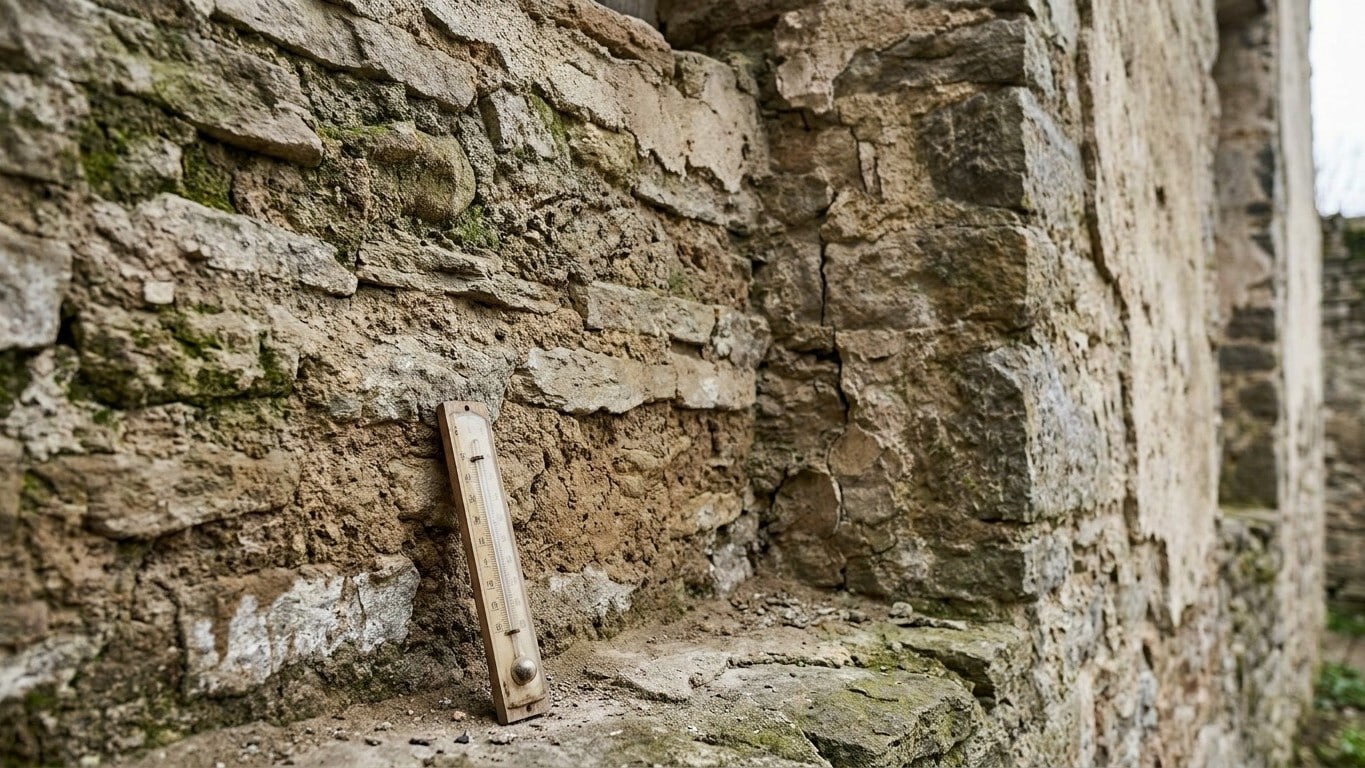
Inside a 19th‑century stone farmhouse, the thermometer shows 24°C on a scorching afternoon. 200 meters away, in a pavilion completed five years ago, it climbs above 35°C as early as 2 p.m. This isn’t a grandmother’s tale: it’s pure physics, and it has a precise name, thermal inertia.
Old buildings aren’t magical. While newer homes become stifling at the first heat waves, some ancient structures stay cool without air conditioning or fans, thanks to several physical principles that prevent heat from entering and then vent it out before it accumulates. The culprit? The use of heavy materials—stone, solid brick, rammed earth—endowed with strong thermal inertia.
Key takeaways
- Why an old house stays cool without air conditioning while the neighboring home becomes unbearable
- The hidden role of the night: this physical mechanism that almost nobody knows
- How modern building standards unintentionally turn summers into ovens
The heat sponge that takes hours to yield
Thermal inertia corresponds to the capacity of a material to store heat and then gradually release it; the more inertia a material has, the more it slows the interior temperature fluctuations. Concretely, a thick stone wall of 50 or 60 centimeters acts like a heat sponge: it absorbs calories during the day and releases them only hours later, often in the middle of the night when everyone is already asleep.
This delay between the moment heat hits the façade and the moment it reaches the interior is called thermal lag. And it is far from trivial: with a 40-centimeter masonry, it can reach 10 to 12 hours. The heat peak at 3 p.m. doesn’t penetrate the living room until past midnight, when outdoor air has already cooled. A square meter of this same wall can also store the energy equivalent to 15 kWh of heat, i.e., the daily consumption of a fan running continuously. A mass of stone does, for free, what a large electrical appliance would do with kilowatt-hours.
What the walls manufacture while you sleep
That is where the mechanism plays out, and it’s also the point that most people overlook: a thick wall is useless if it cannot breathe at night. A thick wall does not generate coolness by itself; it delays the arrival of heat and must be able to cool down at night. In well‑thought-out old houses, residents throw open windows and shutters as soon as the outside temperature falls below the inside temperature, often between midnight and dawn. Fresh air circulates from room to room, traverses the building, and literally recharges the stone with coolness. In a dwelling with high inertia, the thick walls—made of stone, concrete, or brick—accumulate nocturnal coolness, and during the day this thermal mass slows the rise of interior temperature.
Without this nocturnal ventilation, the miracle stops abruptly. During a summer heatwave, the wall ends up storing heat, then releasing it inside; without this regulation, comfort is never guaranteed all year round. Worse still during a prolonged episode: a heatwave is a period of intense heat during which the temperature does not drop much at night for several consecutive nights, and a house with very high inertia will stay cool longer, but will also stay hot longer once temperatures fall. It goes without saying that the old wooden shutters and windows, often mocked, are in fact the central piece of the system, far more than the mere thickness of the walls alone.
The new, well insulated, but unable to store anything
Here is the paradox that disrupts the narrative: homes built under RT2012 or RE2020 standards are excellent students in winter—airtight, well insulated, and energy efficient. In summer, they can turn into ovens. A dwelling that is very well insulated but with little inertia can quickly overheat during strong heat waves, a common problem in very airtight new buildings with large sun-facing glass surfaces: heat enters easily, but the lightweight materials cannot absorb it, and the temperature climbs rapidly despite a good DPE rating.
The difference, therefore, does not lie in the performance of the insulation, but in the nature of the wall itself. The fundamental difference between a timber-framed house and a stone or brick building is not their insulation, but their thermal mass: a light-weight house, even if superbly insulated, reacts very quickly to temperature changes, and the sun beating on a window is enough to push the thermometer up rapidly. Airtightness, intended to retain heat in winter, backfires in summer: it precisely blocks the night ventilation that would recharge old walls with coolness.
One in two homes transformed into a kettle
The phenomenon is not marginal. A study by the consulting firm Pouget Consultants and Ignes, published in June 2026 from nearly 9 million energy performance diagnostics drawn from ADEME’s database, makes a blunt statement: 90% of dwellings lack the equipment to combat heat, and one dwelling in two is considered a thermal kettle. A separate survey conducted for the Fondation pour le Logement confirms the trend: two-thirds of the French have trouble coping with heat inside their homes, and one in two dwellings does not protect against high heat.
The problem even affects the newest constructions: even homes rated A or B on the DPE are not spared, with 35% judged “insufficient” for summer comfort. A Leroy Merlin Observatory study carried out with Ifop among more than 6,000 French confirms that extreme heat is among the top difficulties in housing, and nearly a third of respondents feel their dwelling could become uninhabitable during heat waves.
One final detail worth knowing before celebrating living in old stone: in some churches and grandmother’s houses reputed for their coolness, the freshness does not always come from the walls. Even in very hot periods, these buildings stay cool more thanks to an uninsulated floor in contact with deeper, cooler layers, acting as a reverse radiator. That is a reminder that before knocking down partitions or pouring concrete, it’s worth understanding what, in an old building, actually does the work.
Sources: franceinfo.fr | gameblog.fr
