
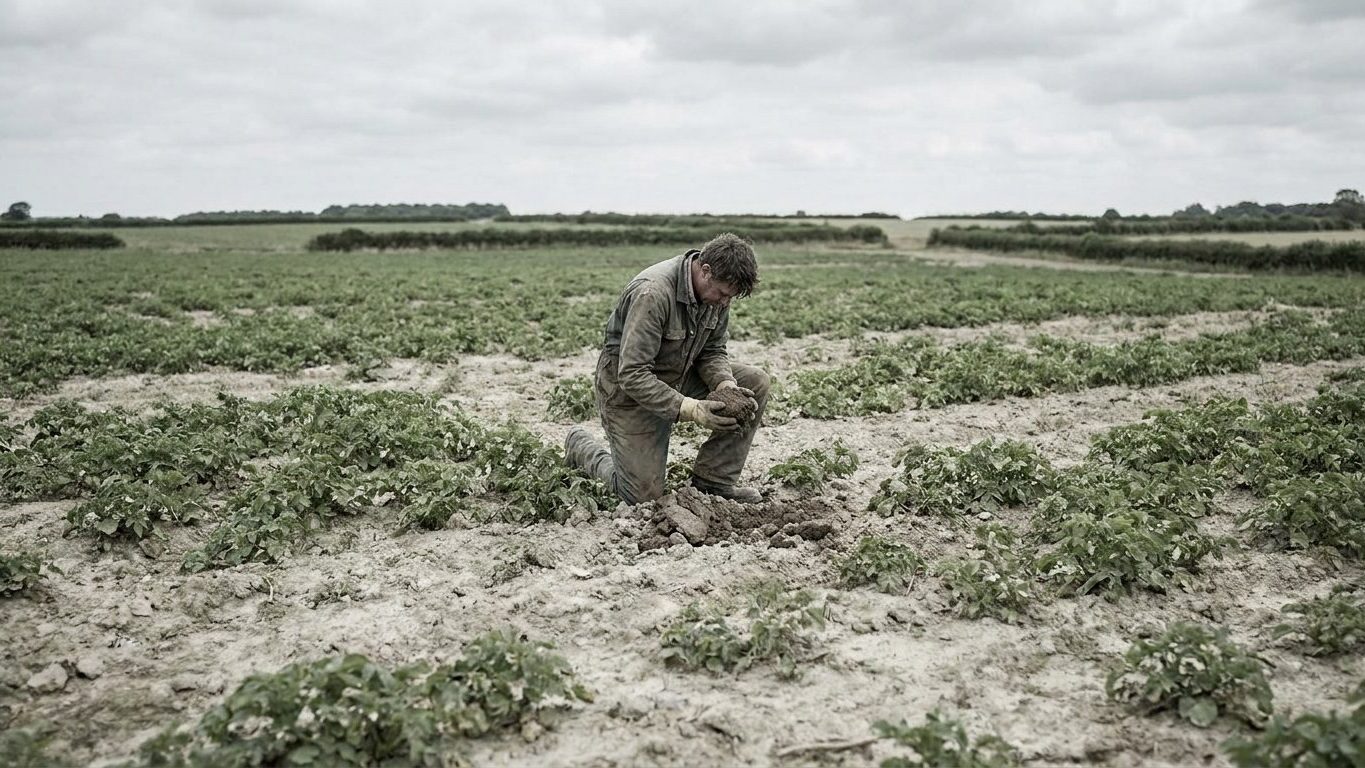
No plant on Earth can do without phosphorus. This element is part of the DNA, RNA, and the molecule that provides the energy fuel for all plant cells. Without it, no seed would germinate, no root would develop, no harvest would grow. And yet, this vital mineral depends almost entirely on deposits concentrated in a handful of countries, a situation increasingly worrying global food-security experts.
- Four countries control nearly all of the world’s exploitable phosphate reserves.
- No plant can do without phosphorus, an irreplaceable element for DNA, RNA, and cellular energy.
- Phosphorus recycling through wastewater treatment and organic farming becomes a legal obligation in Europe starting in 2026.
A Nutrient No Substitute Can Replace
Phosphorus plays a physiological and structural role in DNA, RNA, ATP, and the phospholipids of plants. It literally shapes the living plant at the molecular level. Without this element, photosynthesis slows, flowering is delayed, and fruits do not form properly.
Alongside nitrogen and potassium, this non-substitutable mineral is indispensable for plant growth. Unlike other agricultural inputs, there is no synthetic chemical equivalent able to perform its role. Phosphorus cannot be manufactured in a laboratory from nothing: it must be extracted from the rock in which it has accumulated over millions of years.
Even a moderate deficiency leads to reduced leaf growth. A plant in need is quickly recognizable: dull foliage, a stunted root system, yields that collapse. Farmers have known this for decades, but few consumers realize how much this mineral resource conditions what ends up on their plates.
An Extremely Concentrated Geography
Four countries concentrate nearly all of the world’s exploitable phosphate reserves. This is not a market anomaly but a geological reality. Mastery of this resource represents a major economic and strategic challenge, all the more so since its deposits are concentrated in a small number of countries, making certain territories indispensable on the international market.
This geographic concentration has no parallel among other agricultural inputs. Synthetic nitrogen can be produced almost anywhere in the world from ambient air. Phosphorus, by contrast, remains captive in localized sedimentary rocks formed by the accumulation of marine organic matter over tens of millions of years.
Many farming systems today depend on inorganic fertilizers that rely on phosphate rock. This structural dependency turns a relatively obscure ore into a top geopolitical variable. A logistics hiccup, a trade dispute, or an export decision in one of these four countries can make fertilizer prices wobble on the other side of the planet.
What Gradual Depletion Really Implies
The catastrophe scenario is not a sudden and immediate shortage. It is a gradual degradation of the quality of the remaining deposits and a steady rise in extraction costs.
Phosphate rock shortages, or simply significant price increases, would have a substantial impact on global food security. Farmers in the poorest countries, often unable to absorb a sustained rise in fertilizer costs, would be the first hit. A portion of the world’s staple production depends on a thin thread linking a handful of mines to billions of hectares under cultivation.
These reserves are unevenly distributed and are not renewable on human time scales. Once mined and dispersed into the environment, this resource never naturally returns to a concentrated, exploitable form. That is the paradox: phosphorus does not disappear from the planet; it merely dilutes in soils, rivers, and oceans until it becomes unusable.
Phosphorus is also a trigger for eutrophication of water bodies, driving algal blooms and, in the long run, oxygen depletion in deep waters. Ironically, the very molecule that is so scarce in fields pollutes rivers and lakes in abundance when not captured in time.
Recovering Rather Than Extracting
Faced with this impasse, an entire sector is organizing around recovery. With the coming phosphorus shortage for agricultural needs, improving phosphate recovery at wastewater treatment plants becomes a necessity, notably through the crystallization of struvite.
Struvite, a phosphorus-rich crystal, forms naturally in the pipes of wastewater treatment plants. Long considered a costly nuisance to remove, it is now deliberately captured. Up to 40% of the phosphorus entering a treatment plant can be recovered in this form, a fertilizer marketable for agriculture. A plant in Alsace now recovers nearly 90 tons of this crystal each year through a precipitation process applied to digested sludge.
In Switzerland, recycling phosphorus from wastewater will become a legal obligation starting in January 2026. Other European countries, such as Germany and the Netherlands, are following a similar trajectory. The logic is simple: what we throw away today in wastewater could feed the fields of tomorrow.
Beyond wastewater treatment plants, other paths exist at the level of the soil itself. To unlock the phosphorus already present but inaccessible, one can promote microorganisms such as mycorrhizae, use earthworms, structure the soil with organic matter, or apply organic phosphate fertilizers. Fertilizers derived from animal byproducts, ground bones, or fish bones offer a credible alternative to mineral fertilizers.
Phosphate-solubilizing bacteria play a central role in making soluble phosphorus available to plants. These microorganisms, invisible to the naked eye, transform phosphorus trapped in the soil into a nutrient truly available to the roots. A whole precision agronomy is taking shape, where every gram of phosphorus counts.
Agricultural recycling of manure and livestock effluents completes this system, locally closing part of the cycle. None of these solutions alone will suffice to replace mining extraction on a global scale. But taken together, they sketch a trajectory where phosphorus stops being a stock we exhaust and becomes a material we circulate.
Sources: veoliawatertechnologies.fr | afrique.le360.ma
