
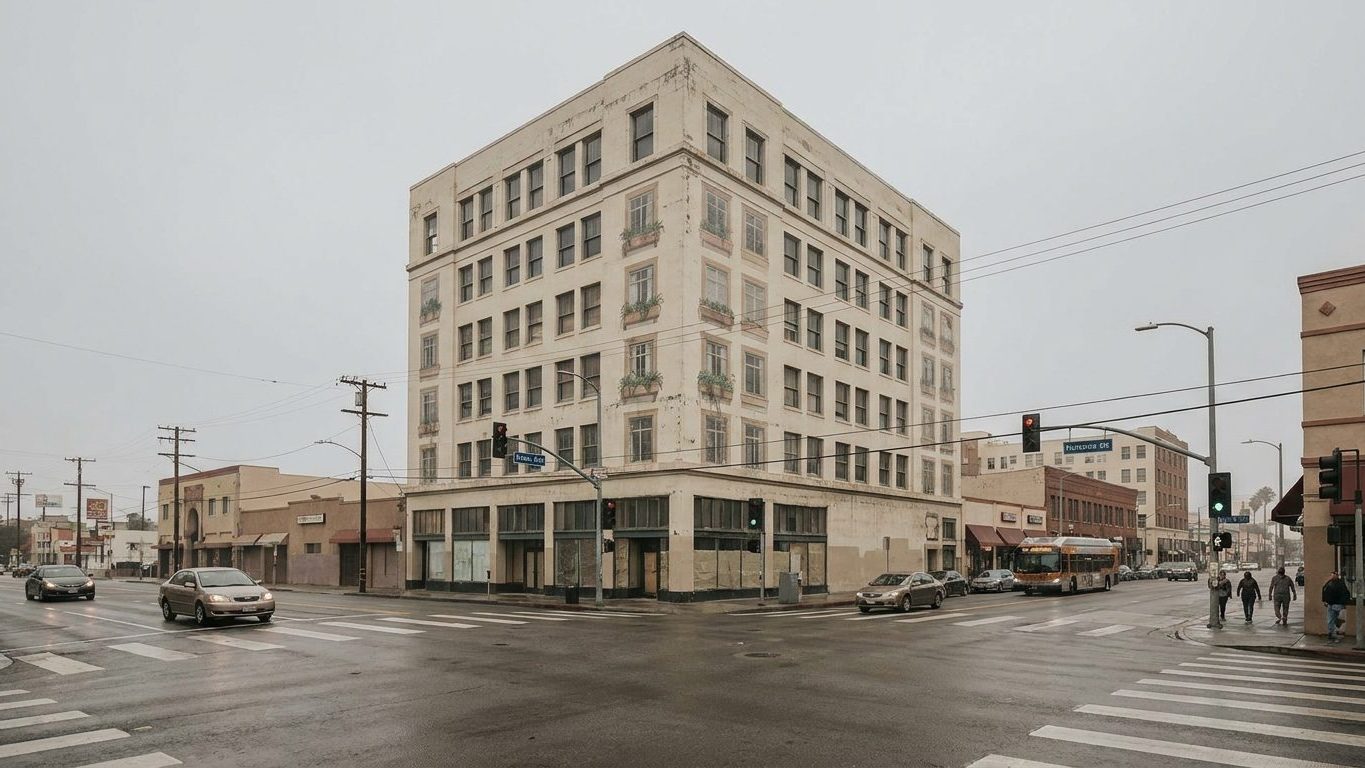
- A nine-story Los Angeles office building hides a derrick with forty oil wells fed by deviated drilling since 1966
- Oil companies have developed sophisticated camouflage techniques to conceal oil facilities in dense urban areas
- Los Angeles voted in 2022 to ban new drilling and initiate a phased shutdown of existing wells
At the corner of Pico Boulevard, in the Pico-Union district, rises a nine-story, cream-colored building that is entirely windowless. Decorative façades mimic painted openings, faux window boxes run along each level, and the structure even bears an almost ironic name: the Tower of Hope. From a distance, nothing about it suggests an office block like the hundreds that dot the city.
Los Angeles hides its oil in plain sight.
Behind this flowery frontage lies, in fact, a dressed-up derrick that has been in operation since 1966. The tower hides off-axis wells that tilt downward beneath the neighborhood to access crude remotely, a technique that allows pumping far beneath residential areas without erecting a visible facility. The exact number of wells linked to this single tower varies by source, ranging from about twenty to fifty, but the installation remains one of the most spectacular examples of oil camouflage in a densely populated urban area. The noise of the pumps is muffled by the building’s insulation and drowned out by the traffic on the boulevard.
This isn’t merely an isolated architectural anomaly. The Los Angeles basin ranks among the United States’ most oil-dense regions relative to its land area, drilled since the late 19th century amid rapid urban expansion. Production there never fully ceased, even as towers and houses eventually surrounded the original derricks.
Yet the local residents did not want to see derricks anymore.
So the companies learned to disguise them. On the grounds of Beverly Hills High School, a petroleum operation long functioned behind a decorative cladding, just a few tens of meters from the classrooms. The site, tucked within the school’s precinct, fed decades of questions about students’ exposure to emissions from drilling.
Off the coast of Long Beach, camouflage takes on a whole new scale. The THUMS artificial islands, built in 1965, cluster four platforms that house dozens of wells apiece. To prevent these industrial facilities from marring the coastline view, designers clad them with faux building façades, planted with palm trees and lit at night with colored lighting intended to mimic a residential or seaside resort complex. Seen from the beach, it would resemble a seaside hotel rather than an offshore oil extraction site.
The result even confounds habitual beachgoers.
In recent years, the coexistence of wells and homes has become untenable. Nearby residents have reported headaches, nausea, and respiratory irritation attributed to emissions from the older facilities. These recurring complaints, documented by several neighborhood associations, have weighed into the municipal debate over the future of urban oil in Los Angeles.
In 2022, the city council finally decided. The city voted to ban all new drilling within its jurisdiction and established a timeline for the phased closure of existing wells, with an amortization period designed to give operators time to recoup their investments before final shutdown. On paper, the measure signaled the end of an activity that had been part of the city’s landscape for more than a century.
In practice, the actual sealing of wells proceeds slowly. Permanently sealing a well is costly and requires lengthy technical work, which explains why several sites, some masked behind ordinary façades, remain active today or simply idle while awaiting their turn. The city thus continues, years after the vote, to count oil installations concealed beneath roofs that never hinted at what they housed.
Sources: dornsife.usc.edu | planning.lacity.gov | planning.lacounty.gov
