
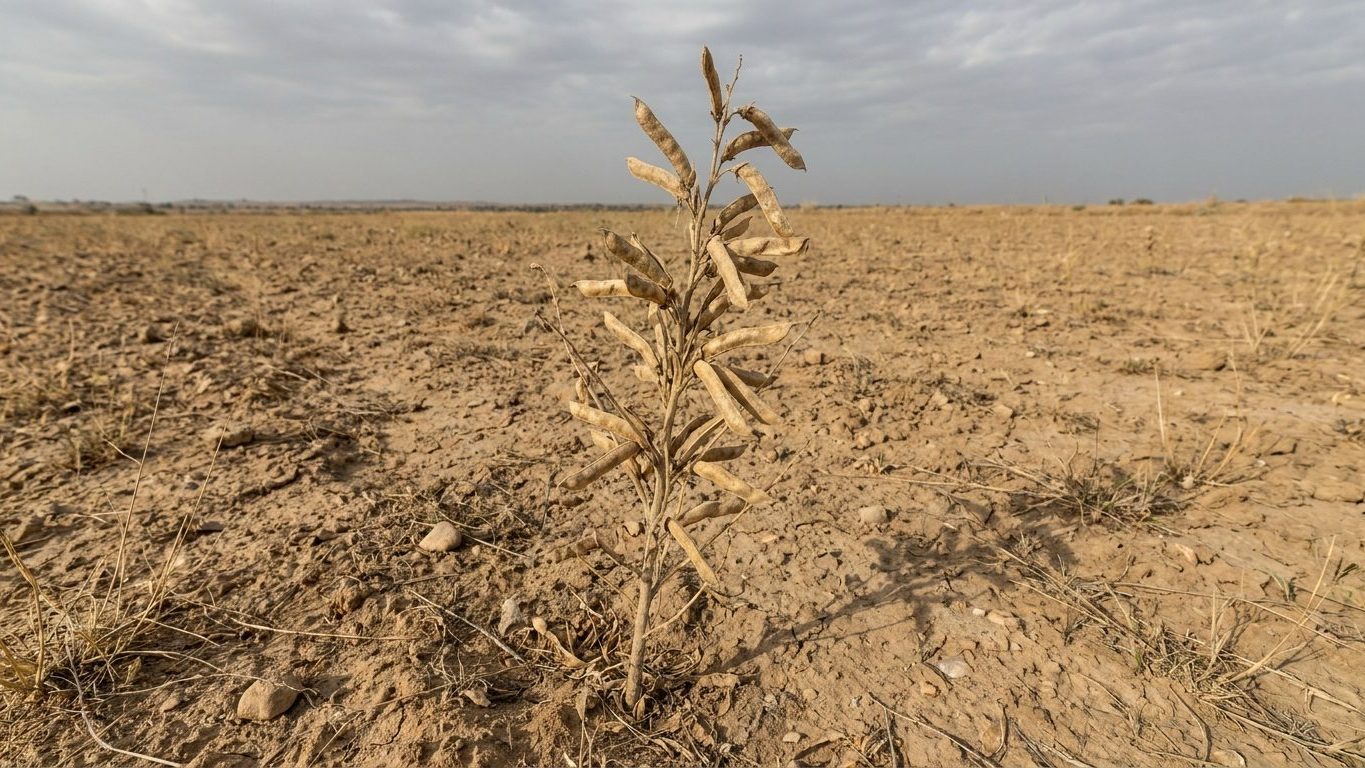
Two industries that had historically paid little attention to each other suddenly found themselves buying the same bag of white powder. On one side, the ice cream and industrial sauce manufacturers who have used this powder for decades to prevent crystallization or stabilize texture. On the other, American shale gas and oil drillers who, around 2010, discovered that this very substance was the best tool to carry proppant—sand—back to the bottom of wells drilled thousands of meters underground. The improbable collision yielded farmers in Rajasthan striking it rich overnight, while a global food industry found itself caught off guard.
- The galactomannan extracted from guar has a thickening power eight times that of starch, with no natural equivalent at this price.
- In 2012, American oil drillers multiplied guar prices tenfold in a single year, exceeding the needs of the food industry.
- Prices collapsed in three years with the fall in oil and the emergence of Chinese synthetic substitutes.
- In 2023, the oil-and-gas industry consumed 80% of global guar gum production, versus 20% for the food sector.
A Desert Legume, Not a Laboratory Product
The guar, scientifically known as Cyamopsis tetragonoloba, is a leguminous plant that thrives in arid zones and withstands drought better than most staple crops. India produces about 2.5 to 3 million tonnes of guar per year, making it the largest producer with roughly 80% of global output, primarily in Rajasthan, Gujarat, and Haryana. From the albumen contained in the seed, a polysaccharide called galactomannan is extracted, marketed under the code E412 in Europe.
This galactomannan has a rare property: it gels in cold water without heating, and dramatically increases viscosity. Guar can have up to eight times the thickening power of starch. No other natural gum combines, at this price, such solubility and thickening ability. Xanthan gum, derived from bacterial fermentation, costs more to produce industrially. Carob, extracted from a Mediterranean tree, hydrates poorly when cold and requires heating to develop its viscosity. Neither of the two reproduces guar’s exact behavior in an industrial sauce or a toothpaste paste.
The 2012 Shock, Told in Figures
Everything changed when American shale gas and oil drillers realized that guar is the ideal gelling agent to transport proppant to the bottom of fractures formed in the rock. With the arrival of horizontal drilling and multi-stage fracturing, industry giants such as Halliburton, Schlumberger, and Baker Hughes began buying guar gum in bulk, a turning point identified by IMR International in 2010. The founder of this specialist firm summed up the situation bluntly: “Oilmen are big buyers, big spenders. They go to guar suppliers and say: what’s your price, give me everything you’ve got. The food industry ends up left behind.”
Prices were multiplied by ten within a year. According to Quartz, the price of guar gum rose from around 3,000 rupees (about $50) per 100 kilograms five years earlier to over 30,000 rupees (about $500) in 2012. In the United States, the finding was similar: the price of guar gum rose from roughly $1 per pound in 2010 to $12 at the start of 2012. An Indian report even mentions an extreme peak, at Rs 90,000 per quintal in March 2012, while the raw seed traded around Rs 3,500 a few years earlier.
For ice cream or sauce manufacturers, the bill climbed quickly. Food buyers were offered prices around ten dollars per kilo, without even guaranteeing the volumes required, as oil companies were systematically served first by suppliers. Some producers had to urgently reformulate certain recipes to curb their dependence on guar.
In Rajasthan, euphoria reigned. Farmers in northwest India could hardly believe their luck, taking out loans to expand their guar plots, some even buying a 4×4 or gold. Thousands of neighbors swapped lentils and millet to grow guar, so that by 2012, 8.6 million acres were devoted to this crop in India. A farmer cited by CNN, bearing a debt of about $12,000, said he never believed he would be able to repay it.
The Fall, as Brutal as the Rise
Then the wind changed. Drillers, who paid up to 30% of a well’s service cost just for this seed, started seeking alternatives. When prices rose, shale gas producers looked for substitutes and found synthetic alternatives from China, explains the president of the Indian Guar Gum Manufacturers Association. Halliburton even developed its own synthetic substitute.
The drop in oil prices completed the correction. When crude traded at $147 in 2008, the United States had revived deep-well extraction with guar; with a barrel price back around $40, demand collapsed. The consequences were severe for the Indian industry: guar gum processors shut down about 60% of their installed capacity within three years. In 2015, guar seeds fell back to around Rs 3,500 to 3,700 per quintal, a level not seen since 2004. Three years. That is how long it took for the market to return to square one.
Who Controls the Resource Today
Guar has never disappeared from shelves. It still appears in ice creams, dessert creams, certain industrial sauces, pet foods, and toothpaste, where it acts as a discreet thickener under the E412 label. But the balance of demand has shifted. In 2023, the oil and gas industry consumed more than 200,000 metric tons of guar gum worldwide, of which 150,000 tons were dedicated to shale gas exploration in the United States, while the food sector accounted for more than 20% of total consumption, driven by the appetite for gluten-free products and ice creams.
The market remains tense at every geopolitically induced tremor. In early 2026, a rebound in oil prices linked to tensions in the Strait of Hormuz was enough to push up Indian seed prices again, with analysts flagging a bullish risk tied to oil and gas demand. The resource, however, remains in the same hands: farmers in Rajasthan who depend on an unpredictable monsoon to grow a seed that glaciers and drillers battle over, year after year.
Sources : commodity-board.com | atamanchemicals.com
