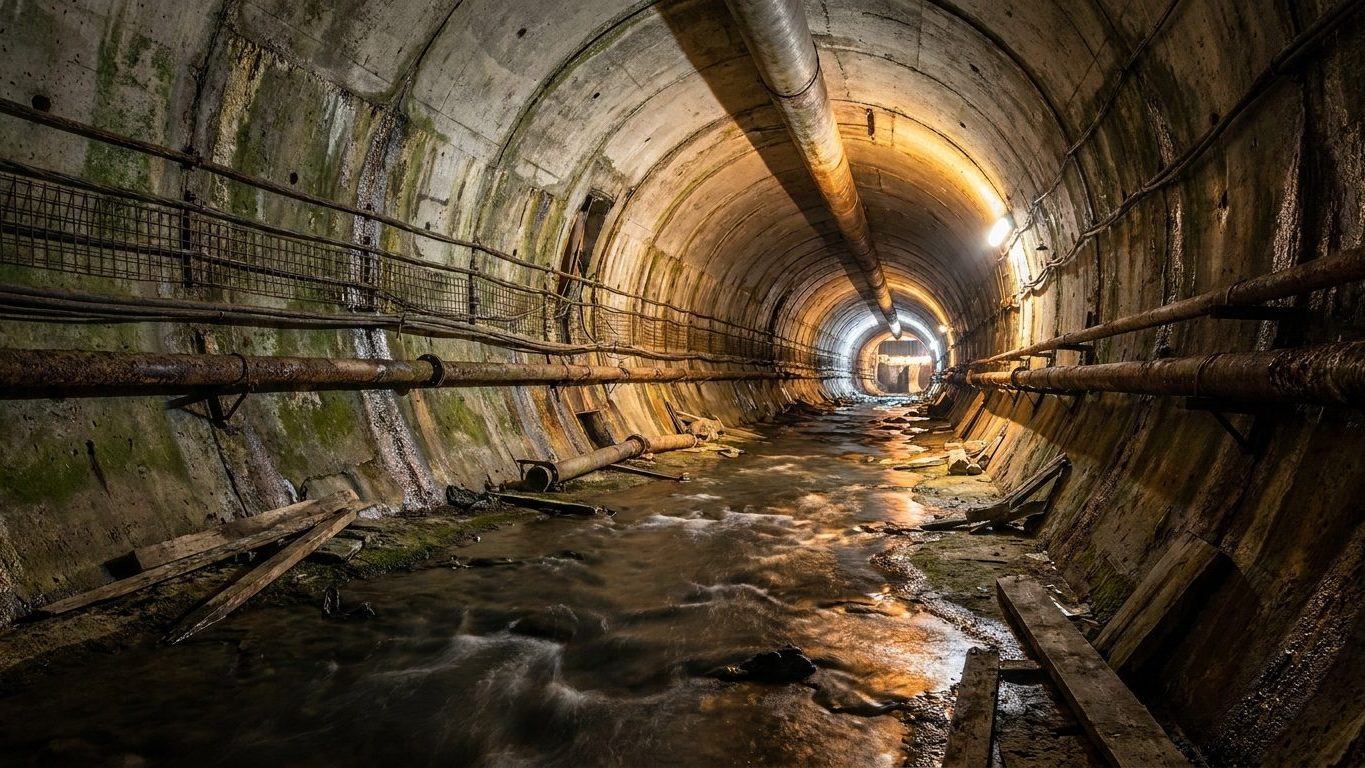
137-Kilometer Tunnel Under New York State Leaks Over 130,000 Cubic Meters of Water Daily, Supplying Half the City’s Water
September 18, 2026
Under the Catskills, between the reservoirs that feed New York and the taps of eight million inhabitants, runs a structure that nobody ever sees: the Delaware Aqueduct. Stretching 137 kilometers in a single unbroken line, it is the longest continuous tunnel in the world, and it alone transports roughly half of the city’s daily drinking water. Since 1988, this very tunnel has been leaking water steadily, up to 136,000 cubic meters per day according to the initial estimate. It would take until September 2024 for the City to dare finally to close a portion of the conduit.
Key takeaways
The Delaware Aqueduct, 137 km long, carries 50% of New York’s daily drinking water.
Leaks in the tunnel were first discovered in 1988, with losses reaching 136,000 m³ of water per day.
A 4-kilometer bypass tunnel has been under construction for more than twenty years at a cost of $1.5 billion, with completion planned for 2027.
A War-Time Construction Dug Under the Hudson
Construction began in 1939 and concluded in 1945, during a period of global tension. At certain points, the tunnel plunges as deep as 150 meters below the bed of the Hudson, with an inner diameter that never drops below 4.1 meters. The tunnel began operating in 1944 when New York Mayor Fiorello La Guardia opened a series of emergency valves. A technical feat for its era, conceived to last decades without ever being shut off.
Spanning 85 miles, the Delaware Aqueduct supplies about half of New York’s water, typically around 600 million gallons per day, relying solely on gravity to move water from the Catskill reservoirs to the city’s taps. No pumps, no motors. Just a slope calculated to the millimeter, capable of delivering nearly 2.3 billion liters daily to the city’s faucets. A project that works so well it has never been able to stop.
The Crack Left Unfixed for Thirty-Six Years
Leaks were first detected in the Delaware Aqueduct in 1988, with losses of up to 36 million US gallons per day. In cubic meters, the order of magnitude is around 136,000 m³ lost each day, absorbed by the fractured limestone beneath Newburgh. Leaks were subsequently confirmed in 1990 and 1992 near Roseton and Wawarsing, caused by a faulted limestone.
There was no way to shut the tap. Half the city depended on it, and still does.
Sealing a crack in a tunnel that carries half of a metropolis’ drinking water implies draining it. Draining the Delaware Aqueduct would deprive New York of a substantial portion of its supply for months. Gravity alone moves about 600 million gallons of water every day, and the tunnel was also constructed during World War II, with reinforced sections designed to withstand bombardment. Ironically, the structure survived the war, but its own effectiveness for repairs was long prohibited. Engineers therefore chose a different path: build a bypass that would never require cutting the supply.
A Four-Kilometer Parallel Tunnel to Never Cut Off the Water
The chosen solution can be summed up in a single sentence: excavate a second, shorter tunnel capable of diverting water around the cracked section. This bypass tunnel measures about 4 kilometers. It features two shafts, one 210 meters deep and the other 275 meters deep, granting access from the surface. The entire program, planned for more than twenty years, carries an estimated price tag of about $1.5 billion.
The bypass tunnel runs 2.5 miles in length and lies roughly 600 feet beneath the Hudson River, a depth that required years of drilling before any final connection could be contemplated. That junction, precisely, is the trickiest step: you must dewater the old tunnel to weld the two structures together while ensuring that the weakened walls do not collapse under the opposing pressure. The risk stems from the fact that the leaks had until now been outward, at around 35 million gallons per day, a force that helped maintain the integrity of the tunnel lining; without this external pressure, the risk of collapse becomes markedly higher. A project under extreme tension, literally speaking.
The northern section of the aqueduct was closed in September 2024, opening the long-awaited window to finally connect the two tunnels. Work then paused in November 2024, announced by the city as part of a suite of water-restriction measures during the region’s driest period on record. Draining more reservoirs during a historic drought would have been too risky. Completion of the project is now scheduled for 2027, thirty-nine years after the crack was discovered.
This delay is far from trivial for residents in the Delaware Basin, who share this resource with New Jersey and Pennsylvania under an allocation agreement among the four states involved. Each postponement of the final shutoff redefines, for them as well, the amount of water still available upstream. The Newburgh fault continues to seep in silence beneath the rock, awaiting its last summer of leakage.
Sources: southeast-ny.gov | nj.gov | home.nyc.gov
Sindre Halvorsen
I write about space exploration, frontier science and the technologies that are quietly shaping the future. From Norway, I follow the missions, discoveries and ideas that connect life on Earth with what lies beyond it. My goal is to make complex subjects clear, useful and worth paying attention to.