
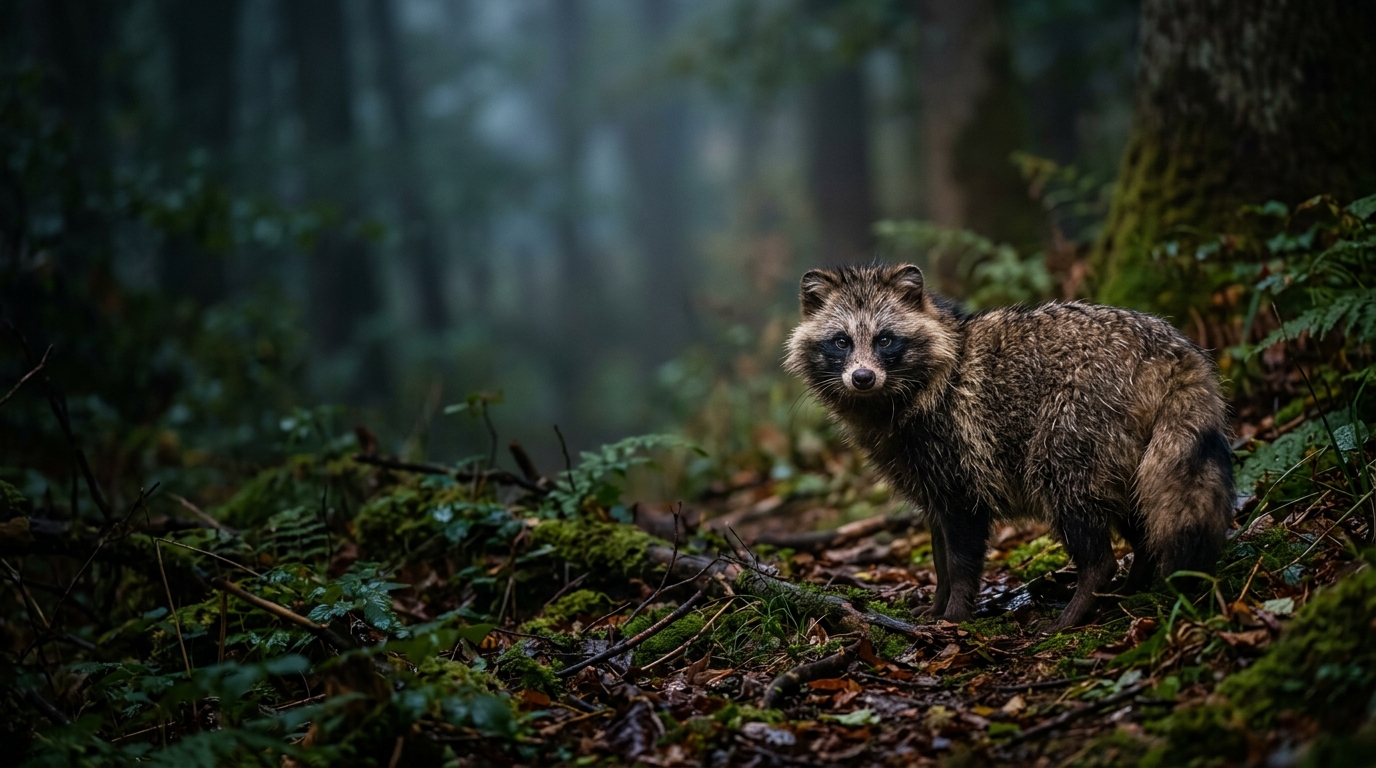
Since the 1980s, an Asian carnivore has been wandering the forests of northeastern France. Almost no one can name it, even less recognize it. Unlike the raccoon—its ill-fated media cousin—no established feral population has ever been confirmed. Yet observations accumulate, quietly, and raise a troubling question: how many are there really?
- The raccoon dog, a canid native to Asia, was introduced accidentally in Europe via releases in the USSR in the 1930s and has been observed in France since 1975 in 35 departments.
- Unlike the raccoon, no stable feral population has been formally established in France; its presence is explained by a gradual colonization from Germany and/or escapes from captive animals.
- Since the ministerial decree of April 3, 2012, the species has been classified as nuisance across the entire French territory due to health risks it poses, notably rabies and echinococcosis.
- A fox’s face, a badger’s build, a Siberian origin
- How an Asian animal ended up released into Soviet countryside
- Why France never had an official feral home
- What these scattered observations really tell us about its future on our soil
In this autumnal return, as the undergrowth of the Grand Est takes on coppery hues, a single animal continues its quiet, almost imperceptible advance. Its name is unfamiliar to most French people, and yet it shares with the raccoon a story of accidental introduction that deserves to be better known. This mysterious visitor is the raccoon dog, a species whose presence on our soil stretches back more than four decades without ever really making itself felt in the public eye.
A fox’s face, a badger’s build, a Siberian origin
Difficult to classify at first glance. With its dark facial mask evoking a raccoon, a stocky silhouette close to a badger, and a thick coat that hints at an unruly fox, the raccoon dog confounds anyone who encounters it. Yet it undeniably belongs to the canid family, making it a distant cousin of our foxes and domestic dogs, even if its appearance is misleading to almost everyone.
Native to East Asia, the species naturally inhabits China, Vietnam, Korea, and Japan, where it has long occupied wetlands and dense forests. It is precisely this capacity to adapt to varied environments that helps explain why, once introduced elsewhere, the animal could settle in landscapes far removed from its homeland.
How an Asian animal ended up released into Soviet countryside
The raccoon dog’s European story begins in the 1930s, in the USSR, where about 9,000 individuals were deliberately released into the wild. The aim was purely economic: to develop a new resource for the fur industry, akin to what had been tried with other species around the world. No one at the time anticipated the long-term consequences of such a decision.
Endowed with remarkable ecological plasticity, the animal soon spread well beyond the initial release zones. It progressively colonized Eastern Europe, then Scandinavia and Germany, taking advantage of forest connections and natural corridors to extend its territory year after year. It is this patient, steady conquest that explains its presence even in the borderlands of France today.
The first official mention on French soil dates to 1975 in Moselle. Since then, authorities have recorded around 150 observations, spread across no fewer than 35 départements. Among them, about a dozen account for at least five observations each, suggesting areas of more regular presence, notably in Alsace, Lorraine, and Franche-Comté.
Why France never had its official feral home
Here is where the raccoon dog’s story diverges markedly from that of the raccoon, a more media-savvy and better identified invader on our soil. If cases of natural reproduction were indeed confirmed in Haute-Saône in 1988, no clearly established and durable feral population has ever been formally identified in France for this species. In other words, unlike the raccoon—which developed genuine autonomous and recognized populations—the raccoon dog seems to advance in small steps, never forming a stable, mapped colony.
Two main hypotheses attempt to explain this scattered presence. The first speaks of a progressive colonization from Germany, where the species continues its easternward expansion and could feed French northeastern populations year after year. The second, more episodic hypothesis points to escapes from captive animals, whether from zoos, circuses, or individuals who kept this uncommon carnivore illegally. These two scenarios are not mutually exclusive and could coexist depending on the region concerned.
Faced with this enduring uncertainty, authorities have taken regulatory action: since the ministerial decree of April 3, 2012, the raccoon dog has been classified as nuisance across the entire French territory. A decision that mainly reflects the health risk associated with this species, notably the potential transmission of diseases such as rabies or echinococcosis, rather than a definitive certainty about the scale of its actual presence.
What these scattered observations really tell us about its future on our soil
The most recent data confirm a progressive establishment in Alsace, in Lorraine, across the Grand Est, and even (more surprisingly) reports from the Loire region. This geographic spread, far from being anecdotal, illustrates a long-term trend that deserves close monitoring in the years to come.
The Swiss case is particularly illuminating for this cross-border dynamic: the species is advancing there as well since 1997, with observations across several cantons. This parallel expansion, on both sides of the border, strengthens the hypothesis of natural colonization from Germany rather than a mere accumulation of isolated escapes.
One question remains unresolved: how many raccoon dogs are truly roaming our forests right now? The absence of an officially recognized feral home does not mean absence of presence; rather, it reflects the difficulty in pinning down a phenomenon that advances in small, quiet increments, far from the usual media and scientific radar.
Between ongoing German expansion and persistent uncertainties about the actual scale of French populations, the raccoon dog embodies, in its own way, those invisible species silently reshaping our ecosystems. As autumn returns with its forest strolls, keep a wary eye: this little-known carnivore could very well cross your path without you truly realizing it.
