
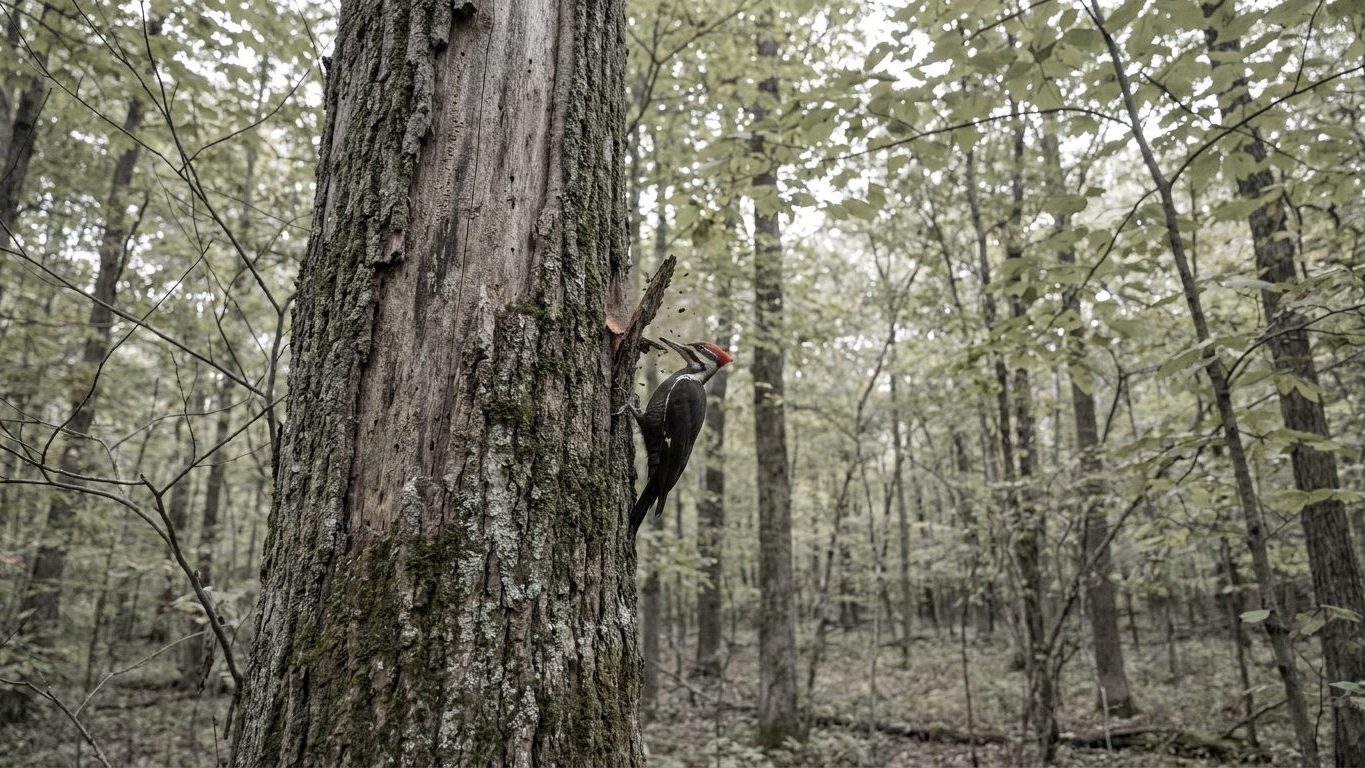
Twenty to twenty-five kilometers per hour. That is the speed at which the woodpecker drives its bill into the tree trunk, in a motion repeated more than 12,000 times each day. For decades, science explained this feat with a simple image: the bird’s skull would act as an integrated helmet, a shock absorber that minimizes the brain’s harmful deceleration upon impact with the trees, an idea that even inspired the design of shock-absorbing materials and protective tools, like helmets. A study published in 2022 in Current Biology debunked this explanation: high-speed video analyses and biomechanical models show that the woodpecker’s head does not function as a cushion, but as a rigid hammer that optimizes pecking performance.
There is no shock absorber.
- The woodpecker strikes about 12,000 times a day with a head deceleration around 1,200 g, well beyond the human concussion threshold.
- Its skull acts as a rigid hammer rather than a cushion, optimizing energy transmission into the wood.
- Its small size lets it tolerate accelerations 11 to 20 times higher than what a human could endure without harm.
What ultra-fast cameras reveal
Biologist Sam Van Wassenbergh, from the University of Antwerp, and his team set out to test an hypothesis that had not really been tested in natural conditions. To do so, they filmed three woodpecker species in slow motion as they hammered a tree—the black woodpecker, the red-crested woodpecker, and the great spotted woodpecker. The footage was used to build biomechanical models, and these data led the researchers to conclude that any shock absorption by the skull would be disadvantageous for these birds. Logically, a skull that cushions would waste part of the energy the bird is precisely aiming to transfer to the wood.
The numbers themselves do not change. The peak hammering speed hovers around 6 to 7 meters per second, with a maximum head deceleration of about 1,000 g. Some measurements, depending on species and protocol, climb higher still: deceleration can exceed 1,200 g during drumming or drilling.
By comparison, a human concussion can occur at roughly 60 to 100 g.
The secret isn’t the armor, it’s the size
If the skull absorbs nothing and the force far exceeds the human concussion threshold, how does the woodpecker’s brain survive? The answer lies in scale physics, not in armor. The bird’s small size, along with the orientation of its brain within the skull, dramatically reduces the risk of brain injury, enabling it to withstand accelerations 11 to 20 times higher than what a much larger human could tolerate. The researchers’ calculations show the woodpecker operates with a safety margin of six to seven times below the threshold that would cause brain injury in it. Numerical simulations confirm that the woodpecker’s brain remains below the concussion threshold known in primates, even without cranial absorption.
The mass saves the day, not the mechanics.
The pieces that do the rest of the work
The skull does not protect on its own, but other structures frame the impact. The most striking is the hyoid bone: according to Alex Bond, senior bird curator at the Natural History Museum in London, some woodpeckers have a tongue reaching up to 10 centimeters, roughly a third of the bird’s total body length. To accommodate this oversized appendage, the bone anchoring it starts at the front of the skull, loops around the eyes, and travels all the way around the head before reattaching beneath the lower jaw. The beak itself is not symmetrical: the dense bony layer of the upper beak is slightly shorter than that of the lower beak, while the outer soft-tissue layer is the opposite, a mismatch that causes more shock waves to propagate from the lower beak toward the neck rather than toward the brain.
The eyes, meanwhile, endure extreme internal pressure with every strike. A thick nictitating membrane sweeps across the eye a few milliseconds before the bill contacts the wood, preventing the force of the blow from literally tearing the retina or popping the eye out of its socket.
This anatomy has long fascinated engineers. They drew inspiration from it to develop cushioning materials and protective helmets. Yet the new findings show that this route was not the right one, since the woodpecker’s anatomy minimizes precisely the absorption of shocks. For a human bicycle helmet, whose job is to dissipate energy before it reaches a brain much larger than a woodpecker’s, copying a rigid hammer would be the opposite of what we seek.
Sources: zoology.ubc.ca | cell.com
