
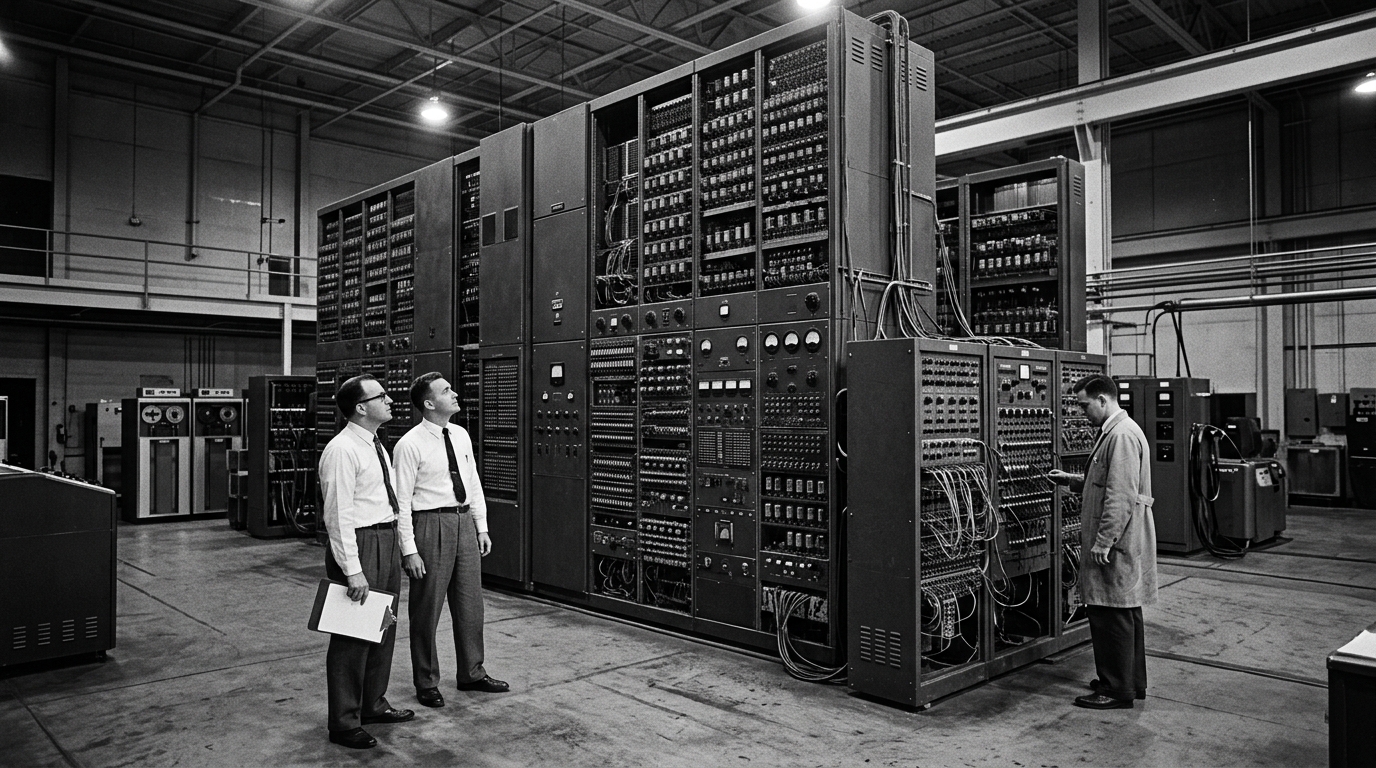
Imagine a room entirely filled by a single machine, as heavy as thirty trucks, humming day and night thanks to tens of thousands of vacuum tubes. This is not a scene from a retro sci‑fi film, but a tangible reality of the American Cold War. In 1958, the United States put into service a computer so massive that dedicated power lines had to be literally built to run it. Its mission: monitor the North American sky and issue alerts in case of a Soviet nuclear attack. What few people know is that this colossal computer was not retired because of a breakdown or its technological age. What made it suddenly obsolete was a strategic upheaval that no one had really anticipated at its design.
- The IBM AN/FSQ-7, weighing 250 tons and incorporating 60,000 vacuum tubes, formed the heart of the SAGE network intended to detect Soviet bombers.
- Thanks to the duplication of centers and a preventive failure-detection system, SAGE’s availability reached 99%.
- It was the emergence of intercontinental ballistic missiles, far faster than bombers, that rendered SAGE obsolete, though the system remained in service until 1983.
- A 250-ton monster against the Soviet threat
- When computing becomes a national defense weapon
- The arrival of missiles that change everything
- An obsolete system that ran twenty more years
A 250-ton Monster Against the Soviet Threat
At the heart of this setup lay the IBM AN/FSQ-7, a machine whose numbers boggle the mind. Each unit weighed about 250 tons, incorporated no fewer than 60,000 vacuum tubes, and consumed up to 3 megawatts of electricity, equal to the consumption of thousands of French households. Such an energy appetite forced the military to build dedicated electrical infrastructure at every installation site, as existing networks could not suffice to feed these giants of metal and glass.
The first center became fully operational in 1958, with the official commissioning at McGuire Air Force Base in New Jersey. In the long run, the network would comprise 24 command centers spread across North America, all under the aegis of NORAD, the North American Aerospace Defense Command. The aim of this program, named SAGE (Semi-Automatic Ground Environment), was simple: detect as early as possible the arrival of Soviet bombers capable of delivering nuclear weapons to American soil.
When Computing Becomes a National-Defense Asset
Keeping such a fleet of vacuum tubes in perpetual operation represented a colossal technical challenge. These components, fragile ancestors of the transistor, failed regularly, somewhat like lightbulbs that burn out one after another. To get around this issue, IBM conceived the idea of duplicating each center in its entirety: one computer handling the operational job while its twin stayed in active reserve, ready to take over at the slightest fault.
A clever mechanism, the marginal checking, also allowed the early detection of tired tubes before they actually failed, a bit like a doctor spotting a disease before symptoms appear. Thanks to this constant vigilance, the system’s overall availability could reach up to 99%, a remarkable performance for a technology that would seem rustic by today’s standards. SAGE was therefore not a fragile system doomed to fail: it was, on the contrary, an engineering feat designed to endure and withstand the wear of time.
The Arrival of Missiles That Change Everything
And yet, something would render this formidable surveillance network obsolete, without a bolt loosening or a tube burning out. That something was the very evolution of the threat it was meant to counter. SAGE had been designed to detect bombers, relatively slow aircraft that gave hours of warning before reaching their target. But in the years following its deployment, supersonic interceptors and, above all, intercontinental ballistic missiles reshaped the strategic landscape.
A ballistic missile crosses the Atlantic in mere tens of minutes, whereas a bomber took hours. In other words, the threat for which SAGE had been tailor-made was no longer the main threat to monitor. Here lies the irony: it wasn’t worn components or the machine’s age that doomed it, but a complete shift in military doctrine, against which no technical update could truly contend.
An Obsolete System That Kept Running Twenty More Years
What makes this story even more fascinating is that despite this obvious strategic obsolescence, SAGE remained the backbone of NORAD’s air defense into the 1980s. Maintenance costs kept rising, but replacing such a network would have been a pharaonic undertaking. It required not only new computers but also a complete rethink of reinforced concrete bunkers and the dedicated power plants that accompanied each center. A project too heavy to undertake lightly, even in the face of a system deemed strategically obsolete.
It was ultimately the commissioning of the Joint Surveillance System (JSS), mature enough by the mid-1983, that allowed the definitive shutdown of SAGE. Twenty-five years after going into service, the old 250-ton computer finally bowed out, not defeated by a technical fault, but simply outpaced by the evolution of the world it was meant to monitor. It also holds a rather uncommon title in the history of computing: the largest computer ever built from discrete components, a feat born of an era when the arms race also played out, quietly, in rooms filled with vacuum tubes.
In looking back at this metal behemoth today, at a moment when our smartphones fit in a pocket and far outstrip its computing capabilities, one realizes how technology never evolves in isolation: it is always shaped by the threats and the stakes of its era. SAGE did not fall because it was bad, but because the world it was meant to protect changed faster than it did. A lesson that, in many respects, still resonates today amid the technological upheavals that continually redefine our defense systems.
