
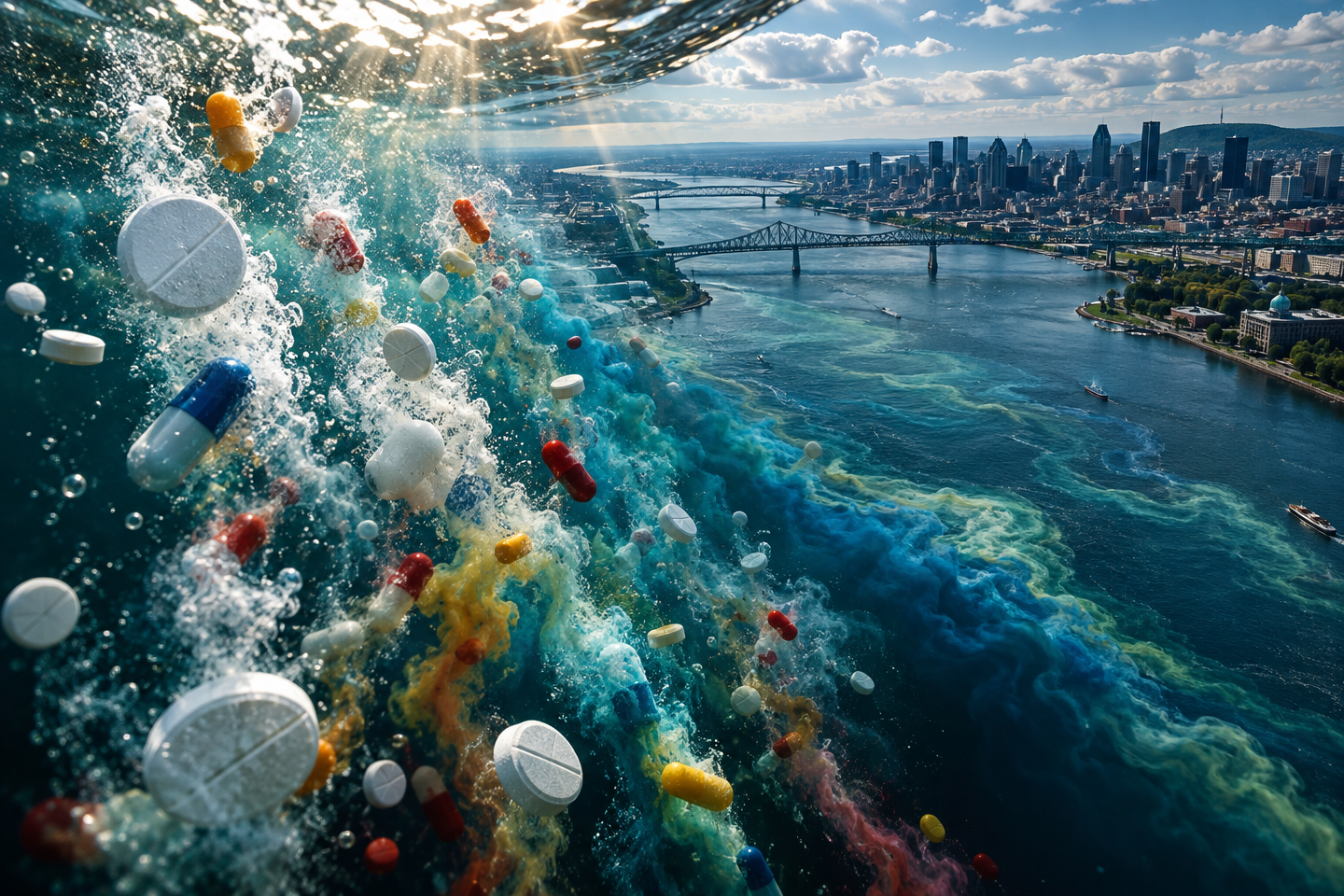
Many people believe that a pill swallowed in the morning simply vanishes from the body, leaving no trace behind. Yet this is a misconception: a large portion of pharmaceutical molecules exits the body intact or almost intact, via urine, before completing their journey in wastewater. And when two million people take this path every day, the impact is measured not in a few isolated traces but across hundreds of kilometers of waterways. This is precisely what a recent analysis of the Saint-Lawrence River reveals, the giant that runs through Canada and touches the Quebec metropolis of Montreal.
- Between 2017 and 2021, more than 400 samples collected along 700 km of the Saint-Lawrence River revealed the presence of numerous pharmaceutical residues, including caffeine, diclofenac, venlafaxine and carbamazepine
- Four molecules (caffeine, carbamazepine, diclofenac, ibuprofen) reach concentrations high enough to affect the growth and reproduction of aquatic organisms, with no Canadian environmental standard to regulate them
- Montreal, whose only wastewater treatment plant handles nearly 900 billion litres of water per year, is the source of the highest concentrations, with detectable contamination reaching as far as Lake Saint-Pierre, 70 km downstream
- A chemical cocktail that flows with every flush
- Four molecules under scrutiny, zero regulatory standard
- Montreal, invisible epicenter of contamination
- Fish growing up under permanent chemical infusion
A Chemical Cocktail That Flows with Every Flush
Researchers at the University of Montreal undertook an impressive, meticulous project: more than 400 water samples were collected along a 700-kilometer stretch of the Saint-Lawrence River between 2017 and 2021. It was a long-term effort that allowed for a precise snapshot of what actually circulates in this major watercourse, which starts at Lake Ontario and traverses Ontario, Quebec, and the state of New York.
The result resembles a veritable liquid pharmacy. Among the substances most frequently detected are caffeine, diclofenac, a common anti-inflammatory used for pain, and venlafaxine, a widely prescribed antidepressant. In addition, carbamazepine, a treatment for epilepsy, and acebutolol, a beta-blocker used to regulate blood pressure and heart rhythm, were found. More surprisingly, traces of chemotherapy drugs and antibiotics were also detected, albeit at lower concentrations but still present in the current.
Four Molecules Under Scrutiny, Zero Regulatory Standard
Across all identified compounds, four stood out to scientists: caffeine, carbamazepine, diclofenac, and ibuprofen. Their concentrations in the river would be high enough to affect the growth and reproduction of aquatic organisms living there. This finding is especially alarming given that, for the vast majority of these substances, there is currently no Canadian environmental standard to regulate or limit their presence in waterways.
Not all of these molecules behave the same once in water. Most degrade fairly quickly and do not cause immediate harm, with the notable exception of carbamazepine, which is more persistent. But the real danger lies in chronic exposure: living permanently in contact with low doses of medicines, day after day, seems to pose a more insidious risk than occasional spikes in contamination, especially for the most vulnerable organisms, such as young fry early in development.
Montreal, Invisible Epicenter of Contamination
Not surprisingly, the most alarming concentrations were measured downstream of Montreal. The Quebec city, with two million residents, has only one wastewater treatment plant to process nearly 900 billion litres of water each year. A staggering figure that underscores the logistical challenge facing the city.
What surprised the research teams most was the persistence of this pollution well beyond the urban area. The Montreal-derived contamination extends to Lake Saint-Pierre, located roughly 70 kilometers downstream. A strong signal that pharmaceutical residues do not simply dissolve into the vastness of the river but travel downstream with the current over long distances. There is, however, a positive development on the horizon: Montreal plans to integrate an ozonation technology at its wastewater treatment facilities, a method capable of removing up to 80% of the pharmaceutical products present in the discharged water.
Fish Growing Up Under a Perpetual Chemical Infusion
For the Saint-Lawrence’s aquatic fauna, this situation equates to growing up in an environment where medicine is part of the scenery. Fish, larvae, and other organisms live continuously in water loaded with active substances, with potential consequences for their development and their ability to reproduce. A continuous, quiet, yet very real exposure.
This phenomenon is not unique to Canada. Similar issues have been observed elsewhere in the world, notably in Europe and Australia. In some Suffolk streams in England, traces of cocaine, ketamine, Valium, Xanax, and tramadol were even found in the bodies of freshwater shrimp, human urine being implicated as well. A reminder that what we consume ultimately ends up somewhere, often far beyond what we imagine.
Between household medicines and river ecosystems, the boundary appears far more porous than previously thought. If technical solutions such as ozonation offer a promising path, they will likely not be enough on their own to solve a problem that also affects other regions of the world, such as Europe and Australia. The question remains: how long before regulations catch up with what science already observes in our waterways?
