
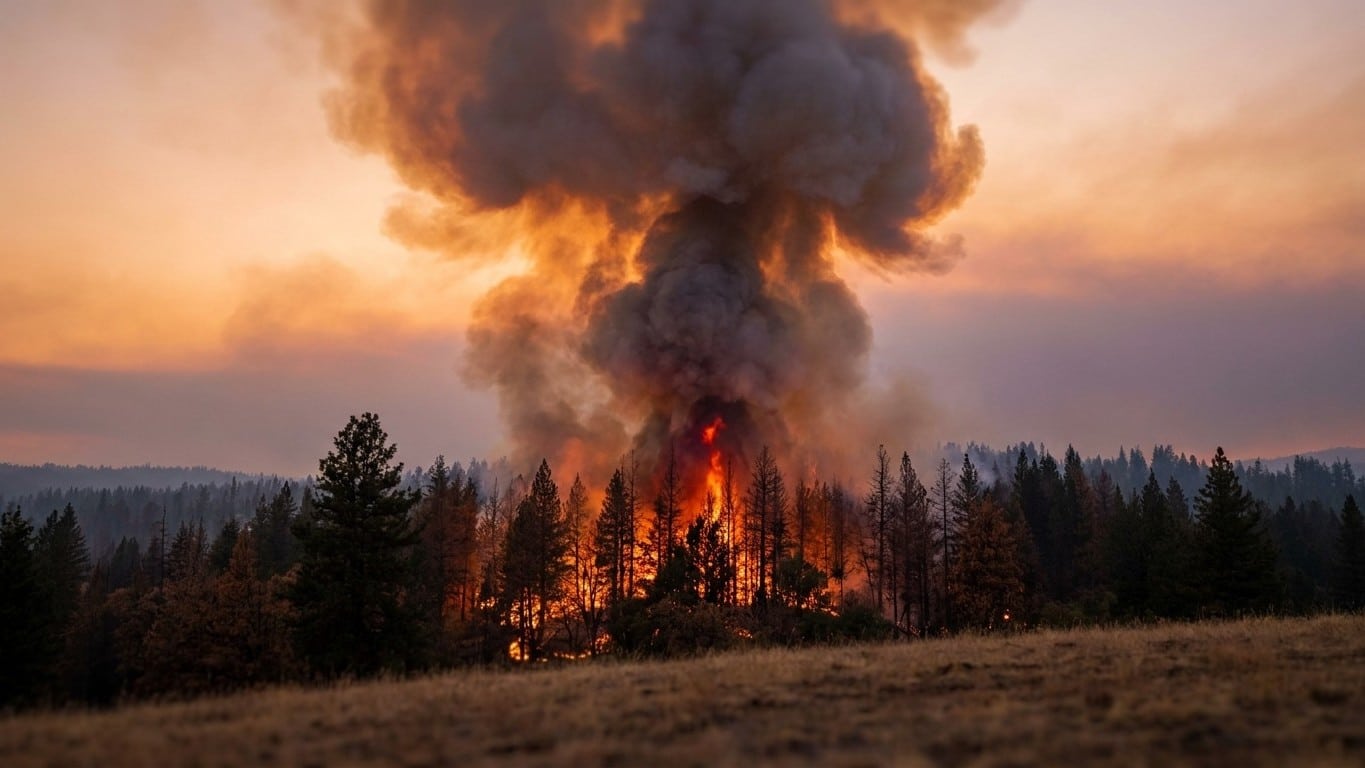
Four thousand eight hundred hectares burned in barely thirty-six hours, a plume of smoke visible for miles, and firefighters who, for the first time in a long while, admit losing the battle against the elements.
Key takeaways
- What makes this Gironde fire different from all other blazes?
- How can a fire generate its own local storms?
- Why do traditional firefighting strategies become obsolete in the face of this phenomenon?
A fire that has already laid waste to everything in its path
It all began on Wednesday between the communes of Saumos and Le Porge, in the pine forest of the Landes de Gascogne that has kept burning more and more in recent years. While the fire that broke out on Wednesday to the north of the Arcachon basin has by Thursday, July 23, reached the commune of Lège-Cap-Ferret, a firefighter was wounded during the explosion of a gas cylinder in a house in flames. An incident that illustrates the brutality of the situation on the ground, where teams sometimes engage in hand-to-hand combat with the flames to save homes.
Two houses have already been destroyed. Two houses were destroyed Thursday in Lège-Cap-Ferret in the fire that has been consuming the north of the Arcachon basin and its pine forest since the previous day, the two affected dwellings being located in the northwest of this Gironde commune that remains threatened by the flames. Faced with the urgency, the prefecture ordered a massive evacuation that continues to broaden hour by hour. In the afternoon, as a precaution, residents of the Ehpad Les Tchanqués, located in Lège-Cap Ferret, were evacuated and transferred to suitable reception facilities. A delicate logistical exercise, partly conducted by sea since road access was saturated or threatened by the fire.
The human toll, meanwhile, continues to grow. A violent forest fire not far from Bordeaux led to an evacuation of at least 8,800 more people on Thursday, bringing the total number of tourists and residents evacuated to more than 20,000, including 8,800 additional evacuees on Thursday in the Cap Ferret tourist area. Some residents express their shock at the scale of the disaster: “When you see this, you get a little anxious. We’re afraid,” says a local resident. About 500 firefighters are deployed on the ground, now supported by reinforcements from elsewhere in France but also from abroad.
The European Commission announced on Thursday the deployment of three fixed-wing aircraft to help fight the fire, with European Commissioner Hadja Lahbib specifying that “following France’s activation of the EU Civil Protection Mechanism, the EU is assisting and is deploying 3 water-bombing aircraft.” The Commission announced that it would deploy three water-bombing planes and two helicopters to assist in fighting the fire in the north of the Arcachon basin, in Gironde, starting Friday. A helping hand that comes in addition to national resources already on the ground: a Dash, two Canadairs, and two Tracker-type water bombers have been deployed since 9:30 a.m. this morning according to local channel ICI Gironde. On the scene, a brigadier-chief of the SDIS of Deux-Sèvres does not mask his pessimism: “There is a very strong chance that this fire will keep us busy for several more days.”
Why this fire escapes all control: pyroconvection explained
Here is what makes this blaze particularly alarming for firefighters: it has entered a phase where the wind no longer dictates its direction. Normally, a forest fire follows a simple logic, moving in the direction of the prevailing wind, which allows teams to anticipate its trajectory and position their resources accordingly. Here, nothing of the sort remains. The Gironde blaze has entered what specialists call a convective phase, a stage where the fire becomes powerful enough to generate its own local weather.
The mechanism boils down to the simplest physics. On the ground, a major fire is a tremendous heat factory: as it burns, vegetation releases enormous amounts of thermal energy, and the air heated above the flames becomes much lighter than the surrounding air, rising violently into the atmosphere at incredible speeds and creating a powerful convection column. This column acts like a giant vacuum. To fill the void left by this rising air, fresh air is drawn in sideways from the fire’s periphery, giving rise to a true chimney effect: even on a previously calm, windless day, the fire will generate its own local gusts.
These gusts, nicknamed “fire winds” by scientists, are especially treacherous. Fire winds blow toward the center of the blaze but can change direction chaotically, trapping rescue crews. This is exactly the scenario firefighters in the Gironde fear: a front that, instead of advancing in one predictable direction, fans out in all directions at once, dooming traditional confinement strategies. It becomes clear why authorities emphasize preventive evacuation rather than merely protecting homes, a costly concession in comfort for residents but the only reasonable option against such an unpredictable foe.
The heatwave, invisible fuel for the blaze
This phenomenon does not arise by chance. It requires vegetation dried to the core and extreme temperatures, exactly the ingredients gathered in the Gironde in recent weeks. This third heatwave of 2026, within less than two months, lasted from July 4 to July 19, when the first two longest heat waves since measurements began in France in 1947 occurred in July 1983 and July 2006. Three heatwaves in one summer, on a single forest massif already weakened by the 2022 fires: the repetition is not insignificant, it dries the soils deep and turns every pine forest into a powder keg.
The national tally is dizzying. France records 12,500 fire starts since January 2026, with 44,000 hectares burned according to Interior Minister Laurent Nuñez, already surpassing the catastrophic toll of 2022, when blazes had ravaged the southwest of France. This figure places the Gironde episode in a broader context: a fire season in France that has ceased to be a summer exception and has become a climatic routine. Authorities have forbidden all forest work using internal combustion engines in Gironde, placed on red alert for forest fires. It remains to be seen how long it will take for this convective front, once weakened by aerial reinforcements, to cease dictating its own law to the people tasked with extinguishing it.
Sources: franceinfo.fr | cnews.fr
