
Imagine for a moment a plane capable of linking Paris to New York in just over two hours, with three hundred passengers comfortably aboard, all at a speed twice that of the Concorde. This dream did exist on paper, and the Americans spent the equivalent of a billion dollars of the era before pulling the plug abruptly. What ended this venture was not a technical problem insurmountable, nor an engine failure, nor even a spectacular accident. The real cause is far more surprising, and it says a lot about the tensions that ran through American society in the early 1970s.
- The Boeing 2707 was to fly at Mach 2.7 and carry up to 300 passengers, compared with Mach 2 and around a hundred seats for the Concorde.
- Despite a budget of one billion dollars and 122 firm orders, not a single unit was ever built; only a full-scale mock-up came to life.
- The program was canceled in March 1971 by the American Congress because of the sonic boom disturbances, allowing Boeing to focus its resources on developing the 747.
- A billion dollars and a wild promise: Mach 2.7 for 300 passengers
- The Boeing 2707, this 80-meter giant that was to dwarf the Concorde
- The sonic boom, the invisible foe that brought Congress to its knees
- Nineteen years in a hangar: what remains of the American supersonic dream
A Billion Dollars and a Wild Promise: Mach 2.7 for 300 Passengers
Everything began in 1963, when President Kennedy formally launched the federal supersonic transport program, keen not to let Europe and the Soviet Union win the race in this technological contest. Three years later, in December 1966, Boeing won, over Lockheed and its L-2000 project, the coveted contract to develop what would become the Boeing 2707. The stated ambition was dizzying: to design an aircraft capable of cruising at Mach 2.7, roughly 2,900 kilometers per hour, where the Concorde topped out at Mach 2.
To fund this audacious dream, the American federal government injected close to one billion dollars into the project, a colossal sum for the era. And airline confidence seemed total, with no fewer than 122 firm orders registered from 26 carriers, even though not a single unit had yet been built. A bold yet risky bet on the future, illustrating the technological euphoria of a time when anything seemed possible.
The Boeing 2707, This 80-Meter Giant That Was Supposed to Dwarf the Concorde
On paper, the Boeing 2707 wasn’t simply faster than its Franco-British rival; it was also significantly larger. With a fuselage of 306 feet, roughly 93 meters long, the aircraft would accommodate between 234 and 300 passengers, versus about a hundred at most for the Concorde. A difference in scale that would have entirely altered the economics of supersonic travel, enabling faster flights to become financially viable without sacrificing commercial capacity.
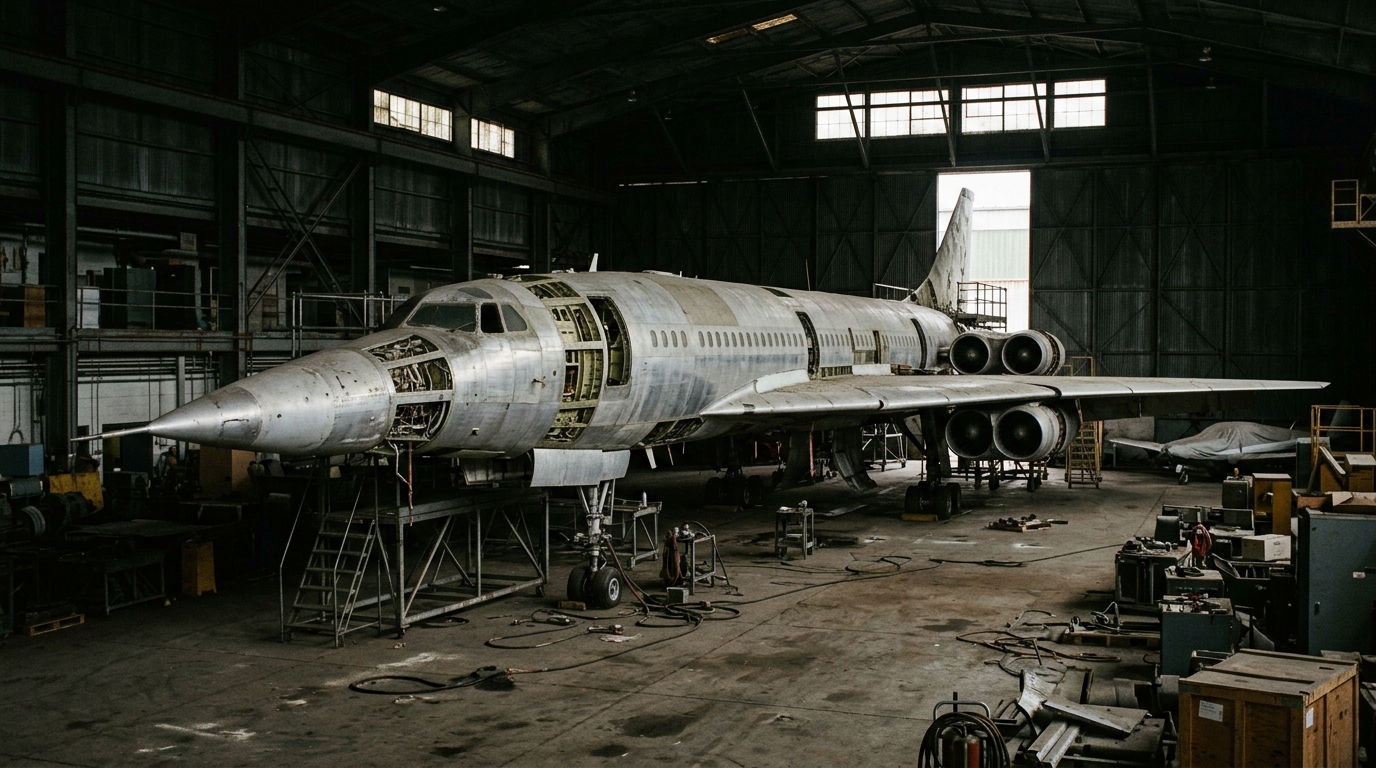
To give life to this titanic project, Boeing built a near-80-meter full-scale mock-up, intended to validate cabin ergonomics and to persuade airlines of the rationale for their orders. This behemoth, now on display at the Museum of Flight in Seattle, remains the most tangible testament to this unfinished adventure. For curiously, while plans, mock-ups, and orders piled up, not a single rivet of the real aircraft was ever assembled. The 2707 remained essentially a paper project.
The Sonic Boom, the Invisible Enemy That Brought Congress to Its Knees
This is where the real reveal of the story lies. One might have thought the program’s cancellation stemmed from a engine problem, an aerodynamic concern, or an uncontrollable budget overrun. In reality, what unsettled the project was an invisible but horribly audible phenomenon: the sonic boom. Every time a plane breaks the sound barrier, it generates a shock wave capable of rattling windows and frightening residents, a nuisance that became particularly problematic for an aircraft intended to overfly populated areas.
Facing this real threat to Americans’ quality of life, an unlikely coalition formed. Budget-conscious conservatives, early environmental activists, and citizens tired of government spending related to the Vietnam War joined forces against the project. The pressure paid off: in March 1971, the U.S. Senate voted to halt funding by 51 to 46, a decision soon confirmed by the House of Representatives, 215 to 204. The axe fell, and with it collapsed one of the most ambitious aerospace programs ever launched by the United States.
Nineteen Years in a Hangar: What Remains of the American Supersonic Dream
After the program’s cancellation, the famous full-scale mock-up began a notably chaotic journey. Tossed from place to place, it served for a time as a church prop before nearly meeting outright destruction in a junkyard. It would finally spend almost nineteen years stored in a Florida warehouse, forgotten by all, before being saved and restored to join the Museum of Flight’s collection in Seattle, where it now tells this little-known page of aeronautical history.
There is, however, a gleeful irony in this failure. By abandoning the 2707, Boeing was able to concentrate all its resources on another program long held back by the priority given to the supersonic: the 747. This wide-body, which would later become a true icon of commercial aviation and be nicknamed the Jumbo Jet, owes its rise indirectly to the abandonment of its supersonic cousin. It shows that sometimes a spectacular failure opens the way to a success that will leave a lasting mark on air travel history.
The story of the Boeing 2707 reminds us that a technical feat, however impressive, is never enough to guarantee a project’s success. Environmental, social, and political considerations can be just as decisive for the fate of an innovation as its raw performance. As new supersonic aircraft projects reemerge, the question of noise and social acceptance remains more relevant than ever: will history repeat itself, or have today’s engineers finally found a way to tame the notorious sonic boom that felled the American dream?
