
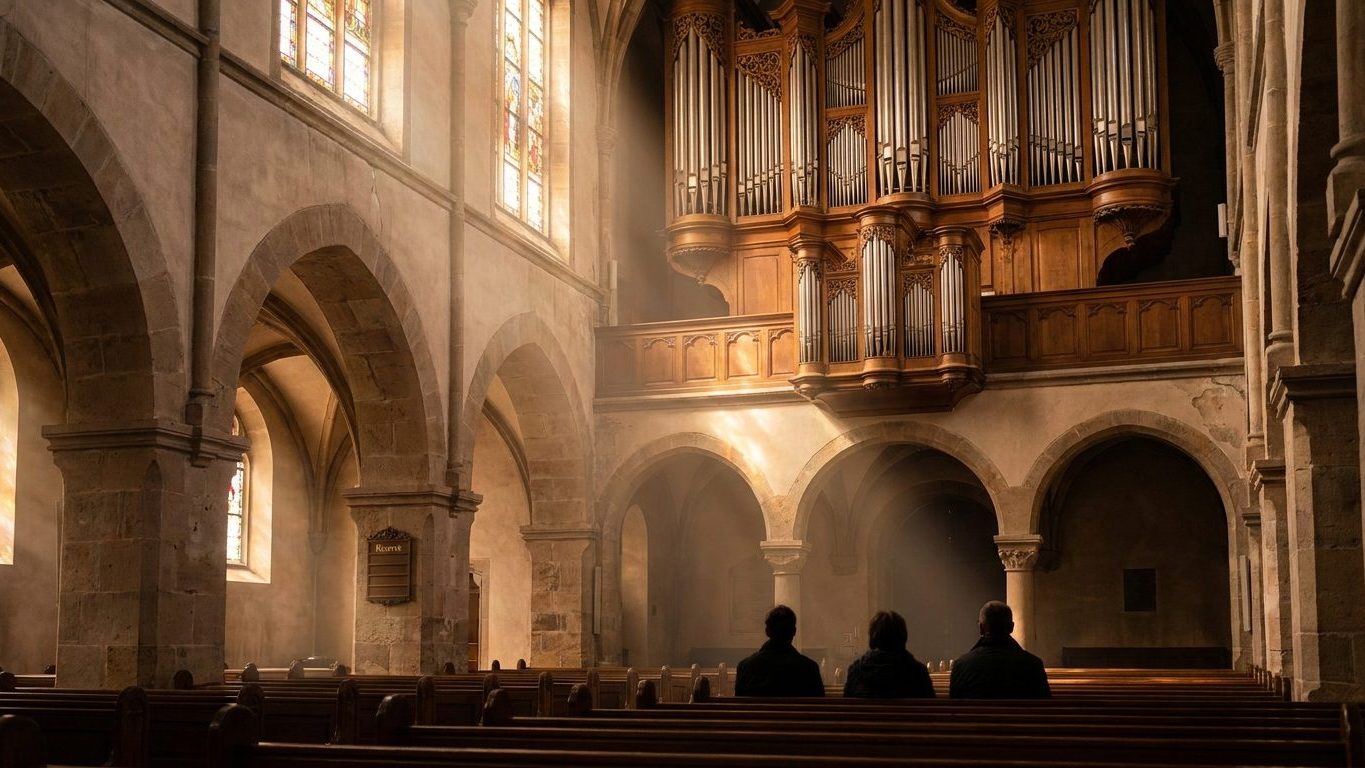
Since September 5, 2001, an organ has been sounding without interruption in the former Saint-Burchardi Church in Halberstadt, Germany. A single piece, a single score: ORGAN²/ASLSP by John Cage, whose title translates to “as slowly as possible.” Its duration has been set at 639 years, with a final end planned for 2640.
No spectator on day one will hear the last note.
The calculation may seem absurd, almost provocative, until you understand where this figure comes from. Saint-Burchardi Church dates back to 1208, and in 1361 a grand organ was installed there, one of the first with a keyboard type that would later become standard for pianos. The organizers wanted to emphasize this gap: 639 years separated 1361 from the year 2000, the date initially planned to begin the project. The start was ultimately postponed by one year due to budget constraints.
- The organ has been playing since September 5, 2001 and will only stop in 2640, representing 639 years of continuous music.
- The score begins with a seventeen-month silence, the first sound not heard until February 5, 2003.
- Weights and sand keep the keys pressed while volunteers manually modify the pipes every two to three years.
A seventeen-month silence to open 639 years of music
The Cage score begins with a perplexing directive: a pause. In Halberstadt, that pause lasted seventeen months, from September 5, 2001 to February 5, 2003, the day the very first sound finally resonated within the building.
The choice of date is no accident. The launch took place on September 5, 2001, the day marking John Cage’s 89th birthday, Cage having died in 1992 without ever fixing the work’s duration. Musicians and philosophers debated this instruction at a 1997 conference, because a properly maintained organ can technically sound indefinitely. From this seemingly trivial question, one of the most radical musical projects ever undertaken emerged.
Twenty-five generations will have to succeed each other to see the work reach its conclusion.
Weights, sand and a blower that never stops
No one plays this organ in the conventional sense. The keys are held down continuously by weights and sacks of sand, while an electric blower feeds the instrument with air to produce a continuous sound. The result is an unceasing drone, day and night, for more than two decades.
Changing chords does not mean pressing a new key. A change of chord, carried out manually, alters the sound of the pipes, either by adding new notes or by letting existing notes fade away. Volunteers and artisans physically intervene on the instrument, adding or removing pipes according to a calendar set decades in advance.
The most recent alteration, on August 5, 2026, shifted the concert from seven to eight notes with the addition of a pipe on A4. This seventeenth modification accounted for about 4% of the 639-year undertaking. The previous change had occurred in February 2024, more than nine hundred days of identical sonic silence earlier. The next is anticipated for October 5, 2027.
Crowds for hearing a single note move
What might seem like a non-event has, in fact, drawn hundreds of people to each change. More than 150 individuals packed the church before the latest chord alteration, some traveling from across Europe for the occasion. The project’s board chair, Anneli Borgmann, sums up the fascination by saying that “as fast as our world evolves, it is a wonderful place to be and to return to oneself.”
The building itself has a history of renewal. The project transformed the Burchardi Church, which had been largely ruined until funds allowed a new roof and other repairs. An abandoned church thus became, somewhat unexpectedly, one of the continent’s most peculiar musical pilgrimage sites.
A visitor from Scotland, who came specifically for the August 2026 event, captured the sentiment succinctly: “it’s just one of those things, one of those unique things in the world of music.”
The organ’s durability matters just as much as the patience of those who maintain it. The organ maker Johannes Hüfken stated that the pipes he designed for this instrument will endure for at least another five hundred years. The question remains: who, in the centuries to come, will continue to patiently add a pipe every few years, until the final chord scheduled for September 4, 2640.
Sources: ledevoir.com | stephanelarue.com
