
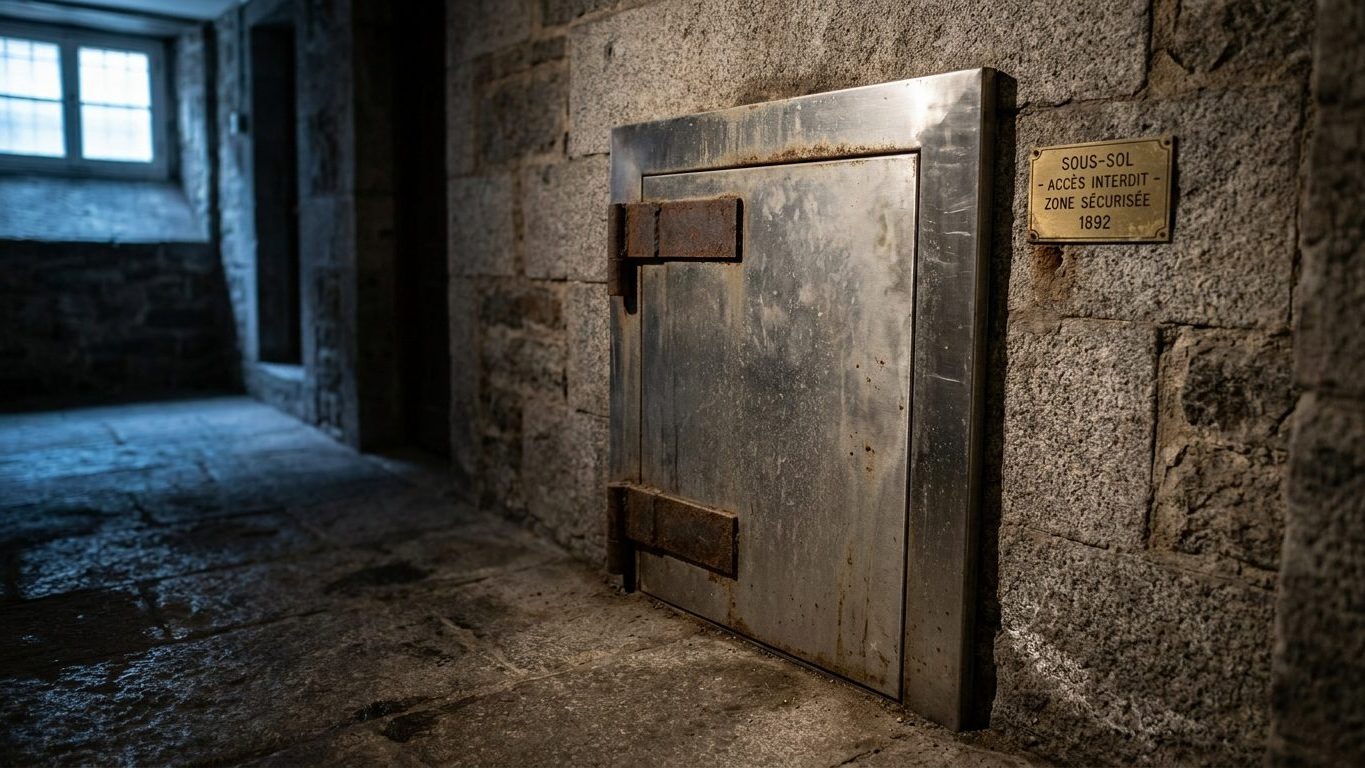
A stainless steel door, welded shut so it could never open for six thousand years. That is precisely what lies beneath the campus of Oglethorpe University in Atlanta, where the Crypt of Civilization was sealed on May 28, 1940, with instructions not to open it before May 28, 8113. Since that date, no one is allowed to touch it, no one may know what exactly lies inside.
The countdown has barely begun.
The story begins with the frustration of an academic. In 1935, Oglethorpe University president Thornwell Jacobs was researching the history of ancient civilizations and was irritated by a simple fact: archaeologists know almost nothing about the daily lives of peoples who have vanished. Inspired by the opening of the Egyptian pyramids, he envisioned creating a repository of ordinary objects from the 1930s and a record of human knowledge accumulated over six thousand years. Not treasures, not sacred relics—everyday objects, the ones we rarely think to keep.
To fix the opening date, Jacobs undertook an almost obsessive calculation. He added to the first known Egyptian calendar, dated to 4241 BCE, exactly 6,177 years up to 1936, and then projected that same interval into the future. The result: the year 8113. A date chosen not at random, but to place the twentieth century squarely in the middle of known human history.
- The crypt is 6 meters long and was welded shut on May 28, 1940 with a prohibition on opening before May 28, 8113
- It contains ordinary objects from the 1930s, 600,000 pages of microfilmed text, and recordings of Hitler, Roosevelt, and Mussolini
- A language integrator filmed was planned to teach English to inhabitants of the year 8113 in case the language disappeared
A Swimming-Pool Chamber Turned into a Time Vault
The project began in the lower levels of Phoebe Hearst Hall, a Gothic granite building on the campus. The chosen site was an abandoned pool, equipped with an already watertight foundation, a detail that simplified waterproofing work. The chamber measures roughly 6 meters in length, 3 meters in width, and 3 meters in height, resting on the bedrock beneath two feet of stone, with its walls lined by glazed porcelain panels embedded in tar.
The final closure occurred in May 1940, after three years of methodical collecting.
The chamber was then sealed by a massive stainless steel door, welded in place. No lock, no code, no hidden key among the archives: just a weld, literally irreversible without cutting. No precious objects, no gold or jewelry lie inside: this is not a treasure to guard but a testament. The Guinness World Records even acknowledges it as the very first serious attempt to durably preserve a record of twentieth-century culture for generations living thousands of years hence.
A Plastic Donald Duck and the Voices of Hitler and Roosevelt
What the crypt contains is a blend of attic and laboratory. It holds seed samples, dental floss, a women’s handbag filled with its usual contents, an electric toaster, a baby bottle, a manual typewriter, Lincoln Logs construction sets, a plastic Donald Duck figure, a bottle of Budweiser, and records of Artie Shaw the clarinetist. Alongside these ordinary objects lie microfilms representing more than 800 books, i.e., over 600,000 pages of text.
The sound recordings are dizzying.
Voices of Adolf Hitler, Stalin, Roosevelt, and Mussolini sit beside those of Popeye the Sailor and a hog-calling champion. A nearly comic contrast, revealing the gamble Jacobs had taken: not filtering what deserves to survive, but presenting an era in all its contradictions, from dictator’s speech to cartoon joke. The project’s archivist, Thomas K. Peters, anticipated another major problem: what happens if electricity no longer exists in eighty-two centuries? Jacobs assumed electricity might not be in common use by the 82nd century, so Peters installed a wind turbine within the vault to run the microfilm readers and projectors, along with a hand-cranked device named the “language integrator.”
An English Course for Future Custodians Who Do Not Yet Exist
This language integrator deserves a moment’s attention, as the idea verges on science fiction. It is a modified mutoscope, a primitive cinema projector fitted with sound, loaded with reels showing common English phrases and objects, accompanied by their recorded pronunciations. The idea behind the device: what if, in the year 8113, no one on Earth spoke English anymore?
No one can guarantee that language will have survived six thousand years.
Jacobs thus designed something akin to an automatic classroom manual, crafted for strangers about whom he would never learn a thing. A vertiginous wager on the continuity, or the possible lack of continuity, of human language. For a humorous aside, Jacobs also sold metal cards for a dollar, allowing the descendants of donors to attend the crypt’s opening in 8113—a rendezvous that neither he nor anyone today will ever witness.
The Wound That Will Never Heal in Our Lifetime
That is the core of the matter, what makes this story different from all the other time capsules buried around the world: the door to the Oglethorpe crypt remains welded today, beneath a campus that is fully active, with students walking above it daily without giving it a second thought. The university officially keeps the site under surveillance and conducts regular inspections, never compromising the seal, to preserve the room’s integrity until its scheduled opening in 8113.
Oglethorpe maintains a chamber of which it is no longer permitted to know the contents.
There are more than six thousand years to wait. No living human today, nor any of their children, grandchildren, or descendants spanning roughly two hundred fifty generations, will ever know for sure what lies behind that steel door. The university has kept a written inventory of the deposited objects, enough to know on paper what lies sleeping in the dark, but the physical experience — the act of reopening the door and feeling the confined air of 1940 — will remain beyond reach for any person who might someday read this article.
What stands out most, in tracing the history of this project, is its almost naïve ambition: Jacobs was not addressing his own children, nor even his grandchildren, but humanity itself, a species so distant that it might have forgotten even its own language. The Oglethorpe campus continues to host classes, exams, and campus life just above a sealed chamber that no one will see in their lifetime, a quiet reminder that some promises are kept on timeframes that utterly exceed the bounds of a human life.
Sources: oglethorpe.edu | historyofinformation.com
