
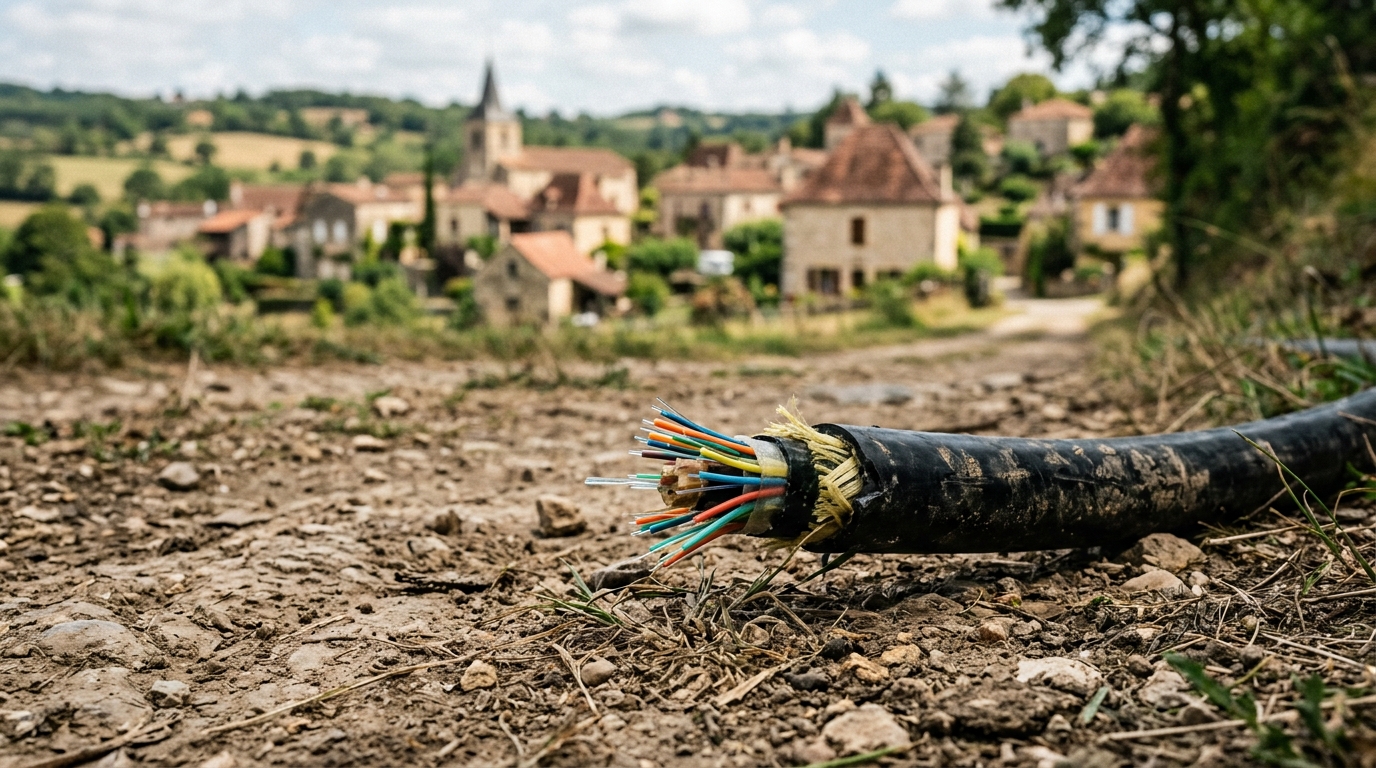
On one side, official maps entirely green, symbolizing a rural France finally connected to ultra-fast broadband. On the other, residents who watch, powerless, a brand-new street cabinet and an optical fibre cable that never passes the threshold of their home. This dissonance between the promise and the ground reality sums up one of the most stubborn blind spots of the France Very High Speed Broadband Plan. At the start of autumn, as the final budgetary decisions loom, the question of the last-mile connection reemerges with particular insistence, driven by data that contradict the narrative of near-complete coverage.
- By the end of March 2026, there were still 2.3 million premises in France awaiting fibre connections, mostly in rural areas and on networks run by public initiatives
- According to Arcep, one fibre connection out of sixteen fails on average, often due to blocked conduits or telecom manholes that cannot be located
- Since March 2026, an experimental government scheme funds up to €1,200 of works when existing infrastructure physically prevents pulling the cable to the dwelling
- When the state announces very high-speed but forgets the last mile
- The mirage of official figures: connected does not mean online
- Why operators stop precisely at the village exit
- What the rural digital divide in France really reveals
When the state announces very high-speed broadband but forgets the last mile
Since 2018, the State has multiplied announcements about connecting thousands of rural municipalities to fibre, presenting the project as one of the great successes of territorial digital planning. On paper, the ambition was clear: to offer every household, even the most isolated, access to very high-speed broadband comparable to what is available in major cities. Miles of cables were laid across the countryside, funded largely by public funds and presented as the backbone of a connected France.
But this narrative glosses over a more complex reality. Because connecting a village to a fibre network does not mean that every dwelling in that village actually has a functional connection. Between the pooling point installed at the village edge and the terminal socket in residents’ living rooms, there exists a whole final segment, often neglected in institutional communication, which concentrates the bulk of technical difficulties. The initial objective of full fibre coverage, set for the end of 2025, was not achieved: by the end of March 2026, 2.3 million premises remained to be connected in France, largely in rural areas and in territories managed by public‑initiative networks.
The mirage of official figures: connected does not mean online
Coverage statistics, frequently brandished to illustrate progress in ultra-fast broadband, deserve careful reading. In rural areas served by public-initiative networks, fibre-to-the-home coverage today stands at 93.3%, a figure that at first glance seems flattering. It hides, however, a national backlog of more than one million premises not connected, the largest such total across the country. In other words, being theoretically eligible for fibre does not guarantee you can actually connect when the moment arrives.
The Arcep, the telecom regulator, regularly publishes an observatory dedicated to fibre network quality, revealing failure and outage rates that remain higher than the standards expected in certain areas covered by recovery plans. The eighth edition of this observatory, with data covering up to March 2026, shows that the quality indicator for connections now spans 46 networks, representing 30% of the country’s premises. A particularly telling element from this analysis: one fibre connection in sixteen fails on average in France, a rate that forces reprogramming of technical interventions, sometimes multiple times, thereby extending the wait for affected households.
Why operators stop precisely at the village exit
This blockage a few hundred metres from the home does not reflect a lack of will on the part of technicians, but rather concrete material constraints. The common causes of connection failure identified by Arcep include buried conduits that are blocked or damaged, and telecom manholes that are inaccessible or unfindable, sometimes buried under decades of roadworks or simply overtaken by vegetation. These underground infrastructures, often inherited from the old telephone network, were not always designed to accommodate the passage of fibre, and restoring them represents a project in its own right.
In response to this finding, an experimental government aid scheme has been introduced since March 2026 to fund up to €1,200 of works when existing infrastructure physically prevents pulling the cable to the dwelling. This allowance, the highest on the aid schedule, covers the heaviest jobs, particularly when there is no pre-existing conduit and a trench must be dug, a scenario far more common in rural areas and in older buildings than in modern urban subdivisions. This cost, previously often borne by individuals themselves or simply ignored, largely explains why so many cables stop abruptly at the village entrance: beyond that point, every extra metre becomes an expense that no one wants to assume.
What the rural digital divide in France really reveals
A parliamentary question already highlighted, after years of deployment, that the objective of complete coverage had still not been reached, with rural, sparsely populated areas being particularly affected by this connectivity shortfall. This reality outlines the contours of a digital divide that no longer simply concerns the absence of a network, but now moves toward unequal access within officially covered territories. According to Arcep, thousands of rural households connected to the France Très Haut Débit Plan remain without an actual connection, the fibre stopping at the edge of the commune, a phenomenon that directly questions the effectiveness of public investments made for nearly a decade.
This imbalance is not limited to the rural world alone. Arcep has also pointed to a decline in operator investments in high-density zones since 2021, signaling that deployment difficulties extend far beyond a single rural issue. Fibre, long touted as an almost completed infrastructure project, thus reveals a geography far more fragmented than announced, where the line between connected and unconnected no longer follows administrative boundaries, but the more prosaic ones of a blocked conduit or an inaccessible telecom manhole.
Ultimately, this story of cables stopping at the entrance of villages perfectly illustrates the gap that can separate an ambitious national plan from its concrete on-the-ground implementation. The coverage figures, as reassuring as they may appear on paper, tell us nothing about the daily lives of households waiting, sometimes for years, to obtain a simple Internet connection. The question remains whether the recently introduced aid mechanism will be enough to fill this last mile, or if France will continue for a long time counting its connections in kilometres of cable rather than in households truly connected.
