
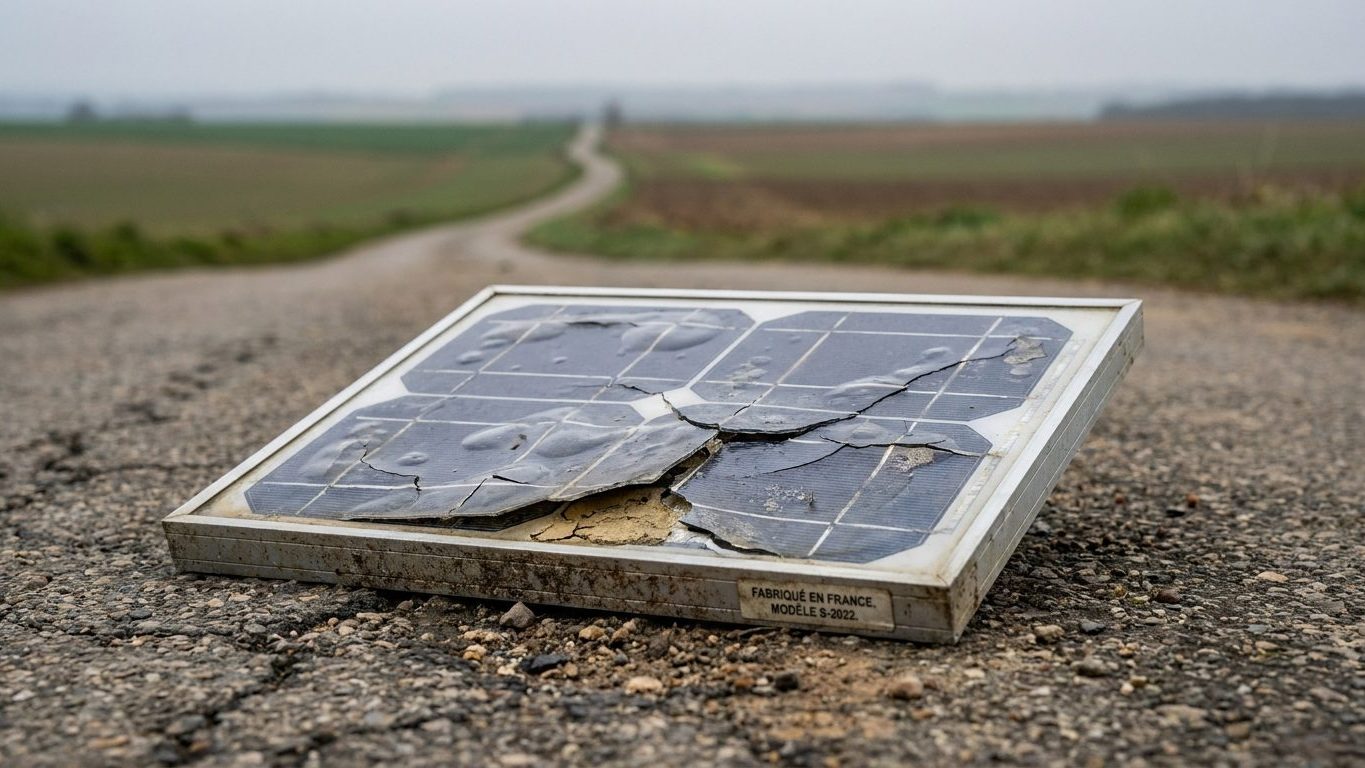
On December 22, 2016, in Tourouvre-au-Perche, in the Orne department, the Environment Minister at the time, Ségolène Royal, grandly inaugurated the world’s first photovoltaic road. A kilometer of asphalt covered with solar cells, intended to generate electricity beneath the wheels of cars and tractors. Before the road had reached its fourth anniversary, a large portion of the installation had already been ripped out of the ground.
- The solar panels glued to the road peel away under the weight and shear forces of heavy agricultural vehicles
- Actual output reached only 37,900 kWh in 2019, three times lower than promoters’ projections
- The granular coating increases rolling noise and forces a reduction in traffic speeds
A Five-Million-Euro Global Showcase
The technology, developed by Wattway, a subsidiary of the Colas group, consists of a road surface measuring 2,800 m² of photovoltaic panels arranged as tiles glued directly onto the asphalt, with no earthworks or new foundations. The State funded the project with 5 million euros in subsidies. The ambition extended far beyond this Norman village: Ségolène Royal hoped to equip 1,000 kilometers of French roads with this surface by 2020. A figure that, eight years later, sounds like a promise never fulfilled.
The promoters of the project spoke of an output capable of powering the street lighting of a town with 5,000 inhabitants.
A Mechanical Failure Before Becoming Electric
A solar tile placed on a roof only bears its own weight and the wind. Bonded to a country road, it must also withstand the weight and shear forces of tires, trailers, and especially the heavy agricultural machinery that daily use this stretch. Under this repeated pressure, the adhesive eventually gives way: the solar panels installed on the road peel off, allowing water to seep beneath the cells.
Laid flat, dirty, and sometimes shaded, a cell heats up and produces significantly less energy than a tilted and ventilated roof-mounted cell. The actual energy yield turned out to be about half of the initial forecasts, due in particular to shade, dust, and the degraded surface.
The granular surface intended to ensure tire grip has another side effect: it amplifies rolling noise with every vehicle pass. This noise becomes so loud for nearby residents that traffic speeds had to be reduced on the stretch. In addition to the mechanical degradation, repeated maintenance works periodically closed access to the road. The municipal council would later cite residents’ dissatisfaction, tired of these recurring works, to approve the site’s abandonment.
Production Three Times Lower Than Promised
As early as 2017, the stretch produced only 78,397 kWh, already half of what had been planned.
The decline worsened from January 2019 onward, with annual production dropping to 37,900 kWh. A surface of panels installed on a roof of equal size would have produced almost five times more electricity, according to calculations submitted to the National Assembly. The fiasco is thus not only mechanical: it is also, perhaps above all, a performance failure.
In response to this assessment, a large portion of the tiles was dismantled as early as 2019, even though the stretch had not yet reached four years. A shorter section remained under review before being torn out in the summer of 2024, after seven and a half years of dysfunction.
The dismantling did not cost the municipality anything, the financial burden being borne by the company itself.
The Trade-Off Revisited with Every Energy Bill
Wattway did not completely give up on its technology. The company redirected its tiles toward smaller surfaces, between 3 and 12 square meters, to power bike charging stations, surveillance cameras, or lit bus shelters. The Tourouvre failure primarily led French stakeholders to abandon traditional solar roads in favor of photovoltaic canopies installed over parking lots, where panels remain inclined and ventilated as on a roof. The takeaway can be summed up in one sentence: the physics of a solar cell cannot be negotiated with the enthusiasm of a media launch.
Five million euros invested in roofs or canopies would have generated, on equal surface area, an output almost five times higher, according to the same parliamentary calculations. The autumn ritual of electricity bills reopening each year brings this trade-off back to the table, and it is hard to escape: a tilted roof panel is better than a tile glued beneath a tractor’s wheels.
Sources: revolution-energetique.com | assemblee-nationale.fr | contribuablesassocies.org
