
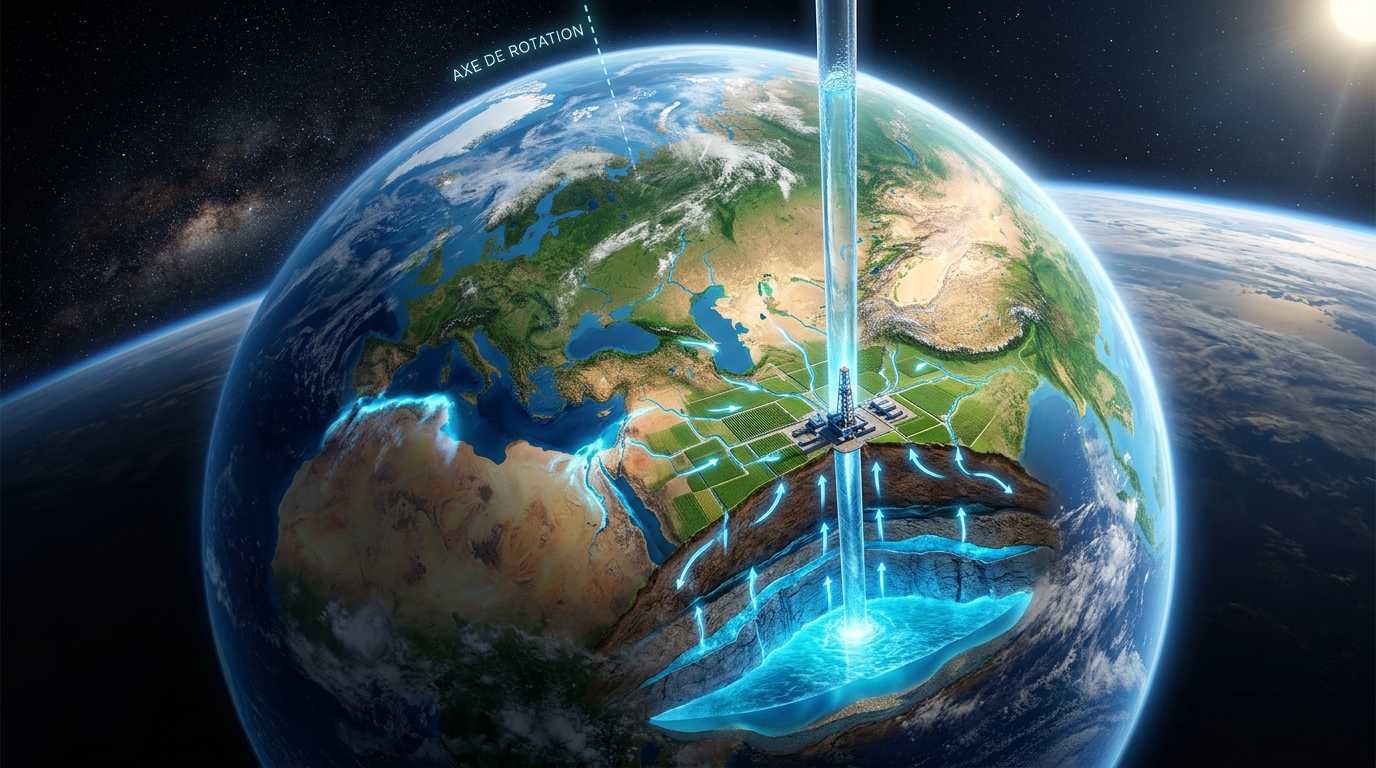
Imagine a spinning top that you set in motion on a table. Add a bit of weight to one side, and its axis begins to wobble imperceptibly. Our planet works exactly the same way, except that the “weight” in question is billions of tonnes of water we have drawn from underground to irrigate our crops. What seems like a simple agricultural activity has, in reality, produced an effect that is both subtle and spectacular: a measurable shift in the Earth’s rotation axis. It is enough to make one dizzy when realizing that a seemingly banal act like pumping water to water crops has literally moved our planet.
- Between 1993 and 2010, humanity pumped 2,150 gigatonnes of groundwater, mainly for irrigation, nudging the Earth’s rotation axis 78.48 cm to the east.
- This extracted water eventually reached the oceans, contributing to a sea-level rise of more than 6 millimeters, with the western United States and the northwestern region of India being the areas most affected by groundwater depletion.
- Greeland ice melt remains the primary driver of pole movement, responsible for an annual shift of about 7 centimeters, ahead of groundwater pumping.
- A 6 sextillion-ton spinning top unsettled by irrigation
- Where did all that water pumped from beneath our feet go
- Why moving a mass of water is enough to make an entire planet wobble
- What this pole movement reveals about our grip on the planet
The Earth weighs about 6 sextillion tonnes, a figure so dizzying that it seems impossible for human activity to alter the balance. And yet, between 1993 and 2010, humanity accomplished this feat by pumping as much as 2,150 gigatonnes of groundwater, i.e., 2,150 billion tonnes, mainly to irrigate crops and meet domestic needs. An amount hard to picture, but it was enough to disturb the delicate balance of our planet in rotation.
For the Earth is not a perfectly rigid, homogeneous sphere: it responds to the slightest variation in mass distribution, much like a figure skater changing spin speed by widening or narrowing their arms. By removing this astronomical quantity of water from the subsurface and pouring it elsewhere, humans have modified, on their scale, the planet’s weight distribution. The result: the Earth’s rotation axis drifted by about 78.48 centimeters, pointing at 64.16 degrees East, i.e., nearly 80 centimeters in just seventeen years.
Where did all that water pumped from beneath our feet go
This water, once stored in groundwater for potentially millennia, did not simply disappear. Once extracted to irrigate fields or fill pipelines, it ended up evaporating, running off, or seeping away, before inevitably joining the oceans. This massive transfer of liquid mass from the continental subsurface to the seas contributed to a rise in the average ocean level of more than 6 millimetres during the studied period, a figure that may seem modest but adds to other well-known phenomena such as glacier melt.
Two regions around the globe stand out in this great movement of invisible water: the western United States and the northwestern part of India. It is in these areas that groundwater depletion was most intense, driven by intensive irrigation-dependent agriculture. These territories thus act as true tipping points in the global equation of the pole’s movement.
Why moving a mass of water is enough to make an entire planet wobble
One might think that a few billions of tonnes of water, on the scale of a planet, amount to a mere droplet. That is precisely where the subtlety lies: it is not so much the absolute quantity that matters, but the exact place where this mass moves. Much like on a seesaw, where a small weight added at the right spot can tip the balance, the relocation of water from the continents to the oceans subtly changes the Earth’s moment of inertia, that physical quantity that determines how the planet spins on its axis.
This kind of mass rearrangement at the planet’s surface happens constantly and can have both natural and human origins. Greenland ice melt remains, in fact, the leading cause of this axis movement, responsible for an annual offset of about 7 centimeters, far outpacing groundwater pumping. Yet it is precisely by combining these different factors, notably incorporating this withdrawal of 2,150 gigatonnes of groundwater into scientific models, that we can explain with the greatest precision the actually observed drift of the rotation pole.
What this pole movement reveals about our grip on the planet
Beyond the scientific feat of measuring this phenomenon, the discovery raises a even more dizzying question: how far can human activity influence the fundamental physical mechanisms of our planet? The North Pole itself has shifted its trajectory during this century, now oriented toward the United Kingdom, an additional sign that Earth’s balances, long considered immutable, are in fact sensitive to large-scale human activity.
Irrigation of fields, an ancestral and vital act to feed billions, thus fits into a chain of consequences far broader than we imagine, spanning sea-level rise and changes to the planet’s rotation. It is no accident that the driest regions, such as the American West or the northwestern India, lie at the heart of this planetary dynamic.
This phenomenon reminds, with an almost poetic elegance, that the Earth is a system in perpetual balance, where every withdrawal, every movement of matter leaves a measurable imprint, even if tiny on our scale. Behind this figure of 80 centimeters lies a broader truth about our collective ability to weigh, literally, on the fate of the planet. An invitation to rethink our relationship with resources once thought inexhaustible, and to wonder what other surprises physics may still have in store as we carry out our daily use of water.
Source: Geophysical Physical Research
