
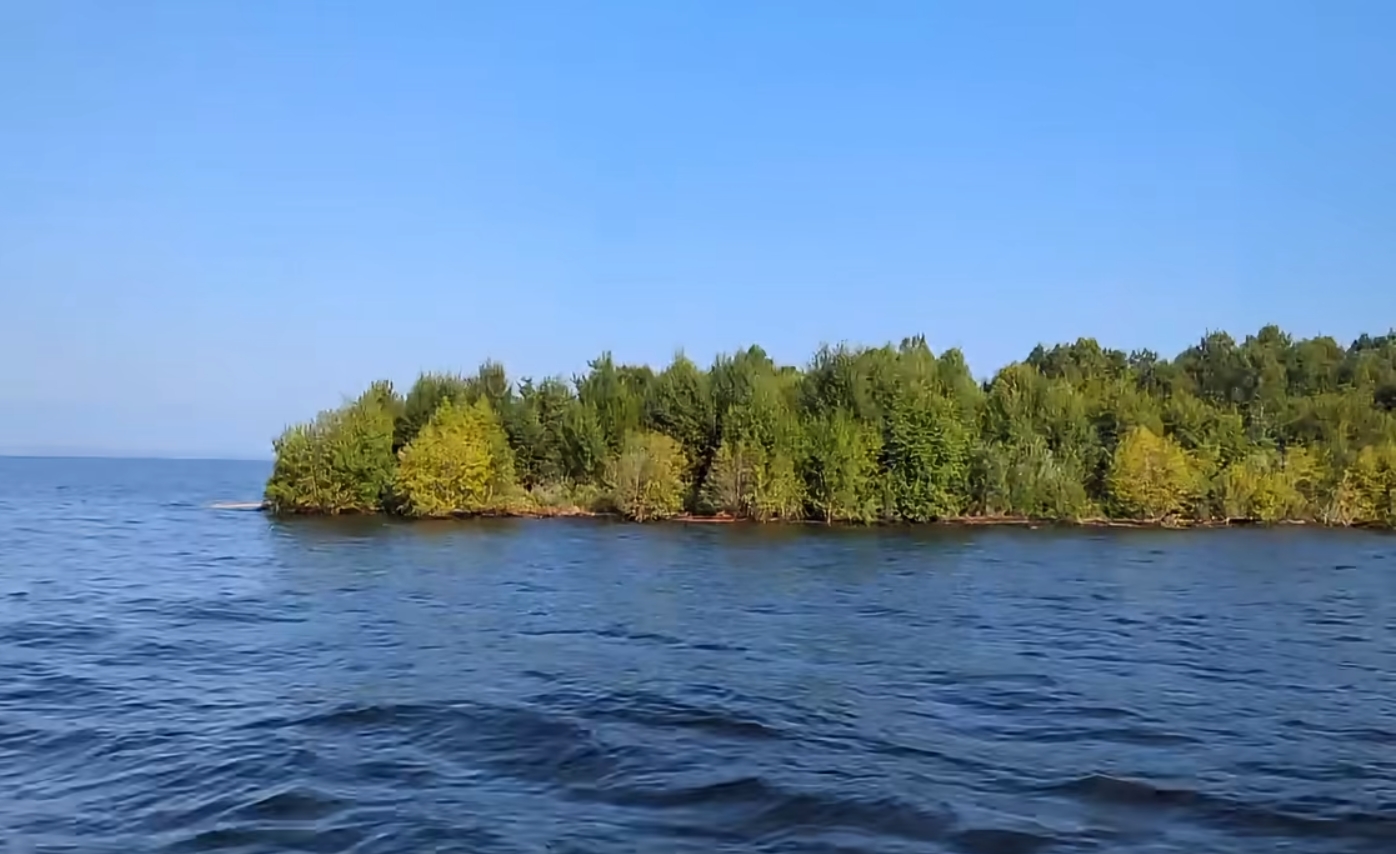
At the end of the summer of 2026, boaters spotted a surprising structure in a man-made lake in British Columbia. Spanning about a hectare, this drifting island is covered with trees. How did it come to be?
An island as big as two football fields
The Williston Reservoir is an artificial lake created in 1968 by the W.A.C. Bennett Dam on the Peace River, in British Columbia (Canada). Far from being just a body of water, this reservoir is the province’s largest freshwater mass and the seventh-largest artificial lake in the world by volume. Covering a vast area of 1,761 square kilometers, the Williston Reservoir has recently drawn attention for a remarkable discovery.
As CBC News revealed in a report dated August 29, 2026, boaters spotted a strange structure in the middle of the lake. It is an island covering 9,800 square meters – 70 meters wide by 140 meters long (almost a hectare), i.e., the size of two football fields. It is notable for supporting a genuine forest of trees that appeared to be intact.
“It was an incredible sight, I had never seen anything like it in 40 years of life here.”, said Rocky Avery, one of the Canadian boaters who discovered the island and posted a video on social media.
A natural phenomenon…
In charge of managing the reservoir, the state-owned BC Hydro initially thought it was a prank. However, engineers were able to confirm the island’s presence using satellite imagery. A moment of suspense followed, as the island disappeared from radar and then reappeared a few days later. In fact, the island had moved about thirty kilometers to the northwest, demonstrating that the structure is adrift.
While the news sounds spectacular, it is a purely natural phenomenon. Indeed, the structure is nothing more than a wooden floating island – or a giant raft – a conclusion shared by BC Hydro officials and Natalie Kramer Anderson, a fluvial geomorphologist who works for the NGO Gorge Ecology Outdoors. In an interview with National Geographic, she explained the formation process.
According to her, trees fallen into the reservoir – or into nearby rivers – accumulated in a sheltered bay, generating a vast raft of driftwood. Then, these trunks decomposed on the surface, allowing moss, vegetation, and new trees to take root and form a soil layer. Finally, a recent rise in water levels – or strong winds – likely ripped the mass from its anchorage, turning it into a drifting island.
… increasingly rare
The phenomenon of wood-based floating islands has become extremely rare today, to the point that scientists now refer to them as “ghosts of the past.” This gradual disappearance is not happenstance; it directly results from human activities impacting rivers. In particular, the proliferation of hydroelectric dams, the systematic cleaning of waterways, and intensive industrial forestry are cited as major factors.
Unsurprisingly, the event drew significant public interest. Provincial authorities quickly issued strict warnings to keep boaters away from the island or from attempting to climb aboard. The structure, made up of debris and unstable trunks, can tear itself apart at any moment or capsize suddenly under the impact of waves or possible windstorms. In other words, the island is considered highly dangerous.
