
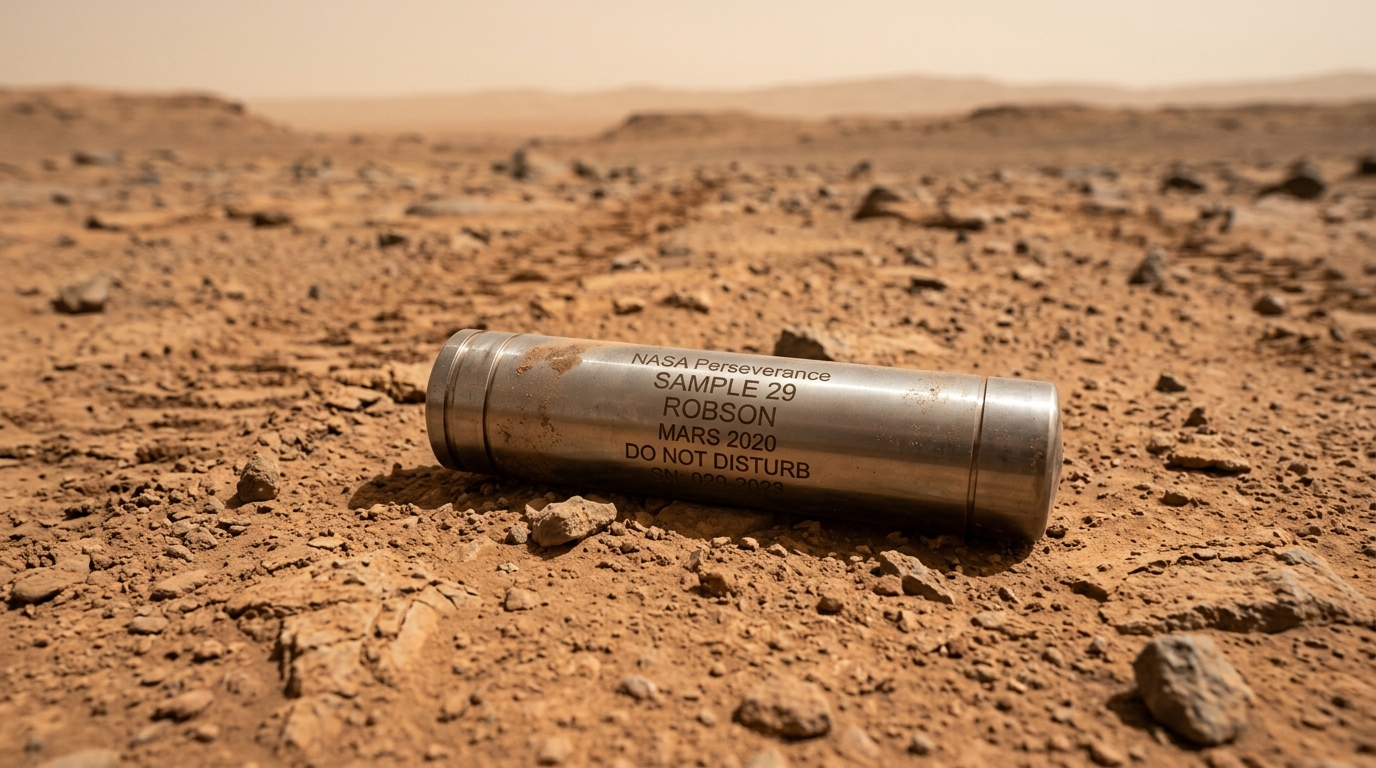
Imagine a one-of-a-kind library in the world, filled with priceless volumes, yet with no one holding the key to fetch the books and bring them home. This is somewhat the situation NASA faces with the Jezero crater, on Mars. For several years now, the Perseverance rover has been patiently gathering samples of Martian rock, sealing them in metal tubes, and then placing them on the ground, ready to be retrieved. Yet no spacecraft has ever come to fetch them. Thirty tubes thus wait, exposed to the winds and the reddish dust of the planet, with little idea of when they will leave their native soil. How can we explain such abandonment, when these rocks could answer one of humanity’s greatest questions: did life exist anywhere besides Earth?
- The Perseverance rover has sealed Martian rock cores in titanium tubes and left thirty of them at the Three Forks site to secure their future retrieval.
- The Mars Sample Return program, tasked with bringing these samples back to Earth, has suffered a cost explosion that delayed and questioned its feasibility.
- With budgets stretched by competing priorities such as Artemis, NASA has not set a firm timetable for this mission, while China is developing its own similar projects.
- Thirty rock cores abandoned on the Martian surface
- The reason NASA still hasn’t sent a craft to retrieve them
- The budget blocking the return of samples to Earth
- What the indefinite wait for Jezero’s rocks conceals
Thirty rock cores abandoned on the Martian surface
Since its landing in the Jezero crater, Perseverance has undertaken a methodical and meticulous sampling mission. Using its robotic arm, the rover drills Martian rock, extracts fine cylindrical cores, and hermetically seals them in titanium tubes designed to preserve their chemical integrity for years, even decades. Some of these samples were placed directly on the ground, in a zone dubbed Three Forks, forming a strategic deposit awaiting a hypothetical future retrieval.
This choice is not incidental: it is an insurance. If Perseverance were to break down before finishing its mission, these thirty tubes would remain available for a later retrieval mission, independent of the rover’s functioning. A smart technical precaution, but it also underscores a less comfortable reality: these rocks, potentially bearing traces of ancient life, now wait on a planet we have not yet the means to revisit and recover.
Why NASA still hasn’t sent a craft to retrieve them
The question seems straightforward, but the answer is far from simple. Bringing Martian samples back to Earth is not an operation that can be improvised with current technologies. One would need a lander capable of touching down precisely in the crater, a small launcher to propel the samples into Martian orbit, and then a vessel able to intercept them and ferry them back into our atmosphere, where they must be recovered without contamination. This program, known as Mars Sample Return, has long been presented as one of the United States’ top priorities in space exploration.
Yet technical complexity has collided with a far more down-to-earth reality: costs have surged through successive revisions of the project, far exceeding initial forecasts. Facing this budget drift, those in charge had to recalibrate ambitions, push back deadlines, and eventually question the feasibility of the mission in its original form. As a result, the thirty tubes remain at Three Forks, with no firm retrieval schedule in sight.
The budget that blocks the return of samples to Earth
This is where the real explanation for the endless wait lies: Perseverance’s samples stay on the ground because there is no truly budgeted return mission for NASA. The agency has indeed attempted, repeatedly, to reboot the Mars Sample Return program, exploring different technical architectures to cut costs. Some proposals now contemplate involving private actors or lighter landing technologies, in the hope of bringing the bill to a level manageable for public finances.
NASA’s overall budget environment does not help either. Between political trade-offs, competing priorities around the Artemis lunar program, and uncertainties about funding year after year, the return of Martian samples is regularly relegated to a secondary priority. We are talking about a project whose price tag could reach several billion dollars, a sum hard to defend in a setting where every space expenditure is closely scrutinized by Congress.
What the indefinite wait for Jezero’s rocks conceals
Beyond financial questions, this wait reveals a deeper tension in contemporary space exploration. On one side, science pushes to analyze these rocks in Earth laboratories, where instruments infinitely more powerful than those aboard a rover could uncover tenuous yet potentially decisive clues about a past microbial life. On the other hand, budgetary and logistical constraints remind us that scientific ambition must always contend with very real economic realities.
There is also, implicitly, a kind of quiet race. Other space agencies, notably China, are pursuing their own Martian sample return projects, with sometimes more ambitious timelines. If NASA delays too long, it could be overtaken in this symbolic as well as scientific quest. The Jezero tubes thus are not merely waiting stones: they embody a strategic, scientific, and diplomatic stake that far exceeds their mere geological value.
These Martian rocks, patiently collected and then left to their fate on Jezero’s red ground, embody the challenges of modern space exploration: immense scientific ambitions tempered by very real budgetary constraints. What remains to be seen is how much longer these samples must wait before a spacecraft finally comes to retrieve them, and what truths about our cosmic past they might reveal once in the hands of scientists on Earth.
