
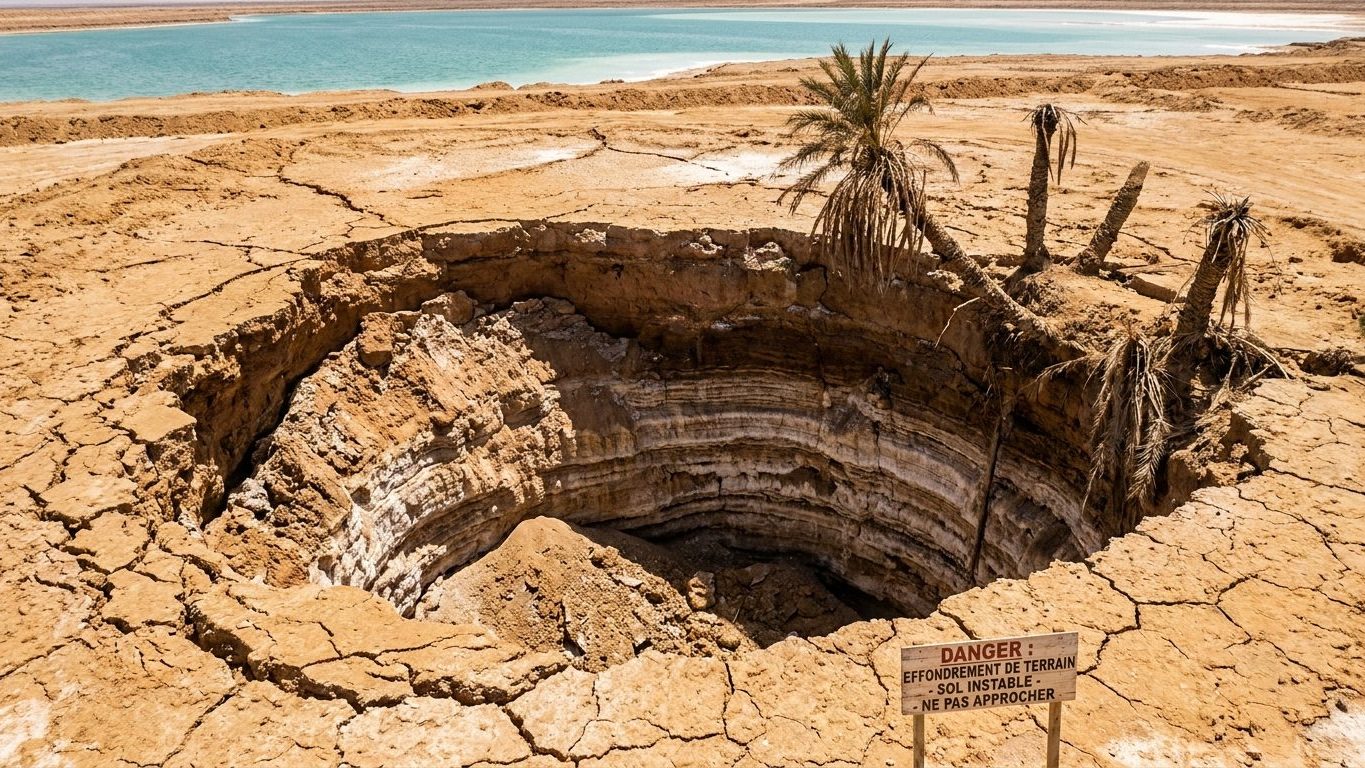
Ein Gedi, on the western shore of the Dead Sea. A brand-new road, engineered to withstand subsidence, cracks open here and there as cars pass over it. A little further along, an entire hotel had to be demolished after several craters merged beneath its foundations. This is not an isolated incident: it is the symptom of a hydrological disaster that has been unfolding for more than sixty years and is still worsening, meter by meter, crater by crater.
- The Jordan River, diverted by Israel, Jordan and Syria since 1960, now delivers only about a third of its historic flow to the Dead Sea.
- Underground fresh water dissolves buried salt layers, carving out caverns that collapse abruptly into around 6,000 dolines on the western shore.
- These craters have closed tourist beaches, destroyed a hotel, damaged a $60 million road, and forced the abandonment of entire palm groves.
A diverted river, a sea in decline
Everything begins with the Jordan. This biblical river once fed the Dead Sea with more than a billion cubic meters of water each year. In the wake of climate change, but mainly as a result of upstream withdrawals, nearly a billion cubic meters annually out of the 1.3 billion that the Jordan River used to pour in have been diverted. Since the 1960s, Israel, Jordan and Syria have drawn on its waters for irrigation and drinking water, leaving the Dead Sea with only a residual portion of its historic flow.
Further south, a second mechanism worsens the situation. Israeli and Jordanian potash plants evaporate some of the remaining water to extract salts and minerals—a manufacturing process that saps even more water from the lake. The office of the Israeli prime minister itself has acknowledged that the Dead Sea coastline is retreating by about one meter per year due to natural evaporation, the northward diversion of Jordanian water for agriculture, and the pumping of water at the southern end by the Dead Sea factories for salt and mineral extraction.
The consequence is visible on the maps. In a little over half a century, the lake’s surface has lost roughly one third of its area. The water level has slipped below the -430-meter mark, a figure that continues to drop each year. Some shoreline points have receded by several hundred meters since the 1980s. Boats that once moored directly on the beach now have to travel kilometers of dried terrain to reach the water.
Beneath the surface, a geological time bomb
Nobody anticipated what would come next. When the water level falls, the highly concentrated brine that once stabilized the subsurface retreats. Fresh underground water continues to arrive from the nearby mountains. It meets thick layers of salt buried there for millennia, from a time when the Dead Sea was much larger.
Chemistry does the rest. Fresh water dissolves salt far more easily than brine does, carving out underground caverns until the ground above can no longer bear its weight and collapses. The process is invisible from the surface, until everything suddenly snaps. This isn’t gradual erosion that you can see; it is a sudden collapse, with no warning.
The figures tell a story of vertiginous acceleration. In 1990, the Geological Survey of Israel counted only a hundred dolines. Today, the figure is estimated at nearly 6,000 dolines along the western shore alone, a tally that varies by agency and year of measurement, with some estimates exceeding 7,000 when accounting for the entire perimeter. A recent scientific study published on the EGUsphere platform measured, on the Jordanian side this time, a 43% rise in cavities between 2018 and 2024, from 1,565 to 2,247 in this sector alone. The progression shows no sign of slowing; it is spreading northward and toward the sea, tracking the continuous drop of the lake level.
Cut roads, abandoned palm groves, razed hotels
Tourism bears the brunt of the damage. The Mineral Beach resort shut down after a crater swallowed its parking lot, spa facilities and several palm trees in a single night. Ein Gedi’s historic beach was declared unfit for swimming in 2020, leaving only a single public access along the northern coastline. The kibbutz Ein Gedi hotel complex faced the same fate: razed after several dolines converged beneath its structures.
Road infrastructure has not been spared. Notable affected assets include a $60 million bridge, a high-speed stretch of Route 90 south of the Ein Gedi nature reserve, and the region’s only service station for more than 60 kilometers. Even built to anti-subsidence standards, this coastal road did not hold up everywhere. Entire segments had to be rerouted, sometimes several kilometers inland.
Agriculture is also retreating. Entire date palm groves were abandoned, parcels deemed too unstable for continued cultivation. Nearly forty professional sites have closed in this already economically fragile area, according to the Israeli authorities themselves. Campsites, too, were evacuated one after another as new dolines appeared near tents.
Billions planned, no project completed
Confronted with this situation, a pharaonic project long stood as the supposed miracle solution: connecting the Red Sea to the Dead Sea via a canal or underground pipeline, leveraging the 400-meter elevation difference between the two seas. The Red Sea–Dead Sea Conveyance was a 180-kilometer-long undertaking, estimated at $10 billion, which would have supplied the Dead Sea with about 2,000 million cubic meters of water per year, of which 1,200 million would flow directly into the lake.
The project never came to fruition. Too expensive, too controversial ecologically—some scientists feared that mixing the waters would trigger algal blooms and alter the lake’s unique mineral composition. Jordan ultimately walked away. Amman abandoned the stalled project, preferring to focus its resources on a national desalination plant in the Gulf of Aqaba.
A hydrologist from the EcoPeace organization, Nadav Tal, sums up the political deadlock surrounding the issue. He notes that the Dead Sea has been losing more than a meter of surface area each year since the 1960s, a decline that continues regardless of diplomatic hesitations. A researcher from Israel goes even further: even with a pipeline, the intended input would represent only a fraction of what the Jordan River once supplied, insufficient to reverse the trend.
The Dead Sea will not disappear on a fixed date. It is moving toward a new equilibrium—smaller, saltier, surrounded by a wintry no-man’s land of holes that no one dares cross without an up-to-date map. In the meantime, each passing year adds new chasms somewhere between abandoned date groves and roads that must be redrawn time and again.
Sources: fr.timesofisrael.com | orientxxi.info
