
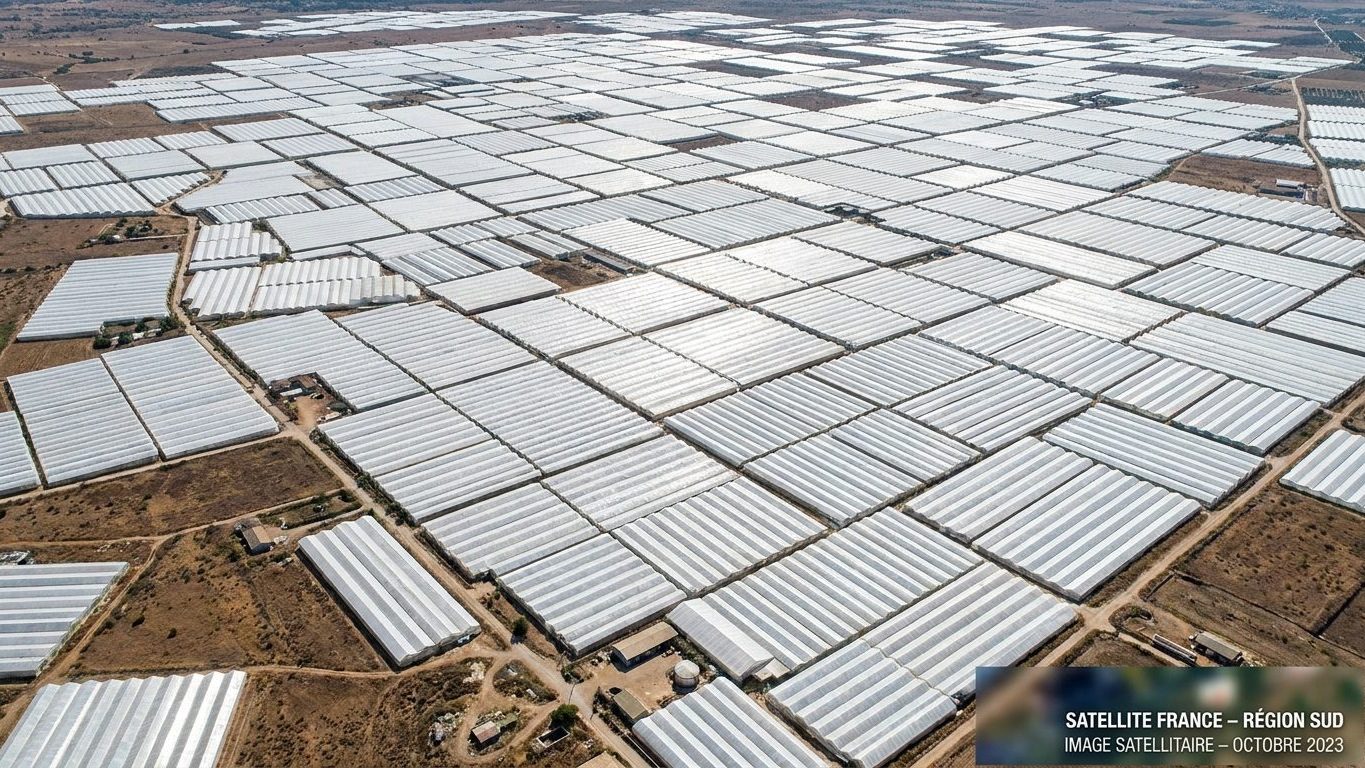
Seen from space, the province of Almería bears little resemblance to a classic Mediterranean desert. Where one would expect ochre and brown hues, a blinding white stain stretches across the coastal plain, between El Ejido and Níjar. It is the largest concentration of agricultural greenhouses in the world, born in the 1970s on land that until then had only served extensive grazing.
A sea of plastic. Literally.
Before the arrival of the greenhouses, this Campo de Dalías plain attracted almost no attention. In an interview published by the Agter association, agronomist Bernard Roux described a near-barren plain, arid, with a very dry climate, about 200 or 300 mm of water per year, near the sea, parceled among large landowners. A territory where only a few flocks of sheep roamed the lands, before borehole irrigation changed the situation.
- The white plastic of the greenhouses reflects 20 watts per square meter of heat back to the sky rather than absorbing it
- The region has cooled by 0.3°C per decade since 1983, reversing the national warming trend
- The greenhouses produce about 3.5 million tonnes of fruits and vegetables annually for European markets
The White Plastic That Cools the Ground
The physical mechanism rests on a simple idea. Bare, dark soil absorbs a large portion of the solar radiation it receives and re-emits it as heat. A white plastic sheet, by contrast, reflects a large part of it back toward the sky before it can heat anything. This is the albedo principle, the reflecting power of a surface: the lighter a surface, the more it repels light rather than absorbs it.
This is precisely what researcher Pablo Campra, from the University of Almería, measured in a 2008 study published in the Journal of Geophysical Research. His measurements show an annual albedo about 0.09 higher on the greenhouse surface compared with typical pasture land. This shift in color has measurable energy consequences: according to an analysis cited in an American patent drawing on Campra’s work, the installation of the greenhouses caused an increase in albedo of around 0.1, associated with an average net heat reflected of about -20 watts per square meter, as measured by the MODIS satellite imagery.
In practical terms on the ground: a thermal anomaly that runs opposite to the national trend. The 2008 study reports a significant cooling of surface temperature of -0.3°C per decade in this area between 1983 and 2006, a local trend that shows no correlation with the warming trends seen in Spanish regional temperatures or in global averages.
A Plain That Became Europe’s Winter Garden
The magnitudes are dizzying. As early as 2007, the foundational study described a spectacular spatial expansion of greenhouse horticulture in the semi-arid province of Almería, reaching a continuous area of 26,000 hectares, the largest greenhouse zone in the world. Since then, the area has continued to grow: depending on the boundaries used and the years considered, current estimates range between 300 and 400 km2, counting recent extensions toward the neighboring Levante. This figure should be treated as a rough order of magnitude rather than a fixed measurement, as satellite cartography differs depending on the calculation method.
This area feeds a large portion of European winter markets. According to recent data cited by the horticulture sector, the zone produces around 3.5 million tonnes of fruits and vegetables each year, largely destined for European markets. A January tomato on a French table is likely to come from there.
This production does not fall from the sky. It rests on massive pumping from underground aquifers, a system inherited from the grand hydraulic works launched under Franco in the 1940s and 1950s.
The Hidden Bill: Aquifers, Plastic, and Injured Workers
The price of this agricultural success is paid underground. A hydrogeological study published in Water Science & Technology already estimated annual inflows into the aquifers at around 50 cubic hectometers, while more than 100 cubic hectometers were extracted during the same period. This is no trivial note: this overexploitation of resources triggers a steady drop in the water table, which leads to seawater intrusion into the aquifers closest to the sea.
The description still holds today. According to a satellite imagery analysis published by CNES, the region’s agricultural development relies on thousands of wells and pumping stations that draw on groundwater, risking depletion and salinization of the aquifers and soils due to seawater intrusion. And as surface aquifers run dry, pumping goes deeper still.
The plastic also becomes a problem when it wears out. Estimates cited by agricultural organizations put the waste generated—greenhouse films, pipes, and structural materials—at about three million tonnes per season, roughly as much as the vegetable production itself.
Behind the tarps, thousands of workers, often immigrants, wait each morning for an employer to pick them up. A report published on Parole d’ères describes these workers waiting patiently for a van to stop and hiring them by the day for about thirty euros, if not less.
A Real-World Lesson for Climatologists
Almería has become, somewhat unintentionally, a case study. It demonstrates openly that all it takes is to change the color of a surface, without removing anything from the atmosphere, to shift local temperatures in a measurable and lasting way across decades.
This logic now inspires urban experiments far from the Andalusian greenhouses. Researchers at University College London have shown, through climate modeling, that painting roofs white can reduce urban air temperatures by 1.2 to 2 degrees Celsius, a performance deemed more effective than solar panels or green roofs in the same study. The technique, known as cool-roofing, draws on ancient practices already widespread around the Mediterranean, from Greece to certain Spanish cities.
Other paths explore light-leaf crops or reflective varieties, extending into the fields what the Almería greenhouses revealed almost by accident. The next time a January tomato lands in a supermarket cart, take a look at a satellite map: in a few seconds of search, the white patch of Campo de Dalías appears, as clear as a frozen lake in the middle of a desert.
Sources: agter.org | image-ppubs.uspto.gov | shs.hal.science
