
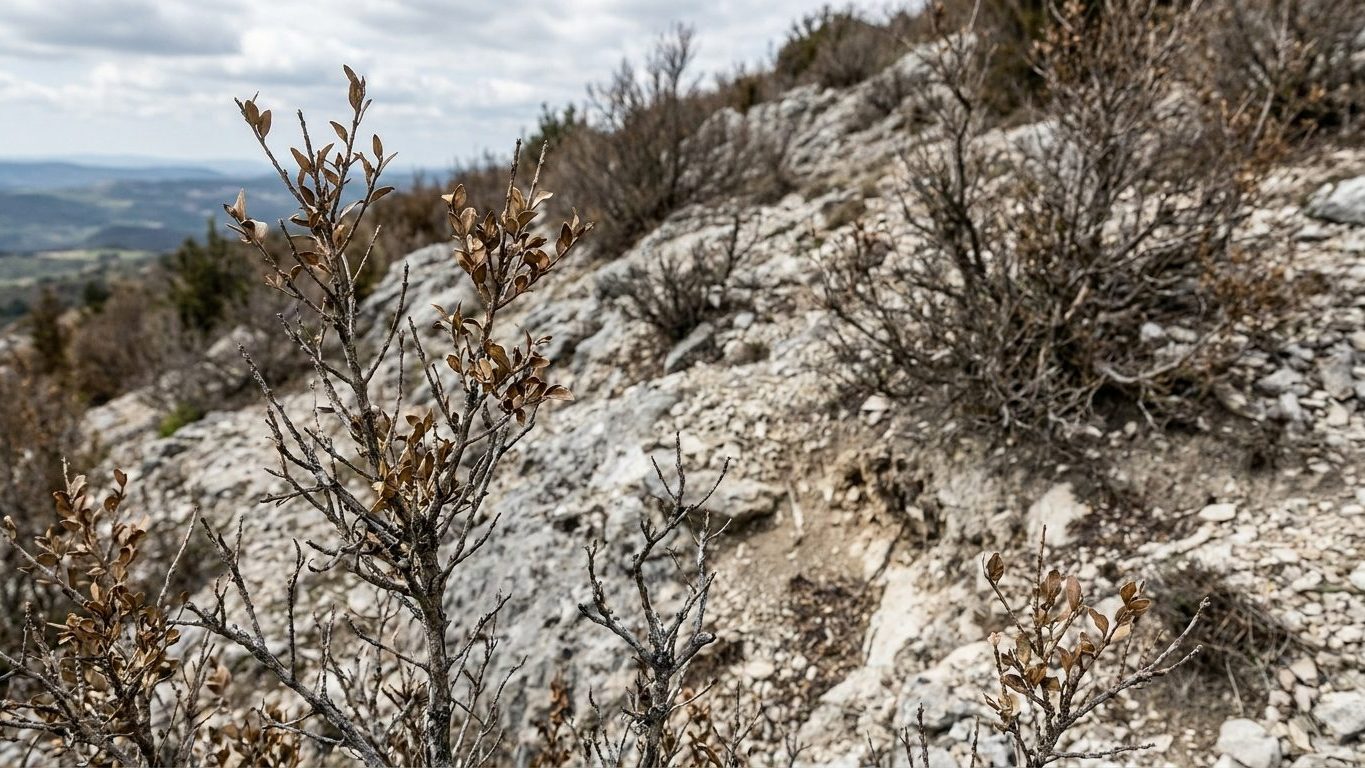
On some calcareous slopes in the southeast of France, boxwood has disappeared in just a few years. It wasn’t a fungus, nor the drought, that felled this shrub capable of living for centuries, but a nocturnal moth from the Far East. The box tree moth, named Cydalima perspectalis, is a species of moth native to the Far East, accidentally introduced in Europe in the 2000s via ornamental plants imported from Asia.
Its name: the box tree moth.
As international trade in ornamental boxwood shaped into topiaries expanded in the 2000s, European nurserymen and garden centers literally brought in the insect that would devour it, along with their flagship merchandise. This moth is believed to have been introduced via the ornamental plant trade between European countries and China, while intra-European trade facilitated its dispersion. The moth was introduced in France in 2008 through the ornamental box trade, just a few months after its first observations in Germany.
- The box tree moth, a moth from the Far East, was introduced to France in 2008 via the ornamental plant trade
- The caterpillars defoliate boxwoods completely across several generations per year, gradually exhausting the ancient trees
- The lack of vegetation cover triggers severe water erosion on calcareous slopes, permanently changing the composition of the undergrowth
A traveling pest, hidden within the boxwoods themselves
The life cycle of the box tree moth is particularly dynamic: females can lay up to 1200 eggs, and three generations can occur within a year. The pest overwinters in the larval stage, and despite periods of intense cold, the caterpillars resume activity by mid-March. Genetic analyses conducted on populations from China, Korea, and sixteen invaded European countries suggest multiple distinct introductions, rather than a single wave of contamination—an scenario coherent with the growth of ornamental plant exchanges across the continent.
The invader initially affected boxwoods in parks and gardens, before spreading to natural environments. In Auvergne-Rhône-Alpes, the box tree moth was detected in parks and gardens in 2011; it was only from 2015 that the first damages to natural habitats were recorded in Isère.
Today, the moth is present in 70 French departments.
Des versants entiers qui changent de physionomie
The boxwood thrives mainly in calcareous regions, in well-exposed understories or dense thickets on ledges and steep slopes, sometimes in almost pure stands that are centuries old. On a slope in the Corbières, a boxwood nearly two centuries old, perched on a cliff edge, was nearly driven to death after only two years of pyrale attacks.
The caterpillars do not merely devour leaves. They also attack bark and buds of the fine branching, reaching branches and stems, which leads to pronounced dieback. After an initial attack, boxwoods often survive, but their response via shoots and vigorous growth remains relatively weak, with reduced foliage mass that pyrale populations end up consuming again. Repeated defoliation followed by re-growth gradually exhausts the shrub’s reserves.
Yet bare calcareous soil on a steep slope is precisely the most exposed terrain there is. Water erosion phenomena in soils are particularly severe during heavy rains, on unstable soils, on steep slopes, or in the absence of protective vegetation cover. Where boxwood once formed a permanent woody mat on the ledges, other pioneer plants gradually colonize the gaps, permanently altering the composition of calcareous undergrowth.
Pourquoi personne ne pulvérise les forêts entières
Treating thousands of hectares of boxwood stands chemically in natural environments has never been a serious option. Such spraying would indiscriminately affect pollinating insects, garden helpers, and a fauna far broader than the single caterpillar targeted. A chemical insecticide would not be more effective, and its impact on the environment would be catastrophic, harming blue tits, sparrows, and other caterpillars and butterflies.
The blue tits, for their part, sometimes feast on them.
In gardens, the preferred defense remains a bacterium naturally present in the soil, selective for caterpillars but needing to be applied several times to hope for lasting results. It is, however, not selective for all Lepidoptera, which means one should refrain from treating flowering plants near pollinators. In forests, managers have instead focused on monitoring: a network of sampling plots tracks, block by block, the resilience of boxwood stands rather than attempting to eradicate a pest now established across the landscape.
Some boxwoods once deemed doomed do reemerge years later, from the bases of their trunks scorched by successive attacks.
Sources: researchgate.net | biodiv.parc-oise-paysdefrance.fr
