
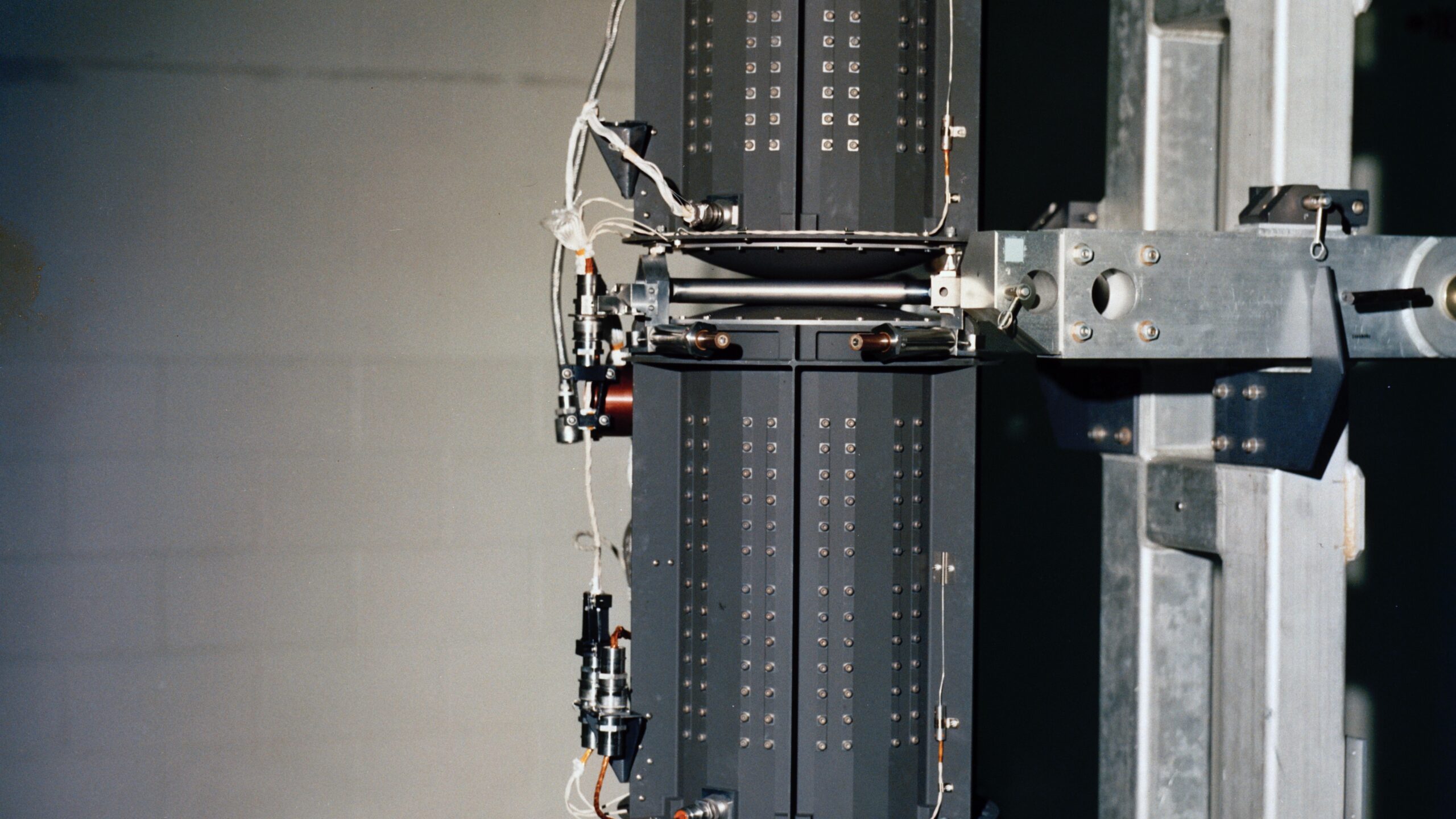
The principle can be summed up in one sentence: instead of capturing sunlight from the Sun, these probes convert the heat produced by the natural decay of a radioactive isotope, plutonium-238, into electricity. It is this mechanism, known as a radioisotope thermoelectric generator, that has allowed the two Voyager spacecraft, launched in 1977, to continue sending data from the far reaches of the solar system. And it is precisely this fuel that today poses an unprecedented problem: only about 1.5 kilograms are produced each year on Earth, and NASA must rely on that to power all its missions beyond Jupiter.
- Radioisotope thermoelectric generators convert the heat from the decay of plutonium-238 into electricity, with no moving parts and no solar input.
- The Sun’s light intensity falls with the square of the distance, making solar panels unviable beyond Saturn.
- Global production of plutonium-238 has hovered around 1.5 kilograms per year since 2015, limiting NASA to roughly one new mission every four years.
A Nuclear Battery With No Moving Parts
A radioisotope thermoelectric generator resembles nothing most people imagine about a nuclear plant. With no moving parts likely to fail or wear out, these generators rely on thermocouples: two different metals linked in a closed circuit, where the junction, at different temperatures, produces an electric current. No turbine, no chain reaction, just the heat from a radioactive chunk slowly cooling down.
Since 1961, these plutonium-238 generators have powered Pioneer 10 and 11, Voyager 1 and 2, Galileo, Ulysses, Cassini, and New Horizons — all spacecraft that could not rely on solar panels for their distant missions. On Mars, the Curiosity and Perseverance rovers carry the same type of generator, in a more recent form called the MMRTG. The common thread among all these missions? An environment where the Sun simply no longer suffices.
Why Solar Power Fades After Jupiter
The brightness of the Sun decreases with distance squared. As a result, near Saturn, sunlight reaching the Solar System from the Sun is only about one percent of what it is on Earth, a level far too weak for solar panels to power a probe. Beyond that, toward Uranus, Neptune, or interstellar space that Voyager 1 reached in 2012, the situation worsens.
Solar energy remains adequate for missions inside the asteroid belt, but for the farthest destinations, toward the outer giant planets, resorting to a radioisotope thermoelectric generator becomes the most suitable solution. This physical constraint is one that no solar-panel technology can escape. It is what pushed American engineers, from the early days of the space age, to rely on radioactivity rather than on the artificial photosynthesis of solar cells.
A Stock That Almost Vanished
Production of plutonium-238 at the U.S. Savannah River site stopped in 1988, at the end of the Cold War, and other producing countries likewise ceased production. For more than two decades, NASA relied on its reserves, supplemented by purchases from Russia. But the last Russian shipment arrived in 2010, and stocks have dwindled ever since, worrying scientists and space-exploration advocates alike.
Restarting production was not as simple as flipping a switch: after the Cold War-era facilities closed, new methods had to be developed and validated in the laboratories of the U.S. Department of Energy. The first tangible result came in December 2015, when Oak Ridge National Laboratory announced it had produced 50 grams of plutonium-238, a quantity almost trivial in the face of a space mission. Fifty grams. For an entire space industry.
The ramp-up remains slow. The Department of Energy targets an average production of 1.5 kilograms per year of plutonium oxide destined for generators, a goal set for 2026. In early 2026, the agency, however, announced a notable breakthrough: the largest delivery of fresh plutonium since production restart, an order of magnitude larger than previous shipments. A sign that the industrial supply chain, long stalled, is slowly getting back on its feet.
What the Shortage Means for Future Missions
Manufacturing plutonium-238 is not improvised. Exposing neptunium-237 to neutrons in a reactor is required, where the nucleus captures a neutron and becomes neptunium-238, followed by chemical transformation into plutonium. No mine can supply this material: it must be produced, separated, turned into a ceramic form, and then sealed into modules through a chain of specialized laboratories.
This scarcity already forces NASA to make choices. The old stock, over twenty years old and significantly degraded, must be blended with newly produced plutonium in a two-to-one ratio to stretch the available reserve. Without this blend, the amount usable to equip a new probe would diminish even faster.
At the current production pace, NASA can only consider a mission equipped with an MMRTG roughly every four years. It is this constrained timetable that now shapes the selection of future destinations. The Dragonfly mission, which will send a rotor-wing drone to explore Titan, Saturn’s giant moon, will be powered by a multi-mission thermoelectric generator and stands among the next beneficiaries of this restarted production. Every gram produced today already conditions the explorations of the coming decade.
Voyager probes, for their part, continue to advance. Initially planned for five years of operation, they have lasted far beyond all initial projections, even though the plutonium aboard has decayed enough for NASA engineers to gradually switch off some scientific instruments one by one. A slow fading, measured in watts lost each year, serves as a reminder that no generator, no matter how sturdy, escapes the half-life of its fuel.
Sources: spacedaily.com | generation-nt.com
