
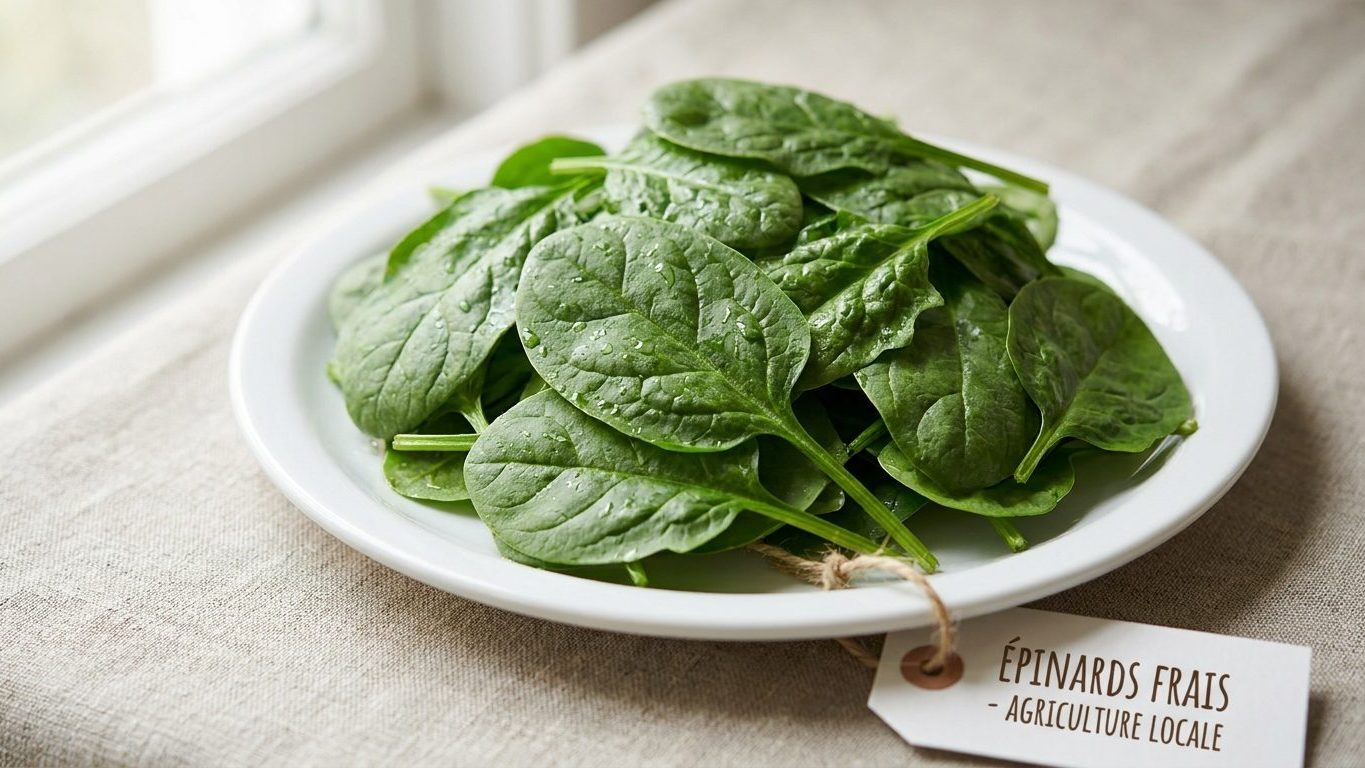
Spinach has carried for more than a century a reputation as a champion in every category of iron, popularized by a cartoon and hammered into school textbooks. This nutritional fame rests, however, on a transcription error: in the 19th century, a German chemist published tables listing the iron content of foods, but a simple misplaced decimal point multiplies the actual quantity by ten, turning 3.5 mg of iron per 100 g into 35 mg. The tale has traversed decades without correction, until it became an unquestioned fact that no one thought to verify.
The iron in spinach, for its part, has never been exceptional.
- A decimal point placed incorrectly in 19th-century German nutrition tables multiplied the iron content attributed to spinach by ten.
- The iron contained in spinach is absorbed by the body at only about 2%, compared with 15-35% for iron from meat.
- Spinach contains oxalates that slow iron absorption, contrary to the beliefs popularized by a cartoon.
How a comma created a myth
The tale begins in the 19th century, when a German chemist published tables that listed the iron content of foods. These tables became a reference for scientists for decades, copied from one work to another with little verification. The erroneous figure settled in the specialized literature as an accepted datum.
According to versions of the story, the transcription would have shifted 2.7 milligrams of iron per 100 grams of spinach to 27 milligrams, a tenfold increase. Other versions speak instead of a jump from 3.5 mg to 35 mg, but the gap claimed remains always the same tenfold factor.
It would take until the late 1930s for other German scientists to realize the mistake and correct it. This rectification, published in specialized journals, never truly crossed the wall that separates research from the general public. The erroneous figure continued to circulate in cookbooks, magazines, and family conversations. The legend, meanwhile, had already taken root elsewhere.
The myth gained a new dimension with the appearance, in the 1930s, of a comic strip sailor who draws his superhuman strength from a can of spinach. The character, a cult figure in the United States, pushed generations of children to finish their green vegetables in the name of iron. Spinach consumption rose by about 33% in the United States during the 1930s, a direct consequence of this popularity. The myth, now carried by a cartoon, became a durable fixture in popular culture.
A story that was itself manipulated
Historians of science have studied this anecdote about the misplaced comma, tracing its traces in original archives. Their thorough investigations into the scientific documentation of the era never managed to locate an error as simple as a decimal separator misplaced in 19th-century German publications. Discrepancies between early measurements and reality seemed instead to originate from imperfect laboratory methods, notably contamination of spinach samples by the containers and the charcoal used for analysis.
The ‘comma’ myth, therefore, would itself be a legend.
What spinach really contains, and why the body benefits little from it
Current analyses place the iron content of raw spinach at about 2.7 mg per 100 g, a level comparable to parsley or Swiss chard. Nothing in this justifies the nickname of a ferrous superfood that the legend long afforded it. Other plant sources, such as pumpkin seeds or lentils, show higher contents without sharing the same historical reputation.
The iron in spinach belongs to the category known as non-heme iron, the type found in plants. Its bioavailability tops out at 2-15% depending on cofactors and inhibitors present in the meal, far from the 15-25% bioavailability of heme iron, found only in meat, offal, and fish.
A single figure suffices to measure the gap between the two worlds: barely 2% of the iron contained in spinach is actually absorbed by the body, compared with 15-35% for iron from meat.
Spinach also contains oxalates, compounds that attach to iron or trap it, thereby slowing its absorption. Cooking, by reducing soluble oxalates, slightly mitigates this phenomenon without eliminating it. Vitamin C, on the other hand, acts in the opposite direction: it converts iron into a soluble form, increasing its absorption. This biochemical mechanism explains why the same vegetable can yield very different results depending on what accompanies it on the plate.
The iron myth does not, however, condemn spinach to the back of the pantry. It provides fiber, vitamins A and K, as well as antioxidants beneficial for cardiovascular and ocular health, qualities that have nothing to do with the misplaced decimal point from a 19th-century German laboratory.
Sources: sciencefourchette.com | shows.acast.com
