
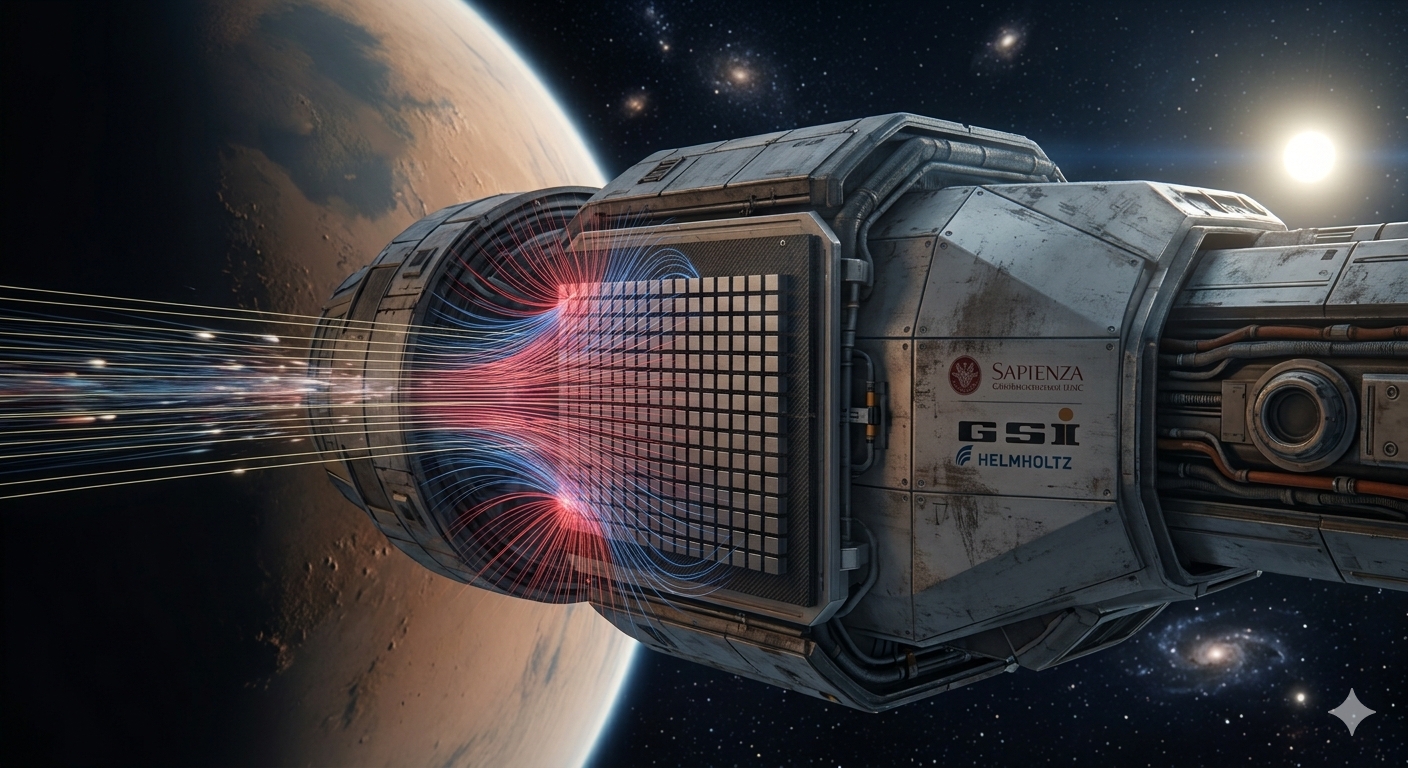
German and Italian researchers have recently unveiled an innovative concept in the form of a compact wall that integrates around 1,500 neodymium magnets. The goal is to equip future spacecraft with this shield to limit astronauts’ exposure to solar radiation. While the technology shows promise, it remains far from real-world deployment.
1,482 Small NdFeB Cubic Magnets
Every space journey comes with risks, and although the list is long, we will focus here on solar radiation. As a reminder, once a spacecraft steps outside the Earth’s magnetic field, the crew is suddenly far more exposed to the charged particles emitted by the Sun. The dangers are multiple, especially with prolonged exposure. Primarily, astronauts face an increased risk of cancer, heart problems, and brain disorders.
In May 2026, researchers from Sapienza University of Rome (Italy) and the GSI Helmholtz Centre (Germany) published a study in the journal Aerospace, describing an innovation that could potentially
reduce astronauts’ exposure to solar radiation. The scientists report having developed a compact wall made up of 1,482 small permanent magnets made of neodymium-iron-boron (NdFeB), cubic magnets measuring about 3 cm on each side. Moreover, the ensemble forms a compact barrier roughly 1.17 m by 1.14 m (about 0.37 m²) with a total weight under 300 kilograms – nearly 200 kg of magnets alone.
“The main objective is to protect a spacecraft from the flux of charged particles emitted by the Sun. To this end, we combine theoretical modeling and numerical simulations, followed by the construction of a prototype for laboratory testing and, potentially, for future experimental validation at the scale of a CubeSat.” reads the study.
A Passive Shield That Itself Produces a Magnetic Field
According to the researchers, this type of magnetic shield could repel about 20% of solar protons while operating without electricity. The device is therefore passive. Typically, active magnetic shields require massive superconducting coils that consume a lot of power and sophisticated cooling systems. However, the scientists’ wall is capable of generating a permanent magnetic field without drawing any energy from the spacecraft.
It should be noted, however, that the shield primarily repels the less energetic solar protons (low-energy). Indeed, solar protons moving very quickly could traverse the magnetic barrier. Moreover, galactic cosmic rays, much more energetic and able to arrive from all directions, will continue to impact spacecraft or space stations.
Further Work to Come
For now, the innovation has only progressed to the feasibility study stage. While nothing is certain, this promising technology could in the future
be integrated into an hybrid defense system, combining this passive magnetic approach with traditional physical protections (water, aluminum, polyethylene). For scientists, one of the logical next steps will be to assess the competitiveness of the new shield against conventional passive-absorbing armor.
Nevertheless, the researchers mainly hope to conduct validation at CubeSat scale. Concretely, this will involve deploying a miniature model of the magnet wall on a small satellite fitted with particle-flux sensors. This will allow a direct comparison of the radiation measured behind the mini-magnetic shield with that encountered in open space. The researchers want to determine whether the NdFeB magnets retain their full magnetic strength over the long term.
