
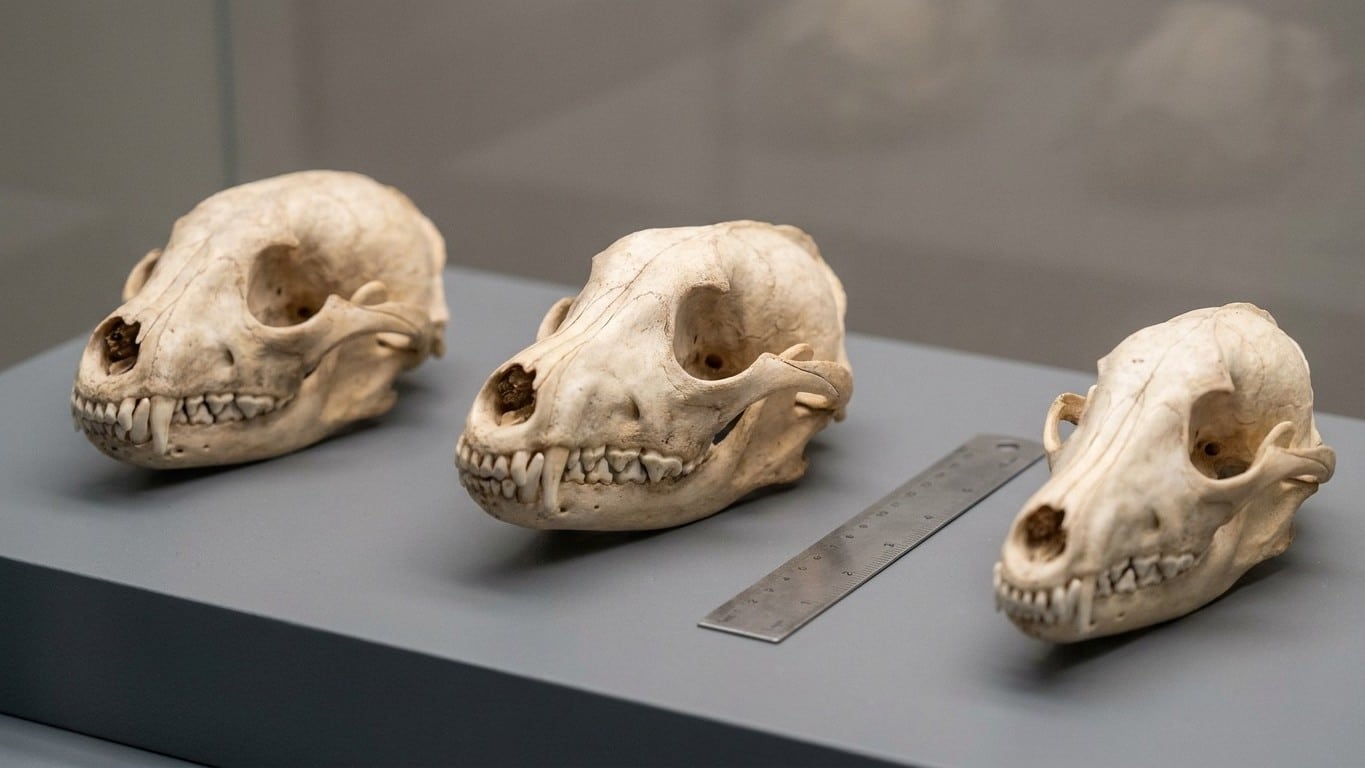
Eleven thousand years. That is the age of the oldest dog skulls already displaying short snouts and broad faces, long before Victorian dog shows invented modern breeds. A study published in the journal Science has just upended the history of man’s best friend: the diversity of skull shapes does not date from the 19th century; it goes back to the end of the last glaciation.
Key takeaways
- Dog skulls dating back 11,000 years already displayed short, broad shapes, challenging the idea that this diversity arose from Victorian dog shows
- 3D analysis of 643 skulls reveals a burst of forms and sizes in the Mesolithic and Neolithic, reaching 53% of the diversity seen in modern dogs
- The earliest phases of domestication remain mysterious: no proto-dog could be identified with certainty before this morphological shift
What 643 3D-analyzed skulls reveal
An international team led by Allowen Evin, a bioarchaeologist affiliated with the Institute of Evolutionary Sciences in Montpellier (CNRS, IRD, University of Montpellier), subjected 643 canid skulls dating from the last 50,000 years to 3D analysis, coming from North America, Europe and Asia. Specifically, the researchers based their work on three‑dimensional analyses of skull models from 158 modern dogs, 86 modern wolves, 281 ancient dogs and 118 ancient wolves.
The technique used, geometric morphometrics, enables fine-grained comparisons of shapes without being limited to traditional measurements. This method allowed for a precise distinction between prehistoric wolves and dogs, not constrained by the features of modern breeds. The result? A morphologic signature of the domestic dog that could be detected well before the invention of breed standards.
The researchers identified “recognizable domestic canine morphologies” as early as around 11,000 years ago, in the form of three skulls found at an archaeological site in the Russian village of Veretye. This morphological shift is expressed by a precise physical change: during domestication, dog skulls became proportionally shorter and wider than those of wolves, according to Carly Ameen, a bioarchaeologist at the University of Exeter and co‑lead author of the study.
An explosion of forms as early as the Mesolithic
The most striking aspect is not merely the appearance of a distinctive canine silhouette. It is the speed with which the variety settled in. Around the same period, dogs associated with the last hunter‑gatherers and the first farming communities showed an “explosion” of skull shapes and sizes, representing more than half of the diversity observed in today’s breeds.
Concretely, even without counting the extreme examples like bulldogs or greyhounds, these ancient dogs already exhibited half of the diversity of modern dogs, a figure that is striking when one recalls that these populations still relied on hunting and gathering.
The raw numbers of the study confirm this early acceleration. The diversity observed in the Mesolithic and Neolithic doubled to 53% compared with Paleolithic specimens, and accounted for half, 52%, of the diversity present in modern dogs. Half the journey toward today’s breed diversity had been completed within a few millennia, long before writing, widespread agriculture, or, obviously, the first British dog clubs.
This finding challenges a well-entrenched assumption. As Allowen Evin herself summarizes: “Traditionally, people believed that major morphological diversification, especially extreme differences in size and shape, occurred only in the last centuries, following the rise of formal dog breeds in the 18th and 19th centuries.”
The enduring mystery of the very first dogs
There remains a large gap, and it is significant. Before this shift 11,000 years ago, there was no trace of a recognizable dog. None of the late-Pleistocene specimens, some of which had been proposed as “proto-dogs,” showed a cranial shape compatible with domestication, suggesting that the very earliest stages of the process remain difficult to recover in the archaeological record. The examined skeletons, some dating back 50,000 years, all resembled wolves, without exception.
Paleogeneticist Greger Larson of the University of Oxford and the study’s principal author sums up the situation with candid clarity: “The earliest phases of dog domestication remain hidden, and the first dogs continue to elude us. But what we can now show with certainty is that once they appeared, dogs diversified rapidly. Their early variation reflects both natural ecological pressures and the profound impact of living alongside humans.”
This dual origin, ecological and cultural, changes how we tell the dog’s story. One might have imagined a straight line: a tamed wolf, then centuries of morphological stability, then the sudden surge of breed standards in the 18th and 19th centuries that would artificially sculpt all the diversity we know. The reality looks more like two waves of transformation separated by millennia, the first driven by life alongside mobile human groups, the second by a much later and much faster aesthetic selection.
There is also a nuance not to lose sight of: even though half of today’s diversity existed thousands of years ago, the most extreme forms—the bulldog’s completely flattened snout or the Afghan hound’s exceedingly slender muzzle—emerged only with intensive selection in the last two centuries. Mesolithic hunter‑gatherers were already breeding dogs with varied silhouettes, but none would have resembled a pug.
Sources: researchgate.net | futura-sciences.com
