
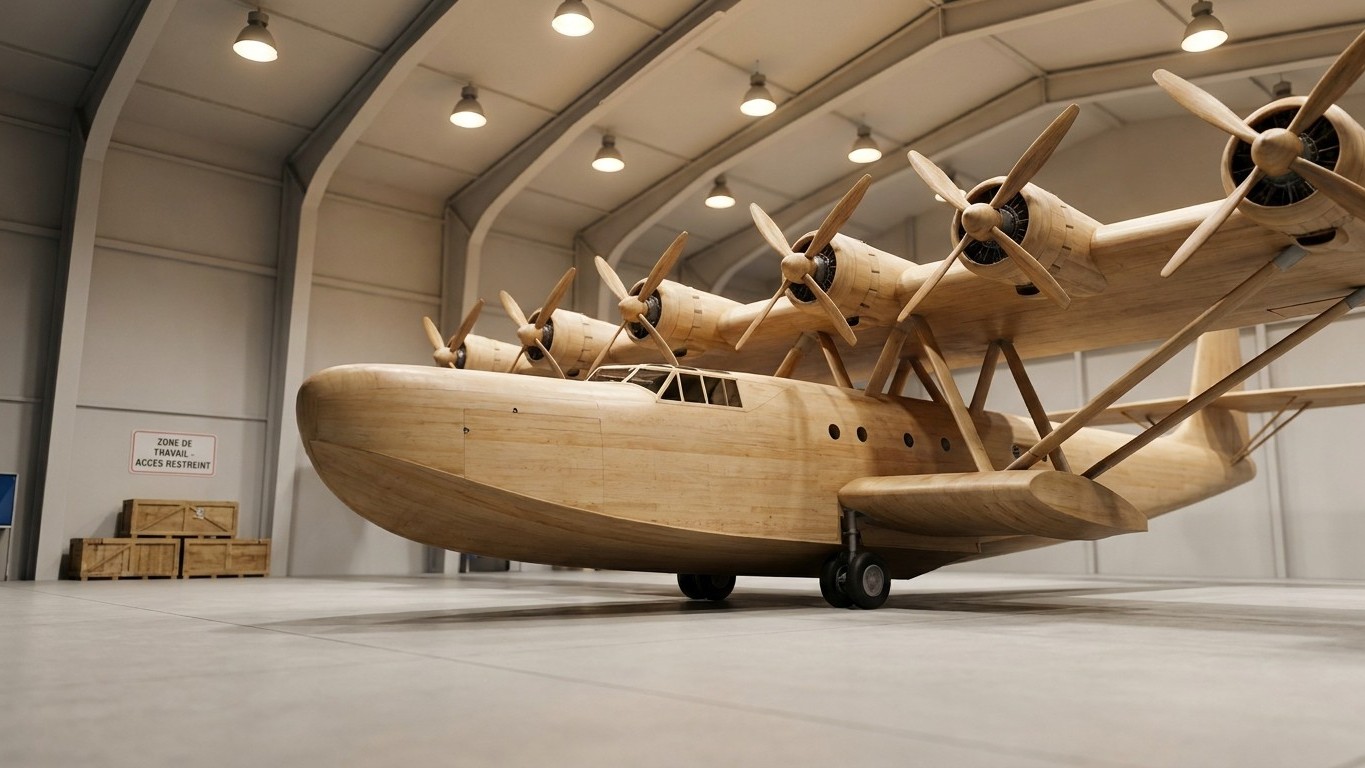
On November 2, 1947, a wooden flying boat rose just tens of meters above the Port of Los Angeles, skimmed a few hundred meters, and then touched down. It was the Hughes Aircraft Company’s H-4 Hercules, executing its first and only flight over the port of Los Angeles. The aircraft had been conceived to cross the Atlantic and save lives during World War II. It would take the war’s end for it to lift off, a single flight on a trajectory so short that it almost reads as a curiosity next to the project’s initial ambitions.
Key takeaways
- A giant flying boat built to save Allied shipping, but only ready after the threat it was meant to counter had disappeared
- Howard Hughes himself at the controls for a flight of less than a mile, enough to prove the impossible but useless for the war
- Thirty years of quiet maintenance in a hangar before a legal battle among heirs, the government, and museums
An aircraft designed to outrun German U-boats
Everything begins in the urgency of 1942. The American War Department faced the need to transport equipment and personnel to Great Britain, while Allied shipping across the Atlantic was suffering heavy losses at the hands of German submarines, creating the demand for an aircraft capable of crossing the ocean with a substantial payload. The idea: build an airframe so massive that it could ferry troops and equipment without relying on convoys, prime targets of the U-boats.
Metal was scarce, requisitioned for the war effort. The aircraft was therefore built from wood due to wartime restrictions on the use of aluminum, which earned it the nickname “Spruce Goose,” though it was made almost entirely from birch rather than spruce. A material misnomer that stuck in history, as such epithets often do, better suited to marketing than to technical truth. The ambition, however, did not lack scale: the aircraft was designed to carry up to 750 fully equipped soldiers on transoceanic flights. Enough to empty an entire village’s stadium with each crossing.
A flight of too little, two years too late
The problem lay in the schedule. The war ended in 1945. The Hercules, however, was not ready until 1947, two years after the threat it was meant to bypass had vanished. In the meantime, the project became a hot political issue: Howard Hughes was summoned before a Senate committee to account for the public funds sunk into its construction. In this climate of suspicion, under the scrutiny of the press, the industrialist decided to silence his critics.
On November 2, 1947, with Hughes at the helm, the craft conducted taxi tests in the Port of Long Beach and, after two passes, finally decided to take off to prove that the aircraft could depart. He steered the Hercules westward, accelerated, and lifted the aircraft to about 21 meters (roughly 70 feet) above the water. The flight covered a little under a mile: this brief ascent would be the H-4’s first and last. The press quickly dubbed it the “Spruce Goose” due to its wooden construction, sturdy yet light. The technical feat was real: it did fly. But it flew for nothing—the mission that justified its existence had ceased to exist twenty-four months earlier.
Three decades of silence in an air-conditioned hangar
What follows is almost absurd. From 1947 until his death in 1976, Hughes kept the aircraft in an air-conditioned hangar at Long Beach harbor, at his own expense, even though the craft officially belonged to the American government. A team remained permanently on standby to keep the systems in working order, with no takeoffs ever scheduled. The plane built to gain time against the U-boats would spend nearly thirty years motionless, treated as if it might take to the air again the next day.
After Hughes’s death, ownership became a bureaucratic dispute. Five years of negotiations among Hughes’s company, his heirs, the federal government, the National Air and Space Museum, and preservation groups culminated in the aircraft remaining intact and fully owned by the Aero Club of Southern California in 1980. At one point the object threatened to be cut up and split among several museums, before escaping that fate. It is now on display, complete, at the Evergreen Aviation Museum in McMinnville, Oregon.
From this history emerges a paradox that is almost delicious for American aviation: the largest wingspan ever achieved by a plane of its era served solely to prove, once and for all and over a trivial distance, that a war-era dream could technically take off after the war itself had ended. The Hercules holds an engineering record without ever fulfilling its original mission. It is not a failure in the strict sense, nor a complete success: it is an achievement that arrived late, and that will remain so forever.
Sources: media24.fr | mermoz-academy.com
