
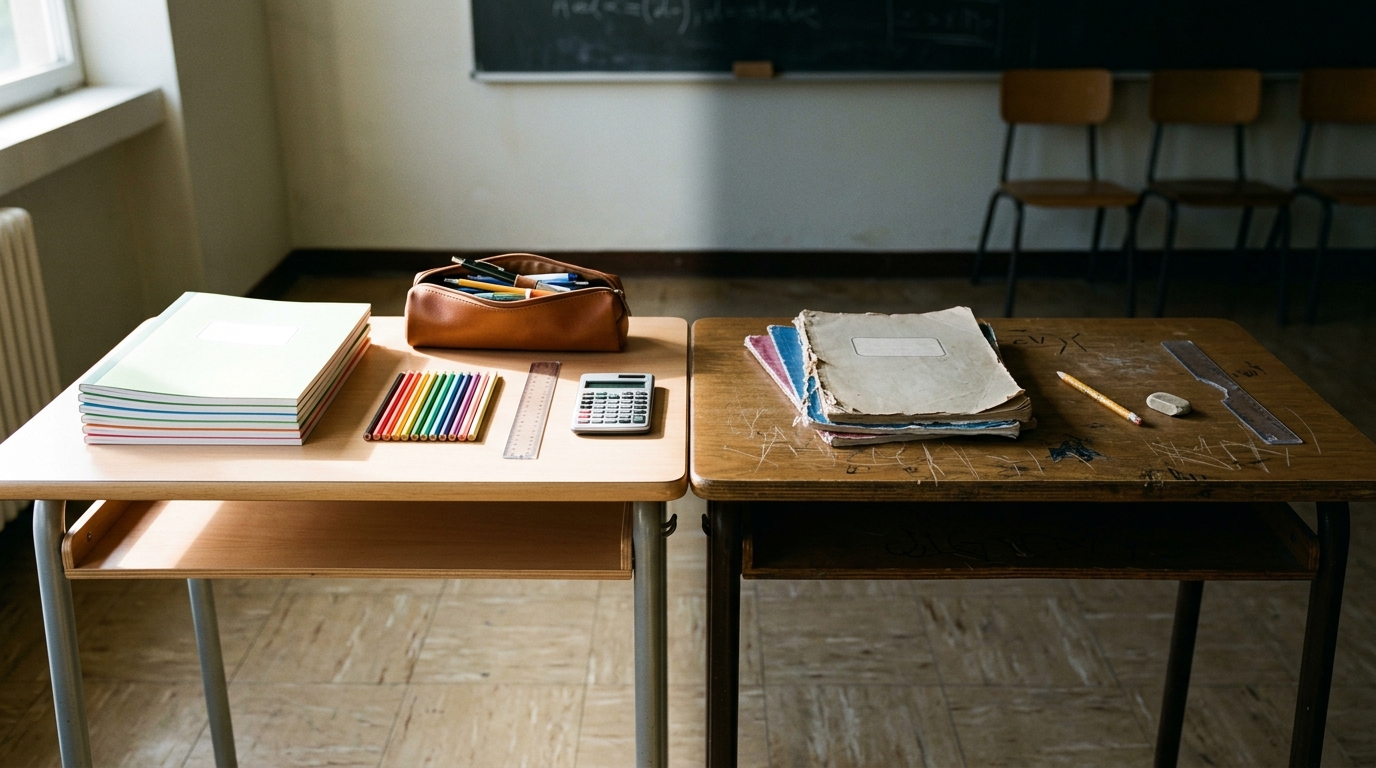
Equality and equity: two terms that are often mistaken for one another, and yet their difference alone accounts for fifty years of educational disillusionment. Equality means giving everyone the same thing. Equity means providing each person with what they need to succeed. As the new school year brings millions of middle school students back to class, this distinction takes on full significance. For in 1975, France chose pure equality by abolishing the separate tracks of middle school to create a common core designed to erase social origins. A half-century later, the assessment raises questions, even anxiety, as the numbers reveal a paradox that no one anticipated at the time.
A Republican Ideal Born in 1975, a Promise of Equality for All
To grasp the ambition of the single middle school, one must situate it in its historical moment. Before this reform, children were steered very early, often as early as primary school, toward distinct tracks that already hinted at their eventual professional paths. Children of workers more often found themselves in technical or shorter routes, while those from more privileged backgrounds were more naturally steered toward general tracks leading to the baccalaureate and then to university.
The 1975 reform sweeps away this two-speed system. The stated objective is simple: to offer all students, regardless of social origin, the same educational pathway through to the end of middle school. This imposed mix was meant, in the minds of its designers, to gradually erase the gaps between children born with a silver spoon in their mouth and those whose parents struggled to make ends meet. A generous, almost utopian gamble, which would nevertheless confront a reality far more complex than anticipated.
PISA 2022: The OECD’s Unequivocal Verdict on France
International large-scale assessments of educational attainment often provide a harsh mirror for schooling systems. And the mirror held up to France in recent years is not flattering. According to the latest results from the OECD’s PISA survey, France earns an unfortunate distinction: the country where social background has the strongest influence on academic performance among all OECD members.
Concretely, this means that a child born into an economically and culturally advantaged household in France has a greater chance of academic success than a child from a modest background, and this gap appears larger than in any other OECD country. The paradox is striking: the country that invented the single middle school to fight social determinism now tops the inverse ranking. The promise of equality has, on the page of international statistics, become a finding of reinforced inequality.
Social Origin, Academic Destiny: How the System Reproduces Inequality
What explains such a gap between the initial intention and the observed outcome? Several mechanisms combine to produce this perverse effect. First, the single middle school has never truly erased the differences in cultural capital among families. A child whose parents own a well-stocked library, master the school codes, and can help with homework carries a substantial advantage, even if they attend exactly the same school as a less favored peer.
Next, geographic segregation has partly bypassed the system’s theoretical uniformity. Wealthier families choose where to live based on the reputation of nearby schools, and the use of exemptions or private schooling allows some to escape the social mix that the single middle school was supposed to impose. The result: some institutions end up with concentrated social difficulties, while others gather a more homogeneous and advantaged population. The core curriculum exists on paper, but in practice, the school map recreates invisible tracks.
Finally, private tutoring, after-school courses, and enriching extracurricular activities create an additional gap that schooling alone cannot compensate for. These resources, expensive, are accessible only to part of the population, thereby mechanically reinforcing the differences in outcomes between students from different backgrounds.
Fifty Years On, What Future for France’s School-Based Social Mobility?
Faced with this reality, the central question today is no longer whether the single middle school failed in its initial mission, but how to rethink a system capable of truly offsetting starting inequalities. Several avenues regularly emerge in education debates, though none has yet achieved consensus. Some advocate a substantial boost of resources for schools located in disadvantaged areas, with smaller class sizes and more intensive personalized support.
Others argue that real social mixing, not just theoretical, should be enforced more firmly, by limiting exemptions from the school map or by tighter control over admission criteria in certain private under-contract establishments. The underlying idea is simple: without daily interaction among students from all horizons, equal opportunities remain a slogan without real translation in the corridors of middle schools.
There is also a deeper reflection on teacher training, often leaving educators overwhelmed when faced with heterogeneous classes where needs vary greatly from one student to another. Providing teachers with pedagogical tools to differentiate instruction without recreating disguised tracks represents a major educational challenge, likely to occupy policymakers for many years to come.
Fifty years after its creation, the single middle school remains at a crossroads. The original ambition, noble as it was, has not alone sufficed to break the social determinism weighing on French educational trajectories. It is not the idea of a common school that is at fault, but the conditions of its implementation, which have too often remained theoretical in the face of persistent social and geographic realities. As students head back to school this year, the question remains open: will France one day turn this promise of equality into genuine equity of opportunity, or will it continue to occupy this not-so-glorious place in international rankings?
