
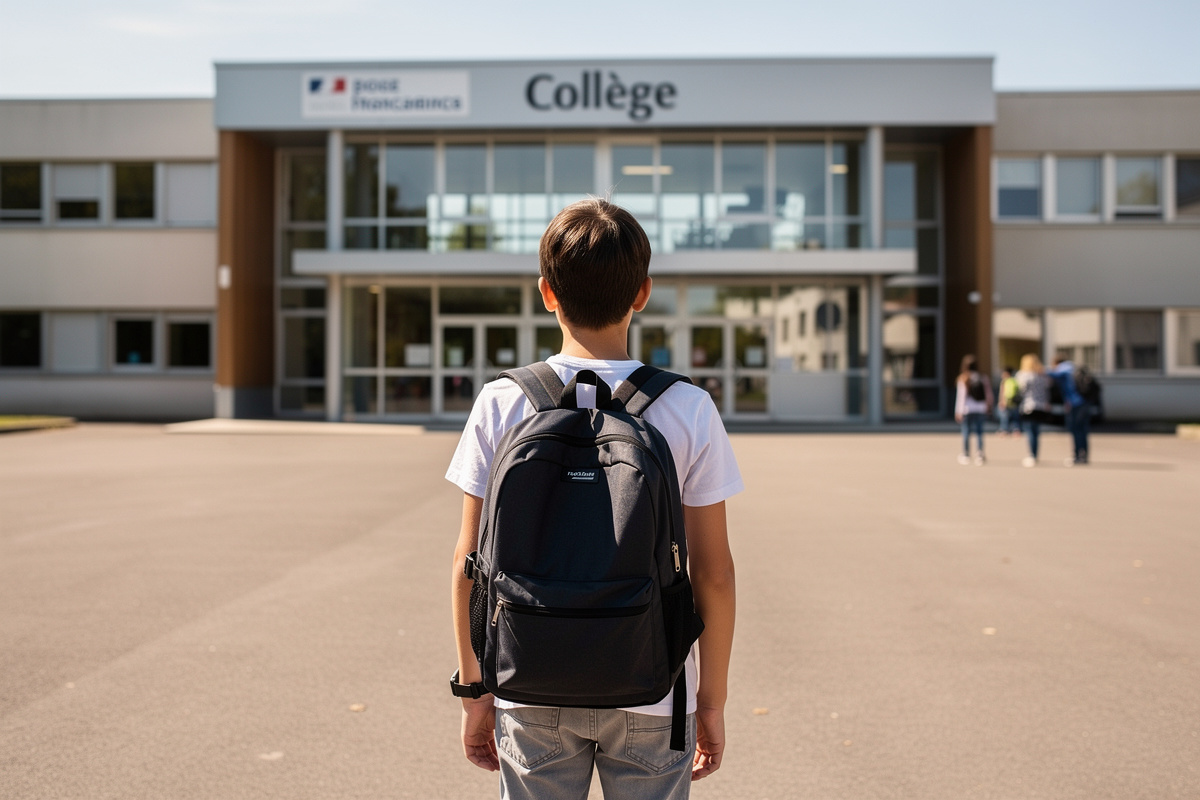
Each new school year, the same scene unfolds in front of pharmacies and sporting goods stores: parents weighing backpacks on a kitchen scale, stopwatch in hand, convinced that below a certain threshold their child will be spared from back pain. This ritual, nearly a September tradition, rests on a cliché that is starting to wobble seriously. For while the weight of the bag has long served as an easy scapegoat, the reality of back trouble among middle school students is much more nuanced, and above all, far more instructive than a simple story about kilos.
- The duration of backpack wear influences back pain more than its actual weight
- The 10% rule of a child’s weight overlooks distribution and duration of wear
- Poorly adjusted straps fatigue the back more than a heavy backpack worn correctly
- Back pain has never been a question of kilos on the back
- The 10% rule: a French standard born from a faulty calculation
- Carrying for a long time hurts more than carrying a lot
- Poorly tightened straps: the real culprit overlooked by parents
- What posture reveals even before opening the backpack
- Rethinking the backpack: what to remember to protect middle schoolers’ backs
Back Pain Has Never Been a Question of Kilos on the Back
For decades, the logic seemed airtight: the heavier a backpack, the more it harms the spine of a growing child. This simple, intuitive equation shaped generations of parental and school recommendations. Yet, by looking closely at the pains reported by middle schoolers, a surprising finding emerges: two students carrying exactly the same weight can experience radically different sensations, one suffering daily, the other hardly feeling a thing.
This paradox has pushed researchers to rethink the problem entirely. The weight alone explains only a tiny portion of the clinical picture. Other parameters, long neglected, come into play in a far more decisive way, and that is precisely what makes this question so engaging to dissect.
The 10% Rule: a French Standard Born from a Faulty Calculation
In France, a norm has taken hold in the collective imagination: a backpack should never exceed 10% of the child’s body weight. So a middle schooler weighing 40 kilograms should not carry more than 4 kilograms on the back. This rule, easy to remember and straightforward to apply, has been widely disseminated in guidelines for families and schools.
The problem is that this threshold rests on a purely arithmetic approach, which completely ignores how the weight is distributed and the duration it is worn. A 5-kilogram backpack carried for ten minutes between two classrooms has nothing in common with the same bag dragged for an hour on public transport. The 10% rule has the merit of providing a reference point, but it obscures factors that are far more decisive in the onset of pain.
Carrying for a Long Time Hurts More than Carrying Heavy
This is where the real revelation of the story comes into play: the duration of wearing weighs far more heavily in the balance than the weight itself. A moderately loaded bag carried for long minutes along a sidewalk or aboard a crowded bus continually taxes the back and shoulder muscles, which never get a chance to relax. In contrast, a heavier backpack carried briefly, from locker to classroom, gives the body time to recover.
This temporal dimension completely changes how we approach the problem. It explains why some students who live far from school, forced to walk long distances or to stand for long waits with their bag on their back, develop pains more often than pupils carrying heavier backpacks on shorter commutes.
Poorly Tightened Straps: the Real Culprit Overlooked by Parents
Another element too often relegated to the background: strap adjustment. A backpack, even lightweight, worn with straps too loose becomes a pendulum that sways with every step, forcing the back to compensate constantly to maintain balance. This repetitive movement, almost imperceptible on a daily basis, generates muscle fatigue that ends up manifesting as pain, sometimes localized in the lower back, sometimes spreading to the shoulders.
Conversely, straps that are properly adjusted, keeping the bag close to the body and centered high on the back, distribute the load far more evenly. This detail, often neglected when buying the backpack or during its use, turns out to be more decisive than the kilos displayed on the scale.
What Posture Reveals Even Before Opening the Backpack
Before even considering what’s inside the bag, the adolescent’s overall posture often offers valuable clues. Rapid growth, still relatively undeveloped muscles, or a habit of leaning forward to read a phone screen already weakens the spine before a backpack enters the equation.
The backpack then acts more as a revealer than a sole cause. It adds to a background that can already be fragile, and it is this combination of factors—far more than the weight carried—that explains why some middle schoolers suffer more than others under similar conditions.
Rethinking the Backpack: What to Remember to Protect the Backs of Middle Schoolers
Faced with this insight, the approach deserves rethinking. Rather than focusing solely on the scale, it becomes more sensible to consider how the backpack is carried on a daily basis. Reducing wearing time by organizing travel, adjusting the straps correctly to keep the bag pressed against the back, and favoring regular trips to the locker rather than carrying everything at once are levers far more effective than chasing after extra grams.
- Adjust the straps so the bag stays tight to the back
- Limit long trips with a full backpack
- Use the school locker to shorten back-and-forth trips
- Prefer a backpack over a bag slung over the shoulder
- Monitor overall posture, not just the bag’s contents
This school year could well mark a turning point in how this issue is addressed, moving away from an obsession with the number on the scale toward a more refined focus on carrying habits. After all, a middle schooler’s back tells not only a weight story, but a story of daily movements repeated day after day, sometimes for years. So, the next time you check your child’s backpack, perhaps it’s wiser to adjust the straps before pulling out the scale.
