
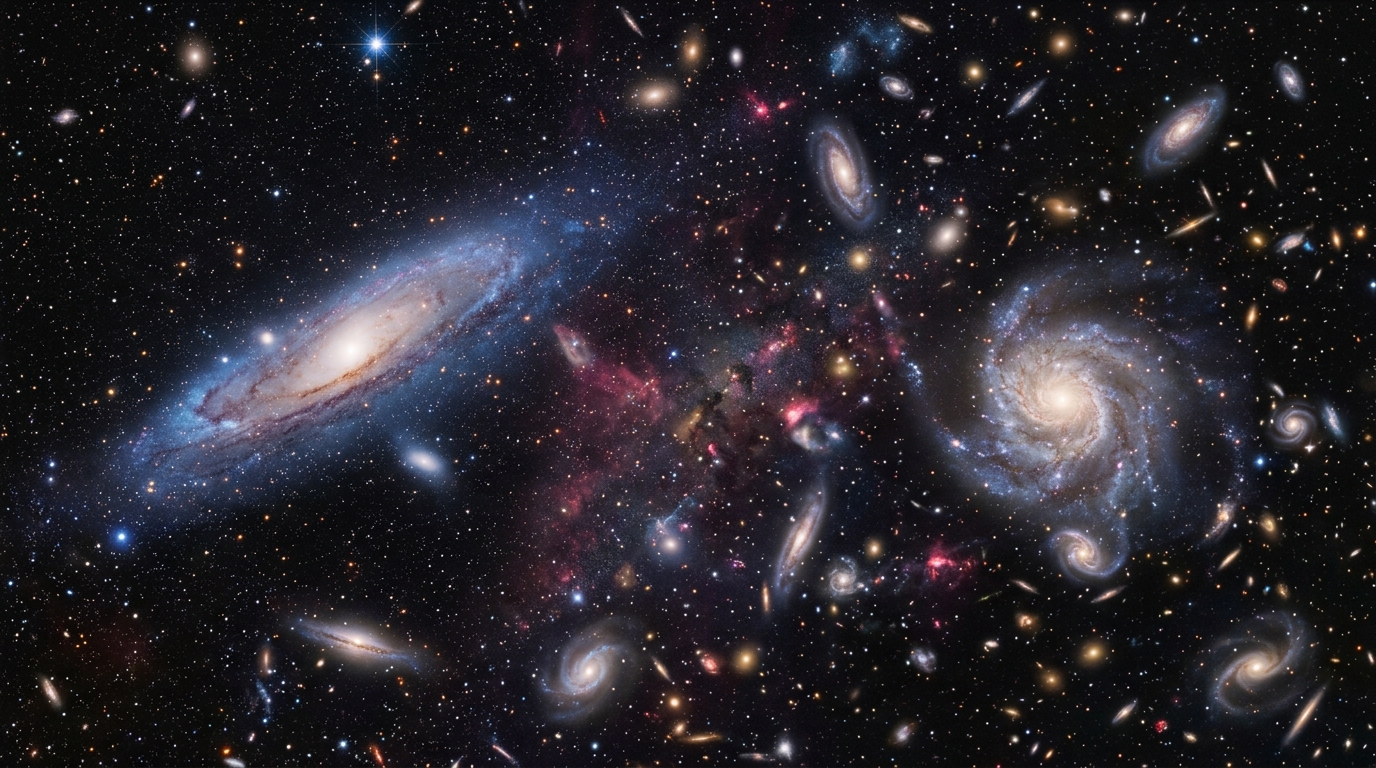
Pointing a telescope toward a distant galaxy is a bit like watching a beach through the keyhole: you can clearly make out the grains of sand, but sweeping the entire shoreline takes years. That is precisely the challenge that Hubble has faced for more than three decades. Its view, no matter how sharp, remains confined to a tiny slice of the sky, forcing it to carry out numerous observing campaigns over many years to sketch a somewhat complete map of the universe. In this early September moment, as space news accelerates, a new instrument is poised to disrupt this slow pace: the Roman Telescope, whose viewing capacity promises to be mind-boggling.
- The Roman telescope carries 18 infrared detectors arranged in a mosaic, delivering a total resolution of 300 megapixels.
- Its field of view is about 100 times larger than Hubble’s while keeping equivalent resolution, allowing it to photograph in one go what Hubble would take years to map.
- Roman does not replace Hubble but complements it, enabling large-scale surveys such as mapping dark matter or surveying exoplanets.
- Why Hubble could only see a postage-stamp slice of the sky at a time
- 18 detectors, 300 megapixels: the anatomy of an extraordinary infrared eye
- 100 times larger, yet just as precise: Roman’s technical gamble
- What this power of vision will change for astronomy
Why Hubble Could Only See a Postage-Stamp Slice of the Sky at a Time
To grasp the magnitude of Roman’s achievement, one must first understand the fundamental limit of its famous predecessor. Hubble was designed in the 1980s with a clear objective: deliver exceptional resolution on small patches of the sky. Consequently, its field of view resembles that of a highly zoomed photographic lens, capable of capturing incredibly fine details, yet unable to cover vast stretches of the cosmos in a single shot.
Specifically, to map a region of the sky spanning a few square degrees, Hubble must take numerous images, piece them together like a giant puzzle, and then patiently repeat this ant-like labor. This process, as meticulous as it is, requires a substantial amount of time, sometimes several years for a survey of significant scope. It is this technical constraint, inherited from optical choices of another era, that pushed engineers to imagine an instrument radically different.
18 Detectors, 300 Megapixels: The Anatomy of an Extraordinary Infrared Eye
The heart of Roman rests on an engineering feat that is simple to summarize, yet remarkably difficult to execute: instead of a single sensor, the instrument carries 18 infrared detectors assembled in a mosaic, delivering a total resolution reaching 300 megapixels. By way of comparison, a top-tier smartphone today rarely exceeds 200 megapixels, and that in far less demanding conditions than cosmic observation.
This grid-like architecture allows Roman to image much larger swaths of the sky without sacrificing a shred of detail. Each detector acts as a tile in an enormous digital fresco, and the whole system operates in perfect synchrony to produce a single, coherent image of exceptional accuracy. It is this combination of scale and quality that marks the instrument’s true revolution.
100 Times Larger, Yet Just as Precise: Roman’s Technical Gamble
Here is the revelation that changes the game: Roman’s field of view spans roughly 100 times that of Hubble, while maintaining an equivalent level of resolution. In other words, where Hubble could only capture a postage-stamp of the sky, Roman images an entire swath in a single exposure, without losing sharpness. This outcome isn’t a mere technological accident; it stems directly from the very design of its 18 infrared detectors, conceived from the outset to cover broad portions of the sky in one shot.
The technical challenge was formidable. Expanding the photographed area without degrading optical quality demanded extreme alignment precision among detectors, as well as a calibration system capable of correcting the minute distortions inevitable on such a large sensitive surface. The teams had to rethink almost wholesale how to assemble an observing instrument, opting for a modular architecture rather than a single oversized sensor.
What This Power of Vision Will Change in Astronomy
The implications of this new capability go far beyond the bragging rights of engineering. By capturing in a few shots what took Hubble years to map, Roman will enable large-scale surveys: mapping dark matter, cataloging thousands of exoplanets, and observing distant galaxies spread across vast swaths of the sky. This dramatic time saving also frees up valuable resources for other observing missions.
It should also be noted that Roman does not replace Hubble; it complements it. Where one excels in surgical precision on specific targets, the other excels in the broad-scope vision, essential for spotting rare phenomena or large-scale cosmic structures. This complementarity could well redefine how astronomers plan their future observing campaigns, combining rapid sky surveys with fine detail according to scientific needs.
Ultimately, this leap forward illustrates how a reimagined optical architecture can transform our relationship with time and the observable universe. What took years for Hubble will soon take merely moments for Roman, opening the way to a map of the cosmos on an unprecedented scale. It remains to be seen what discoveries will emerge from these gigantic images, and whether they too will upend our understanding of the cosmos.
