
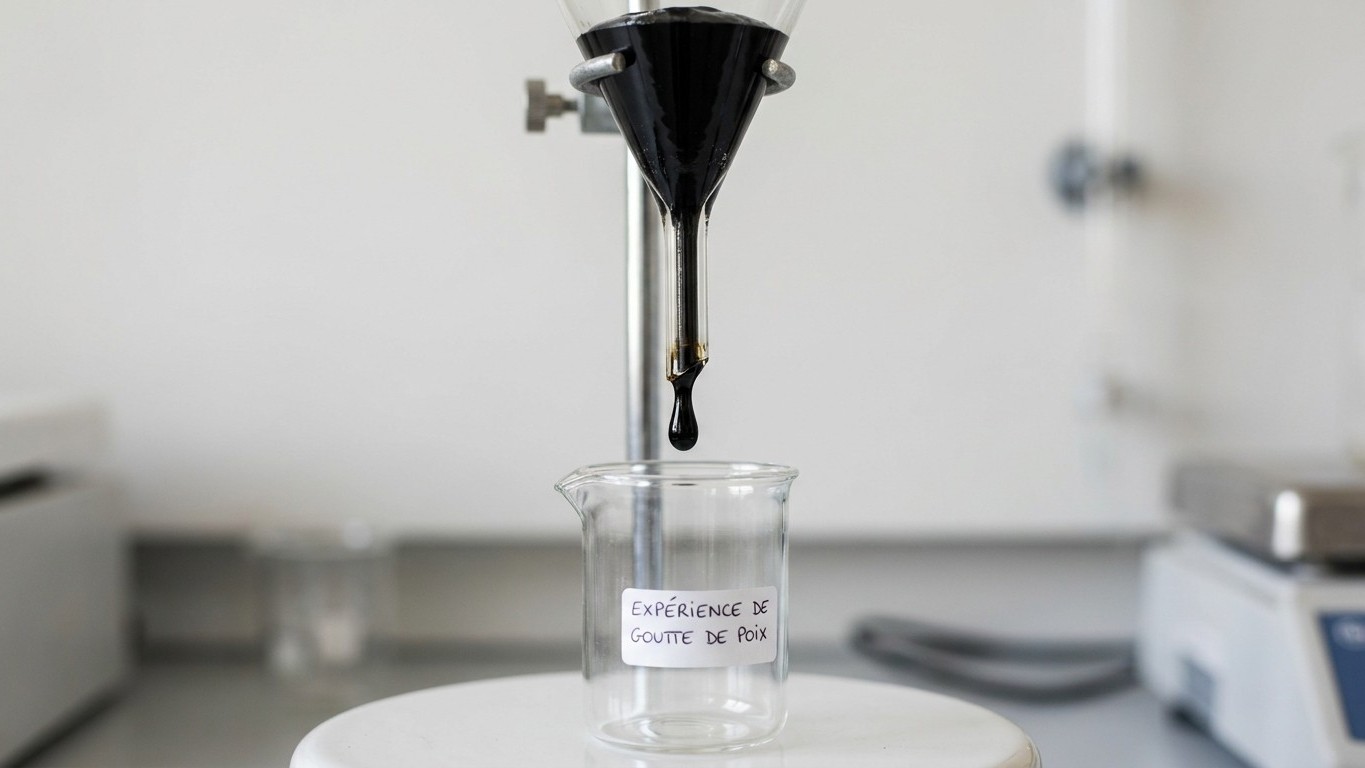
A glass funnel, a dab of black pitch, and a wait that outlives a human life: that is the essence of the world’s slowest scientific experiment. At the University of Queensland in Australia, the institution’s first physics professor, Thomas Parnell, conceived this experiment in 1927 to illustrate that everyday materials can exhibit surprising properties. Since then, eight droplets have taken nearly a century to fall. A ninth eventually touched the bottom of the beaker in 2014. And nobody, absolutely nobody, has ever witnessed the exact instant of the drop’s descent.
The story begins with a pedagogical bit of illusion. At room temperature, pitch looks solid, even brittle, and can be broken with a strike of a hammer. But in truth, this substance, about 100 billion times more viscous than water, is in fact a fluid. To prove this to his students, Parnell conceived a device of astonishing simplicity.
To note
- A material that looks solid yet has been flowing for nearly a century: how can that be?
- Why did the founder of the experiment and his successor both fail to witness a single drop fall?
- How did a surveillance camera and 25,000 online spectators fail to capture the precise moment of the drop’s descent?
A classroom demonstration turned into a centennial experiment
In 1927, Professor Parnell heated a sample of pitch and poured it into a sealed-glass funnel. He allowed the pitch to cool and stabilize for three years, then in 1930 he cut the stem of the funnel. From that moment, the material began to move, but with such slowness that intuition was challenged. The pitch then flowed out of the funnel so slowly that eight years passed before the first drop fell, and more than forty years elapsed before five more followed.
A detail that helps gauge the scale of the phenomenon: later research recalculated the precise viscosity of this exact sample. The pitch was found to be roughly 230 billion times more viscous than water. To put it in perspective, it would be like comparing the flow rate of a glass of water tipped over to the speed of a glacier creeping forward by a few centimeters per century.
A founder who died without ever seeing a drop fall
Thomas Parnell never witnessed the drop that he had set in motion. He died on September 1, 1948, in Indooroopilly near Brisbane, at the age of 67. By then, two drops had already detached—one in 1938 and another in 1947. But the process is so gradual that no human eye can truly perceive the exact moment of separation: one day a drop would still hang, and the next day it would have disappeared into the beaker. Parnell did not live to see a third drop fall in 1954, and the experiment was tucked away in a physics department closet.
It could have stayed forgotten forever. It was physicist John Mainstone, who joined the department in 1961, who saved it from obscurity after a colleague showed him this odd object found in a cabinet. Mainstone became its custodian for more than half a century, turning this dusty curiosity into an international scientific icon. Yet his fate was as cruel as that of his predecessor: during a weekend shift in 1977, he missed the drop by a day. In 1988, while closely monitoring the experiment, he stepped away for a few minutes to brew a cup of tea. Upon his return, the drop had fallen. He had missed the event by mere minutes.
The camera did not alter the curse
Convinced that technology would succeed where human patience had failed, the university installed a camera to monitor the eighth drop, formed over more than a decade. In November 2000, while Mainstone was halfway around the world in London, the drop fell. But a power outage cut the recording right at the crucial moment, leaving the scene blank. Once again, no one saw it.
The university did not give up. The experiment was placed under continuous surveillance, with three webcams fixed on it to capture the fall of the ninth drop, and about 25,000 spectators from 158 countries signed up to follow the moment via a live video stream. John Mainstone passed away in August 2013, a few months before that ninth drop finally fell in April 2014. He thus never witnessed, in fifty-two years of watching, the event with his own eyes.
Even when filmed continuously, the ninth drop kept one final irony. Pinpointing the exact moment it touched the bottom required detecting a change in descent speed—from an unimaginable crawl to an even slower crawl, an instant no human on Earth could possibly perceive live. Only by frame-by-frame analysis of a two-million-fold accelerated montage could researchers locate the moment of fusion between April 11 and 14, 2014. In 2005, this scientific soap opera earned Parnell and Mainstone an Ig Nobel Prize in Physics, the spoof award that celebrates research first making people laugh, then think.
The continuation is being written right now
The funnel has never ceased dripping. Today it is displayed in the Parnell Building Hall on Brisbane’s St Lucia campus, continuing to attract curious visitors from around the world. More than 35,000 people from about sixty countries have registered to follow its live stream. The tenth drop is currently forming under the cameras, visible to anyone with an internet connection and enough patience. Its descent is anticipated in the coming years, with no specific date, and for the first time in the history of this centennial experiment, a whole team of custodians, online watchers, and cameras already await it with eyes wide open.
Sources : en.wikipedia.org | spacedaily.com
