
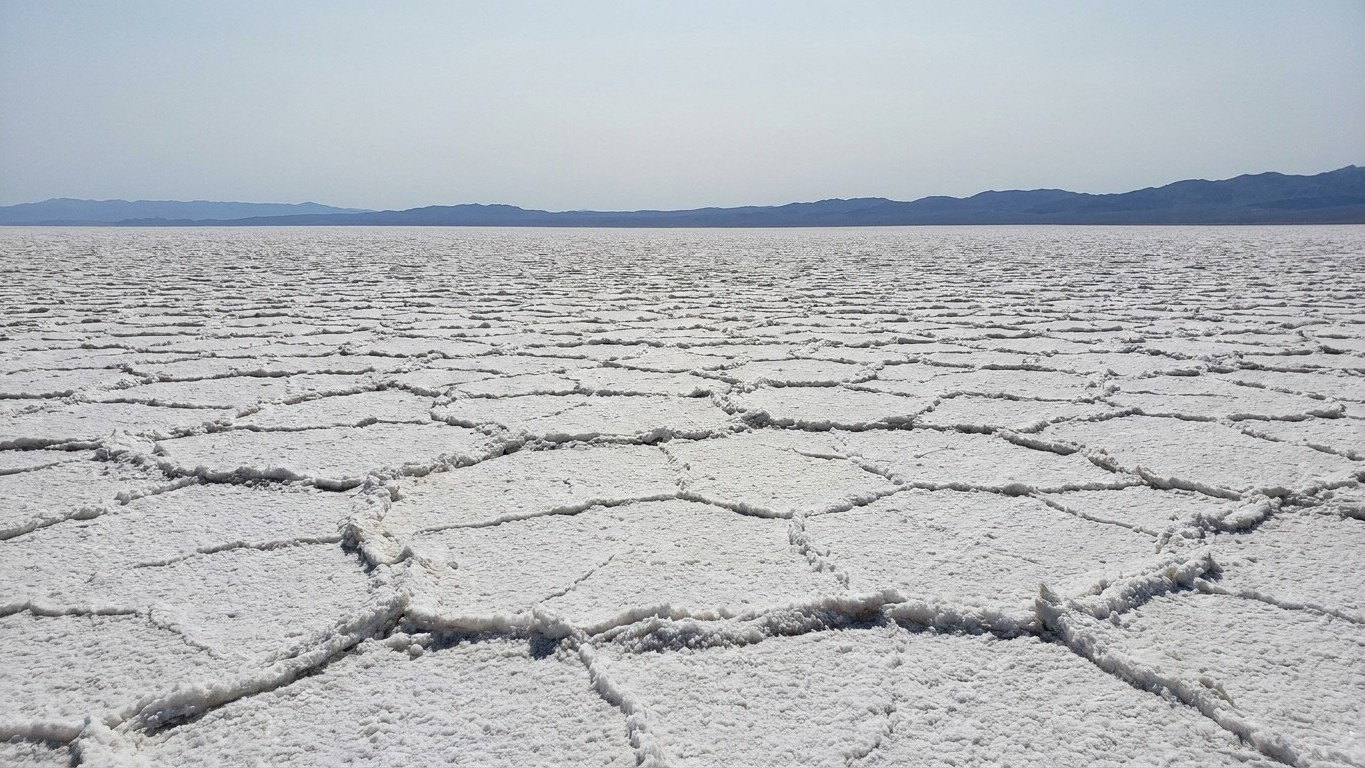
By diverting their rivers toward the orchards and fields of Iran’s northwest, Iranians have literally laid bare a salt desert capable of covering what had for millennia been one of the planet’s largest salt lakes. Lake Urmia, at its peak, covered about 5,200 square kilometers in area. Today, that turquoise expanse exists only on old maps and archived satellite photographs.
Key takeaways
- A millennial lake has drained by 90% in less than two decades, and no one could stop it
- 8 billion tonnes of salt now lie exposed to the air, ready to be carried off by the wind
- Local populations face a rising tide of cancers and respiratory diseases
A lake that has emptied before our eyes
The turning of events was neither gradual nor discreet. The surface of the lake, which normally fluctuates between 5,200 and 6,000 km² according to the United Nations Environment Programme, had been reduced to 2,366 km² by August 2011. Two years later, it reached only 700 km². An almost unbelievable collapse for a body of water that has existed for millennia. In 2014, it was estimated that its surface had shrunk by about 90% in 45 years, relative to the early 1970s.
The outcome arrived in 2023. By autumn of that year, the lake was utterly dry. Satellite images captured by NASA’s Landsat program confirm this unequivocally: where water once filled the basin, there remains only a white crust stretched to the horizon. After having briefly gained in volume a few years earlier, Lake Urmia nearly dried up completely by autumn 2023, becoming essentially a vast salt desert. The primary cause leaves little doubt among researchers: dams built on the rivers that fed the lake, combined with intensive irrigation of surrounding crops, gradually cut off its freshwater supply.
Eight billion tonnes of salt ready to be blown away
That figure is dizzying. The lake’s complete drying would expose about 8 billion tonnes of salt to the air. A study published in the scientific journal Science of the Total Environment reaches the same order of magnitude: the lake would contain 8 billion tonnes of salt, and the disaster would directly and indirectly affect the lives of seven million people in the surrounding areas. Other studies give a slightly broader range, between 6.5 and 10 billion tonnes depending on calculation methods, but the order of magnitude remains the same: a mass of salt comparable to what decades of global mining would produce, dumped there, in the open air, on an Iranian plateau.
This salt does not stay put. Carried by the wind, it can travel long distances and fall on nearby agricultural lands. The winds are now capable of transporting high levels of salt over distances of up to 370 miles, a phenomenon some call a “salt tsunami.” Scientists refer to it as saline dust storms, a phenomenon that is far from trivial for the region’s inhabitants.
Sterilized fields and exposed populations
The most tangible consequence directly affects farming, that same activity that dried up the lake. The multiplication and intensification of salt and dust storms destroy the crops that were growing in the surrounding area, and contribute to lower yields. An irony: diverting the rivers aimed to irrigate more land, yet the final result now threatens all crops in the region, including those that never benefited from a single liter of diverted water.
Salt does not stop at the fields. It gradually seeps into groundwater reserves. The complete drying would lead the exposed salt to rapidly infiltrate the region’s aquifers. Health repercussions follow. This salinization process would become a vector for the spread of diseases among the population, including cancers, high blood pressure, and respiratory illnesses. An American study on a comparable phenomenon, the Great Salt Lake in the United States, noted a 30% increase in skin cancer cases among nearby populations, an indicator of what residents of the Urmia basin might face under the same dust-salt exposure mechanisms.
A region with a reshuffled political agenda
In response to this deterioration, Iranian authorities eventually acted, but belatedly. Measures were announced late to address the escalating tensions surrounding the accelerated disappearance of Lake Urmia, yet they remain patchy. A former official of Iran’s Environmental Protection Agency even mentioned an extreme scenario, that of evacuating towns near the lake in case of salt-laden rains, such was the seriousness of the health risk in his view.
The desertification of northwest Iran has become a political issue in the country, but the proposed solutions—cloud seeding, water transfers from other basins, partial restoration of inflows—struggle to reverse a trend that has been in place for nearly thirty years. The lake did experience brief surges, notably after torrential rains in 2018 and 2019 that temporarily refilled part of the basin. But each respite proved temporary, and the exposed salt bed, once revealed, continues to release its dust with every gust of wind. A question remains that transcends Iran’s borders: how many other lakes, from Lake Chad to the Great Salt Lake in the United States, will follow the same path under the combined pressure of intensive agriculture and global warming?
Sources: revue-ein.com | earthobservatory.nasa.gov | deseret.com
