
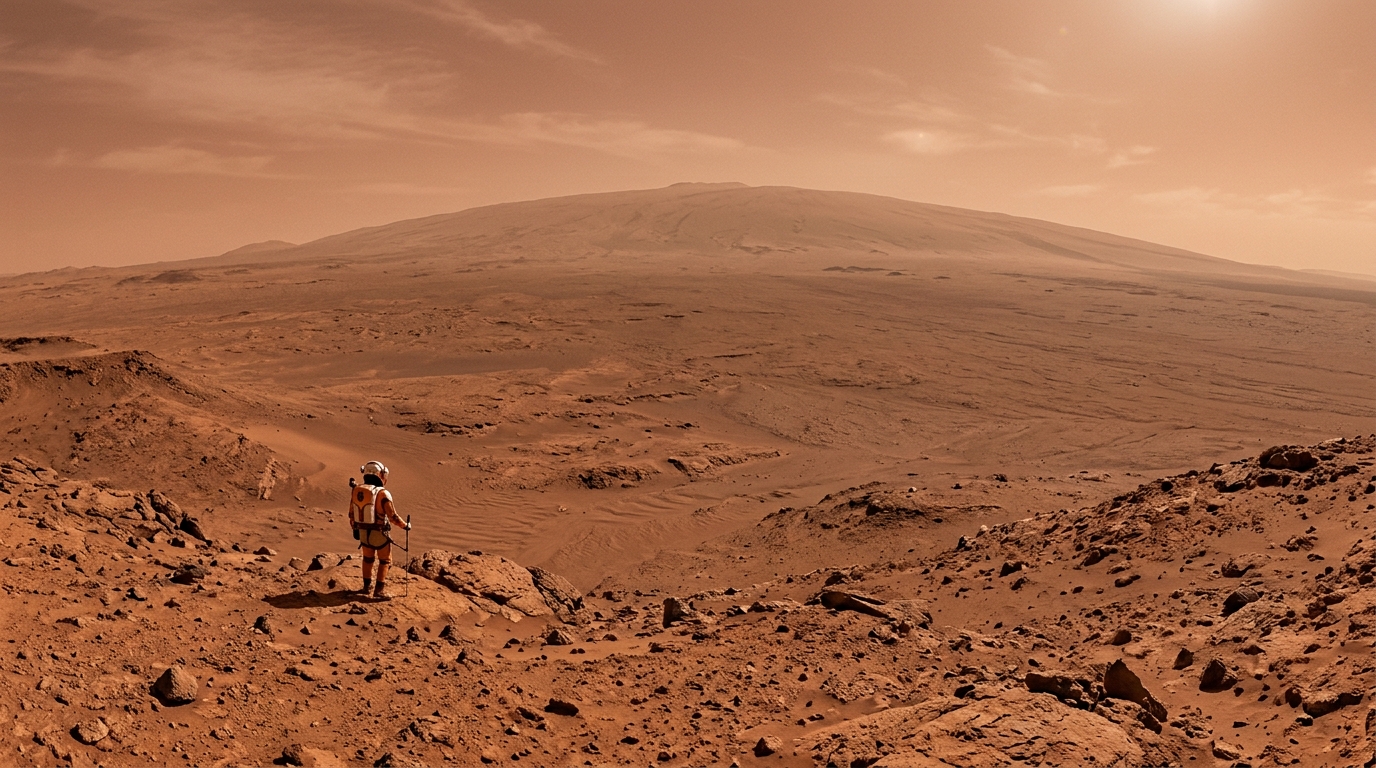
With an altitude of 21 kilometers, Olympus Mons is nearly two and a half times higher than Everest. That’s the number that circles everywhere, the one that sends a chill as soon as we mention the Martian volcano. We imagine it as a dizzying cliff, a dark wall that stretches to the horizon and that would have to be climbed with bare hands. Yet that image, as spectacular as it is, is false. If a hiker stood at the base of Olympus Mons, helmet on, trekking poles in hand, they would not see any of that. Just a plain. A plain that rises very slowly, stretching off into the distance. For this volcano, the largest in the entire solar system, its gigantism hides behind a nearly disarming quietness. To understand this paradox, you must change scale and revisit all our intuitions about what it means to be immense.
- Olympus Mons spans about 600 kilometers in diameter, with average slopes of barely 5%, comparable to a country road.
- The strong curvature of Mars, smaller than Earth, brings the horizon closer and prevents seeing the volcano in its entirety from the ground.
- The absence of plate tectonics on Mars allowed magma to accumulate indefinitely at the same spot, letting the volcano grow without limit for millions of years.
- Why our brain misimagines a volcano of 600 kilometers in diameter
- Slopes of 5%: the secret of a mountain that doesn’t look like a mountain
- Mars’ curvature, accomplice to this geological optical illusion
- What Olympus Mons reveals about the formation of volcanoes without plate tectonics
Why our brain misimagines a volcano 600 kilometers in diameter
The problem starts with our earthly experience. On Earth, the volcanoes we know, such as Mount Fuji or Etna, have relatively narrow bases and clearly defined slopes. Our brain has learned to associate height with steep verticality. When we hear about a mountain 21 kilometers tall, the imagination instantly conjures up a vertiginous wall, almost threatening.
But Olympus Mons doesn’t fit into that category. Its base extends over roughly 600 kilometers in diameter, a surface area comparable to all of France. In other words, to reach its maximum altitude, one would have to traverse a phenomenal distance, nearly on the scale of a country. Our mind, used to proportions that are much more modest, fails to properly visualize the relationship between height and width. We stay fixated on the spectacular figure of 21 kilometers, but completely overlook the magnitude of the base that supports them.
Slopes of 5%: the secret of a mountain that does not resemble a mountain
Here lies the heart of the mystery. The average slopes of Olympus Mons hover around 5%, sometimes even less in certain parts. To give a concrete image, it’s roughly the incline of a gently rolling country road, the kind of gradient you can climb on a bicycle without pushing too hard on the pedals. Nothing like the 30% to 40% gradients you find on the steep flanks of some terrestrial volcanoes.
That gentle incline explains everything. A walker at the base would indeed see only a plain that rises barely, as the initial idea suggests. One would have to progress tens, then hundreds of kilometers, climbing imperceptibly, to reach the summit, never feeling as though one had crossed a dramatic face. It is this incredibly slow buildup of elevation, spread over a colossal distance, that ultimately yields those 21 kilometers on paper, but utterly invisible on the ground.
Mars’ curvature, accomplice to this geological optical illusion
There is another, less well-known factor that further enhances this sense of flatness. Mars is a much smaller planet than Earth, with a radius of about 3,390 kilometers compared to nearly 6,371 kilometers for our planet. Its curvature is therefore more pronounced, and the local horizon is much closer here.
Consequently: because of this more marked curvature, the silhouette of Olympus Mons ends up literally surpassing the local horizon. The volcano is so wide that its summit, even when very distant, cannot be perceived in a single view by an observer on the ground. You never see the entire structure at once, unlike what would happen with a terrestrial mountain of more modest size. This combination of gentle slopes and planetary curvature creates a kind of natural camouflage: the giant hides from the view of the person at its feet, as if the planet itself refuses to reveal the scale of its creation.
What Olympus Mons reveals about the formation of volcanoes without plate tectonics
That distinctive silhouette is not merely a visual curiosity. It also tells a fascinating geological story. On Earth, plate tectonics constantly move the crust over hot spots. The result is that a volcano like those in Hawaii ends up moving away from its magma source, which limits its growth and gives rise to chains of volcanic islands rather than a single enormous edifice.
On Mars, the situation is completely different since the planet lacks active plate tectonics. The Martian crust remains stationary above the hotspot for millions, even billions of years. The magma then accumulates indefinitely in the same spot, layer after layer, lava after lava, never being displaced. It is this geological immobility that allowed Olympus Mons to grow without limit for a very long time, until reaching proportions unimaginable on Earth. The volcano never needed steep slopes to become immense: it simply required time, lots of time, and a planet stable enough to let the magma spread patiently across hundreds of kilometers.
In the end, Olympus Mons teaches us to beware of raw numbers. Twenty-one kilometers of altitude, yes, but spread over such a vast base that the slope becomes almost incidental. This misleading silhouette, blending planetary geometry with geological slow motion, wonderfully illustrates how Mars operates under rules quite different from our own. So, the next time we mention the tallest volcano in the solar system, perhaps we should think less of an impassable wall and more of an endless plain that patiently rises toward the stars.
