
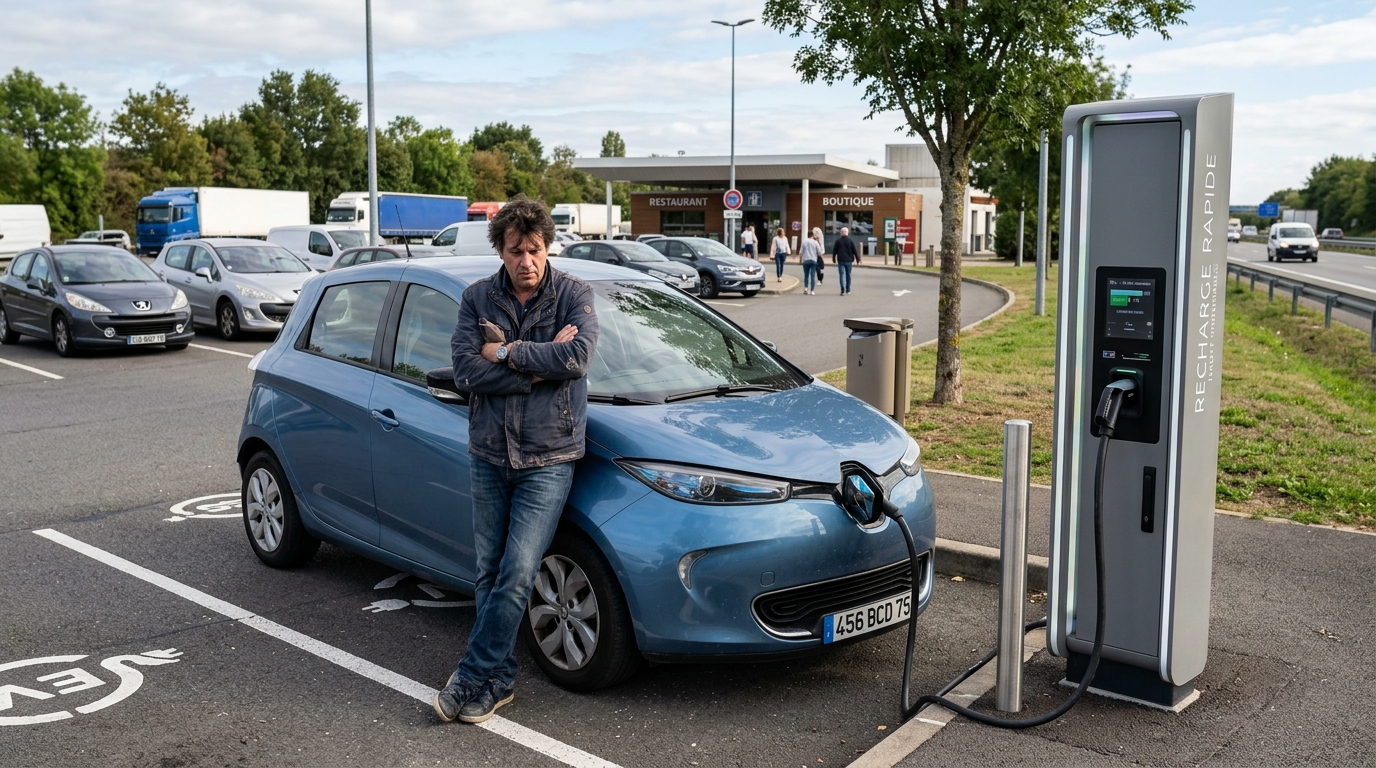
Not all electric cars charge at the same speed, and some Renault Zoé models built before 2020 simply cannot take advantage of highway fast chargers in France. This technical limitation, little known by many drivers, turns a routine stop at a service area into a real logistical headache, especially as the return-to-school season begins and long-distance trips resume their usual pace.
- Renault Zoé models produced before 2020 are equipped with the Chameleon charger, lacking a CCS connector, which makes them unable to tap into the DC current from highway fast charging stations.
- These vehicles cap at 22 kW on AC, versus 50 kW or more for standard fast chargers, significantly lengthening charging times on long trips.
- Before heading onto the highway, it’s advisable to verify the actual year of manufacture, confirm the absence of a CCS connector, and use apps that filter charging stations by the type of current available.
- The silent failure: why some Zoé refuse direct current
- Chameleon, the charger that changes everything (except CCS compatibility)
- 22 kW versus 50 kW: the calculation that drags down long trips
- Zoé pre-2020: what to check before heading onto the highway
It’s a disappointment that many Zoé owners discover too late, often at a service area, smartphone in hand, scrolling the screen of a charger supposed to recharge their car in record time. Yet, nothing goes as planned. The car charges, to be sure, but at a rate that has nothing to do with the promises displayed on so-called fast chargers. This phenomenon, far from trivial, concerns a large number of Zoé cars sold before 2020, and it deserves closer look to understand what really lies behind the hood of these city cars so popular in France.
The silent failure: why some Zoé refuse direct current
To understand this blockage, one must first grasp a key technical concept: there are two major charging families for an electric car, alternating current (AC) and direct current (DC). The former is what you find at home or on most urban charging points—slower, but widely available. The latter, far more powerful, equips the rapid charging stations that you encounter on service areas along motorways, those intended to let you be back on the road in about twenty minutes.
The problem is that Zoé models built before 2020 simply do not have the physical capability to accept this direct current. It isn’t a software lock or a contractual limitation imposed by Renault: it’s a matter of wiring and electronic components missing from the car. In other words, regardless of the power output advertised by the charging station, the car cannot profit from it beyond what its internal architecture allows.
Chameleon, the charger that changes everything (except CCS compatibility)
The key to this riddle lies in a technology Renault long touted as a strong selling point: the onboard charger named Chameleon. This system, cleverly on paper, allowed the Zoé to automatically adapt to different AC power levels, up to 22 kW, without requiring expensive additional hardware. A technical feat that for a long time contributed to the reputation of this French electric city car.
But this flexibility had a hidden drawback: the Chameleon charger had no CCS connector, the combined plug that makes it possible to exploit the direct current from fast charging stations. In concrete terms, the car is equipped to absorb maximum alternating current, but remains hermetically sealed against any rapid DC charging. A technical decision that, at the time, followed an economic and industrial logic, but that today proves to be a real brake for long-distance travel.
22 kW versus 50 kW: the calculation that drags down long trips
To measure the real impact of this limitation, it suffices to compare the numbers. A standard highway fast charger generally delivers a power of 50 kW, sometimes more at newer infrastructures. At that speed, a battery can regain a good portion of its range in about thirty minutes, the time for a coffee break.
A Zoe built before 2020, however, tops out at 22 kW, and only if the charger actually allows that level of AC current, which is rarely the case at motorway stations designed for rapid charging. The result: where a driver of another electric car leaves after a lunch break, the Zoe owner may find themselves immobilized for several hours, or even unable to recharge if the station only offers DC current. This difference in power turns a summer road trip or a simple family visit into a logistics challenge far more burdensome than expected.
Zoé pre-2020: what to check before heading onto the highway
In light of this technical reality, a few simple habits help avoid the bad surprise. The first is to verify the exact year of manufacture of the vehicle, not just the purchase year, since older stock of pre-production models can still be sold after their actual production date. Next, consult the vehicle’s technical data sheet to confirm the absence of a CCS connector, information usually available in the maintenance book or from a Renault dealer.
It is also recommended to favor dedicated mapping apps for electric vehicles, which allow filtering charging stations by the type of current available, rather than relying solely on their location. For long-distance trips, it’s better to plan stops at stations offering sufficiently powerful alternating current, or to accept longer charging times by deliberately incorporating them into the itinerary, rather than discovering it on the spot at a crowded highway service area in September’s peak.
This story of the Zoe stuck at 22 kW ultimately illustrates a broader reality in the electric-car world: not all cars perform the same when faced with rapid charging, and yesterday’s technical choices continue to influence today’s usage. As the fast-charging network densifies along French highway corridors, this compatibility question could become as decisive a criterion as range when choosing your next electric car.
