
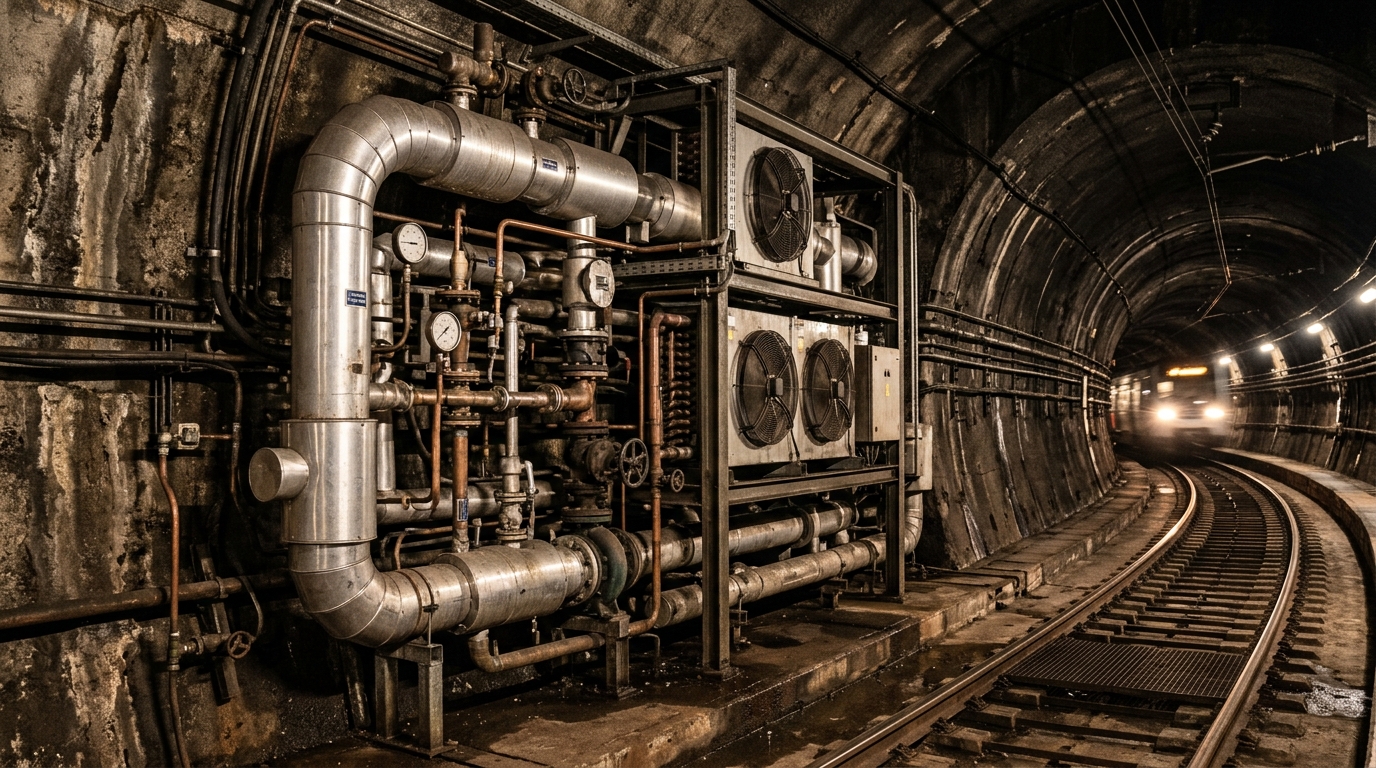
Picture a hair dryer left on in a sealed room with no window to vent the hot air: after a few hours, the temperature would become intolerable. That is exactly the challenge faced, day in and day out, by the Channel Tunnel. Beneath the 50 kilometers of galleries linking France to England, hundreds of trains rush by each week, pulling with them friction, engines heating up, and compressed air moving at high speed. Without a system capable of continuously removing that heat, the most emblematic piece of European civil engineering would literally turn into a furnace. And if this mechanism were to fail, even for just a few hours, the entire rail link between the two countries would be paralyzed.
- Without active cooling, the temperature in the tunnel could exceed 50°C, making the operation of equipment and train movement impossible.
- Since 2016, a 21-megawatt cooling system has been operating continuously, circulating cold water through pipes to absorb the heat generated by rail traffic.
- The rock surrounding the tunnel acts more as thermal insulation than a heat sink, preventing the heat produced by trains from escaping naturally despite the proximity of seawater.
- Under the Channel, heat that could stop everything
- Why an underwater tunnel becomes a furnace
- Megawatts that keep an entire country in check
- The nightmare scenario: what if the system failed
- What the Channel Tunnel really hides
Under the Channel, heat that could stop everything
Few travelers think of it as they settle into their comfortable carriage, but the Channel Tunnel is in a constant battle against heat. It is no coincidence that the infrastructure was designed with a thermal regulation system as robust as it is discreet. Deep underground, several tens of meters below the seabed, heat does not dissipate naturally as it would in open air. It accumulates, spreads, and constantly threatens the proper operation of electronic equipment, rails, and the trains themselves.
This finding was incorporated by engineers from the design stage. But with the growth of rail traffic over the decades, thermal management has become an even more critical concern. Today, without active and uninterrupted regulation, the temperature inside the tunnels would rise at a rapid pace, making the circulation of trains simply impossible.
Why an underwater tunnel becomes a furnace
One might think that the surrounding water, specifically the English Channel, would play the role of natural cooling. In fact, the opposite is true. The rock surrounding the tunnel acts more like thermal insulation than a heat sink. The energy produced by the passage of trains, by their electric motors, by the wheel-rail friction, and by the compression of air in such a confined space finds nowhere to escape naturally.
Result: heat accumulates inexorably, day after day, like in an oven with the door left ajar. Without external intervention, experts estimate that the temperature of the galleries could exceed 50 degrees Celsius. At that level, not only would passenger comfort become unbearable, but more critically, the electronic equipment and signaling systems, essential to railway safety, would cease to function properly. This is the paradox of an underwater structure: it must fight internal heat even though it is surrounded by cold seawater.
Megawatts that keep an entire country in check
Facing this colossal thermal challenge, a rare industrial solution of remarkable scale has been implemented. Starting in 2016, a new cooling system was deployed to replace the aging equipment that had become inadequate in the face of growing traffic. Four large industrial cold blocks — the most powerful in Europe — were installed on either side of the tunnel, at Sangatte on the French side and at Shakespeare Cliff on the British side. Their single mission: to maintain an ambient temperature of around 25°C within the galleries. In 2017, the first full year of operation, the new system saved 4.8 GWh of electricity, equivalent to the annual consumption of 1,000 homes and €500,000 in savings.
Practically, this system works like a giant industrial refrigerator. Cold water circulates continuously through pipelines laid along the tunnel, absorbing the ambient heat before being sent back to cooling installations located on either side of the tunnel, in France and in England. This circuit knows no pause or interruption. It runs 24 hours a day, 365 days a year, summer and winter, rain or shine on the surface. It is this absolute regularity that guarantees that Eurostar trains and freight shuttles can continue to traverse the Channel safely.
The nightmare scenario: what if the system failed
This is where the true dependence of this structure on its cooling mechanism becomes evident. If, for any reason, this system were to stop, the consequences would not take long to appear. The heat generated by rail traffic would instantly begin to accumulate, with no natural outlet through the surrounding rock.
In just a few hours, temperatures would reach critical thresholds, forcing operators to suspend rail traffic entirely. Such an outage would have immediate repercussions for thousands of passengers and cross-Channel freight, but above all, it would illustrate how this strategic link between two countries relies on a piece of technology that few people know about. It’s a bit like discovering that the quiet heartbeat of an invisible machine determines, in reality, the rhythm of life of a major transport axis.
What the Channel Tunnel really hides
Beyond the architectural feat that this 50-kilometer tunnel represents, of which 38 kilometers run beneath the sea itself, lies therefore a true thermal achievement, far less known to the general public. This heat management illustrates perfectly how modern large infrastructures rely on maintenance systems that are invisible but absolutely vital.
The travelers who cross the Channel in about twenty minutes probably do not imagine that they benefit, discreetly, from industrial cooling technology capable of rivaling some power plants. This reality changes our understanding of the structure: it is not merely a railway tunnel, but a complete technical ecosystem, where every element, including cooling, plays an indispensable role in the overall reliability of the system.
Ultimately, the Channel Tunnel reminds us that behind every visible engineering feat lies an invisible mechanism just as essential. The next time you travel across the Channel by train, perhaps you will think of these 21 megawatts that work tirelessly, somewhere beneath your feet, to keep the journey as simple and fast as it seems. One question remains, however: how many other daily infrastructures depend in this way on systems we never see, without which everything would stop abruptly?
