
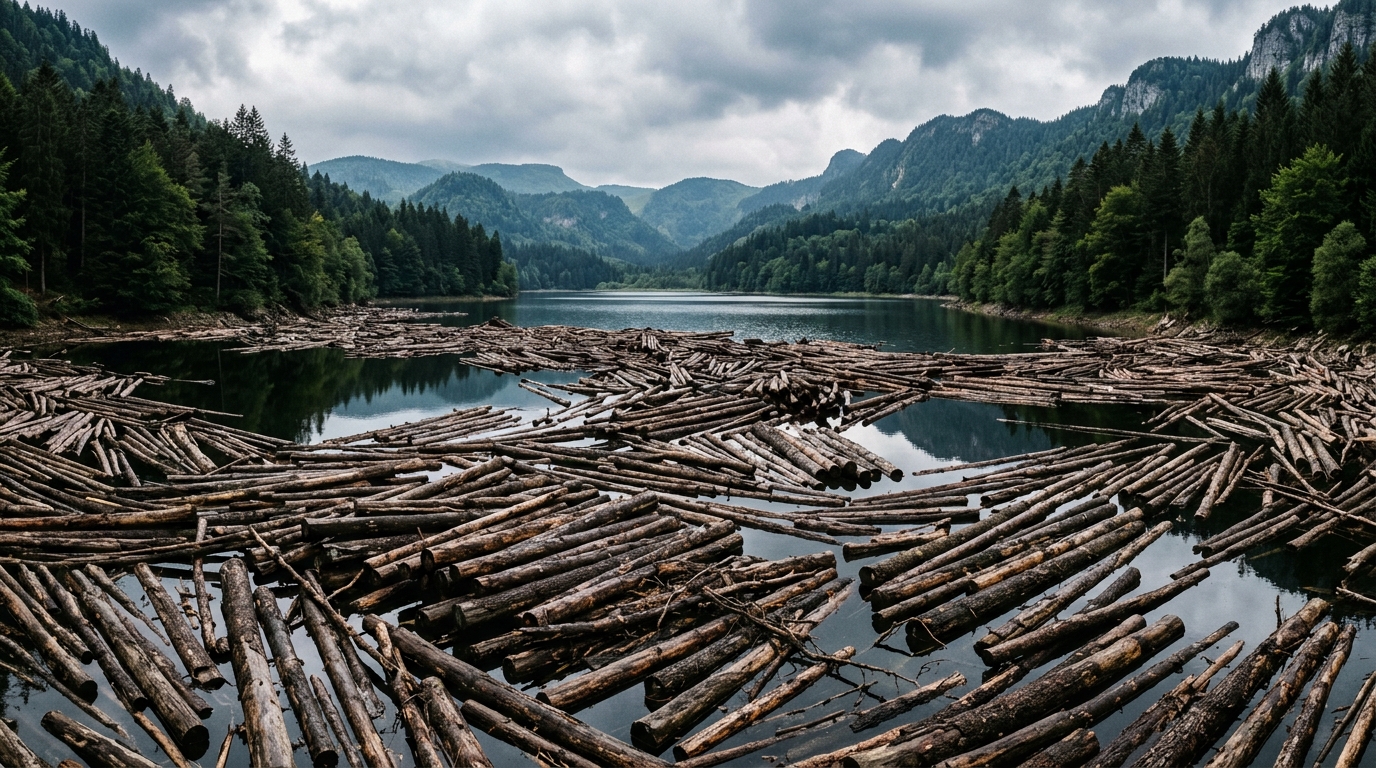
Forty hectares of a Jura valley reduced to a dead zone, hundreds of trout missing from nearby waterways: that is the chilling tally of a technique that is more than a century old and meant to protect the wood. As the forest massifs of eastern France continue to mend the scars left by years of bark beetle infestations, another, more discreet crisis is shaping up downstream of sawmills. For to save their stocks of resinous trees from a ravaging insect, some wood-industry players have adopted a radical remedy: literally drowning the logs under continuous jets of water. A solution that works brilliantly against insects, but which seems to have shifted the problem rather than solved it, moving the catastrophe from the forest to the river.
- To protect logs infested with bark beetles, sawmills spray them continuously, a technique that loads the water with tannins and organic matter
- This water rich in organic matter deoxygenates streams, triggering mass deaths of trout and other aquatic species
- Spraying, viewed as a mechanical solution, partially escapes the strict environmental oversight imposed on chemical treatments
- The anti-bark-beetle countermeasure that changed everything
- Streams choking on tannins
- When saving wood kills the river
The anti-bark-beetle countermeasure that changed everything
To understand how we arrived here, one must go back to an ancient technique known to wood professionals since the early 20th century: the continuous spraying of logs. The idea is simple, yet effective. By keeping the trunks constantly wetted, a thin film of water forms on the freshly cut timber, limiting end-crack formation, preventing blotchy markings from the sapwood, and above all, markedly slowing fungal attacks and infestations by wood-boring insects.
This method gained renewed attention with the surge of populations of bark beetles, those tiny beetles capable of destroying large swaths of spruce forests in a few seasons. In the Northeast of France, hundreds of thousands of cubic meters of logs have thus been kept under spray to escape these pests, a figure added to the 600,000 cubic meters of maritime pine treated in the Southwest in the same way. In neighboring Doubs, near the Jura, the wood sector had to cope from 2023 with a mass influx of infested spruce, forcing an urgent move: get the wood out of the forest before it becomes unusable. A log punctured by bark beetles quickly turns blue, a discoloration that signals the near-total loss of its commercial value. Facing this economic urgency, spray-storage zones multiplied at the forest edge, often hastily set up in the rush.
Des ruisseaux qui suffoquent sous les tanins
What few people anticipated is what becomes of this water once it drains over thousands of stacked logs. As it passes through the bark and freshly cut wood, it gradually loads up with tannins and organic matter—compounds naturally present in resinous woods that, once concentrated and discharged into the natural environment, become real poisons for aquatic life. The waters loaded with these substances, particularly abundant in species rich in extractives such as oak or certain pines, end their course in the streams and rivers that border the storage areas.
The mechanism that kills fish is as simple as it is devastating: this decomposing organic matter mass-consumes the dissolved oxygen in the water, a phenomenon specialists call deoxygenation. For species as demanding as the trout, especially sensitive to habitat quality, a drop in oxygen can prove fatal in a matter of hours. That is precisely the scenario that unfolded in some Jura streams, where fish populations collapsed as storage zones multiplied upstream. About thirty hectares of valley, possibly up to forty in the most affected areas, saw their aquatic ecosystems plunge into what could be described, without exaggeration, as a dead zone.
When saving wood kills the river
There is something profoundly ironic about this situation. The technique meant to safeguard a forest resource threatened by an insect has become a threat to another equally precious ecosystem. Environmental authorities did not stand idly by: when used, chemical treatments must respect strict distances from drinking water intakes, water bodies and protected areas. But the spraying itself, this artificial rain that pounds down on the log stock, partly escapes these boundaries because it is seen primarily as a mechanical solution rather than a chemical one.
Wet storage is now clearly identified as a source of environmental issues connected to water quality, which in theory implies treating the wastewater before it returns to the natural environment. In practice, setting up filtration systems remains complex and costly, especially for temporary storage zones erected in a hurry. Additionally, another paradox: handling logs drenched with water in these storage areas is itself a risky operation, as heavy, slippery trunks pose a danger to workers. The wood sector thus finds itself caught between an urgent economic necessity and an increasingly heavy environmental responsibility.
This Jura episode perfectly illustrates the complexity of ecological balances, where solving a problem upstream can create another grave one downstream. Between the need to safeguard an economically fragile sector from bark beetles and the urgency to protect rivers already strained by climate change, the question must be asked plainly: isn’t it time to rethink the management of these storage zones altogether, before other valleys suffer the same fate as the Jura?
