
A Japanese company built Buddhist temples for fourteen centuries without ever driving a nail, before losing its independence in 2006. Its name: Kongō Gumi. Its specialty: kigumi, a wood-assembly technique passed down orally through generations, which allowed this Osaka-based family firm to weather wars, earthquakes, and economic crises without ever interrupting its activity. The rise of concrete in the construction of shrines and temples, combined with increased competition from large construction groups, led the company to become a subsidiary of the Takamatsu Construction group in January 2006.
À retenir
- An ancient technique allowed assembling wood without metal, rendering the temples nearly indestructible
- The company traversed 1,445 years of history while remaining independent, led by 40 successive generations
- The knowledge transmitted orally was lost the day money ran out, forcing the sale to a modern group
A Project Ordered by a Prince in the Year 578
It all began at the end of the sixth century, at a time when Japan had not yet mastered the craft of building Buddhist temples. Shigemitsu Kongo, a skilled carpenter, along with two other master artisans, were invited from Baekje on the Korean Peninsula to construct Japan’s first Buddhist temple, Shitennō-ji, at the behest of Prince Shōtoku. The wager was bold: to import foreign know-how to erect a religious monument in an archipelago still largely devoted to Shinto. The outcome surpassed the regent prince’s expectations, so much so that Shigemitsu Kongo chose to stay on site rather than return home.
After the success and the honor of having built Japan’s first Buddhist temple, the master carpenter Shigemitsu Kongo founded the Kongō Gumi company under his own name, passing down through the centuries the carpentry techniques as well as the management and ownership of the enterprise. It’s no coincidence that the house thrived for so long: it clung to a sector supported by a religion with millions of followers for centuries, securing near-continuous work. During its 1,445 years of operation, the company contributed to numerous structures, including Osaka Castle and the Hōryū-ji temple in Nara Prefecture, which in 1993 became Japan’s first UNESCO World Heritage site. In other words, the fingerprints of this same family are found in a large portion of the country’s most photographed monuments.
Kigumi, or the Art of Joining Without Metal
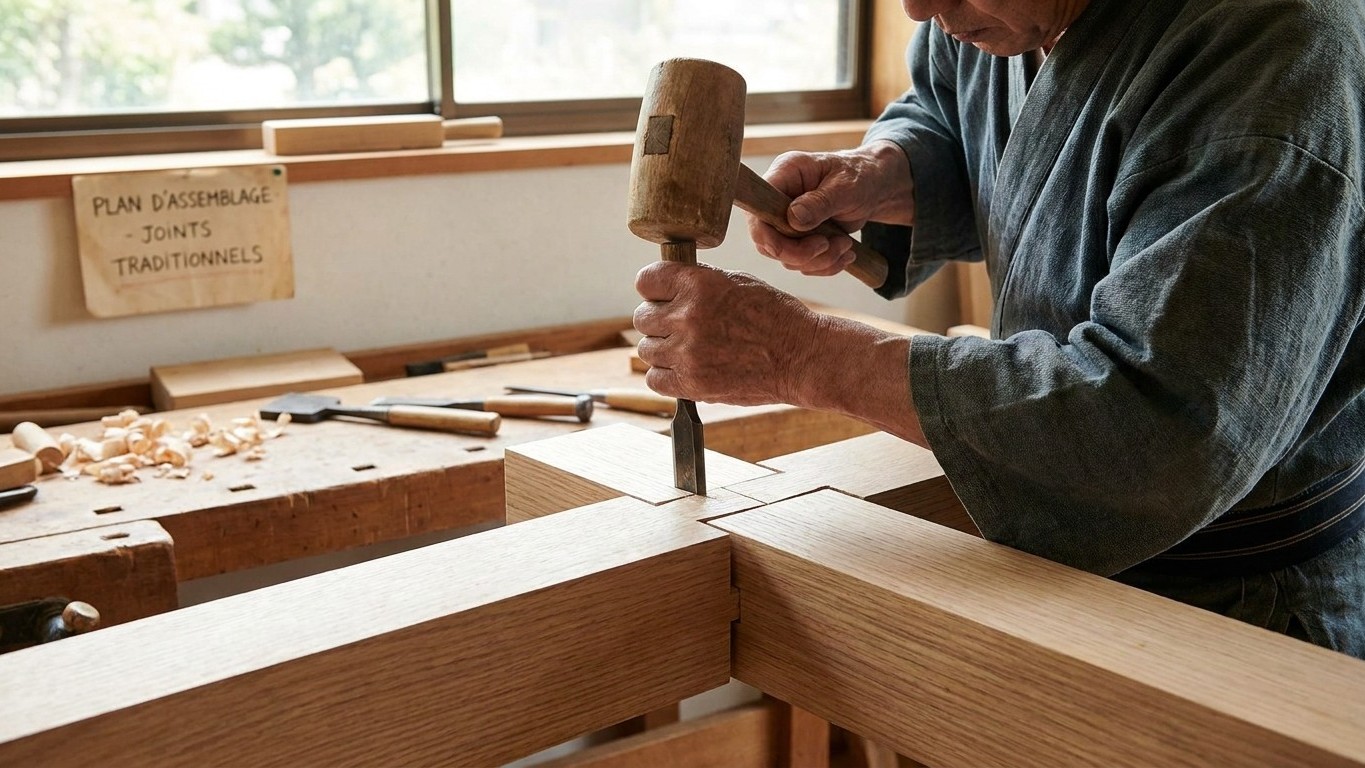
What sets Kongō Gumi apart from any other builders is its technique. One of the most important traditional techniques used in the construction of temples and shrines is kigumi, a method that allows wooden pieces to be joined without nails or other metal components. Concretely, the timber pieces interlock through millimeter-precise cuts, carved by hand by carpenters known as miyadaiku. No written manual codifies these moves: they pass from master to apprentice through observation and repeated practice over many years.
This method is far from mere decorative folklore. Thanks to kigumi, wood is less prone to damage from metal corrosion, and the joints of this type also absorb and disperse vibrations, making the construction more resistant to earthquakes. In an archipelago where the ground trembles regularly, this technical detail is not incidental: it partly explains why some buildings erected with this method have stood for more than a millennium. The founder temple of Shitennō-ji, for its part, has been partially or completely destroyed at least seven times over the centuries by wars and major catastrophes, the last time in the 1960s, but built without nails, its timbers can be removed and replaced to maintain the structure for centuries.
Forty Generations, a Widow at the Head of the House
Succession was never a matter of chance. When there was no male heir, or when the existing heirs were deemed unfit to lead the family business, the reins passed to a son-in-law, who took the Kongō name, or to a daughter, with each future leader carefully chosen for their leadership qualities. A pragmatism that stands in contrast to the rigid image often associated with Japanese traditions.
The most notable episode occurred during the Great Depression of the Shōwa era. The 37th leader, Haruichi Kongō, took his own life by ritual suicide, unable to provide for his family and the artisans; in the absence of a suitable male heir, his widow Yoshie became the first and only woman to lead Kongō Gumi. Far from merely managing the crisis, she challenged the masculine leadership tradition and broadened the company’s scope by obtaining government permission to manufacture wooden coffins to ensure the house’s survival. An early, forward-looking pivot that literally saved the company.
2006, the End of Fourteen Centuries of Independence
The decline began in the 1990s and 2000s. The dwindling appeal of traditional religious rites reduced demand for new temples, while reinforced concrete gradually dominated, even in shrine construction, a domain where large building firms possessed resources that the small family house could no longer compete with. Before its liquidation, the company employed more than 100 people and posted annual revenue of $70 million, or 7.5 billion yen, in 2005. These figures looked solid on the surface, but were insufficient against the magnitude of the debt amassed.
The last president was Masakazu Kongō, the fortieth descendant to lead the firm, and in December 2006 Kongō Gumi continued to operate as a subsidiary of Takamatsu, its assets having been acquired by the group. Notably: contrary to what one might think, this absorption did not erase the know-how. The company retains the millennia-old techniques acquired since its founding in 578, and its employees—carpenters and master carpenters—who remained loyal to the house, continue its spirit by blending modern technologies with traditional methods.
Aujourd’hui, sous label Kongō Gumi mais dans le giron de Takamatsu, les descendants des miyadaiku continuent de tailler le bois à la main pour restaurer sanctuaires et temples classés, perpétuant un geste transmis sans interruption depuis l’époque du prince Shōtoku, quatorze siècles plus tôt.
Sources: dondon.media | association-toki.com
