
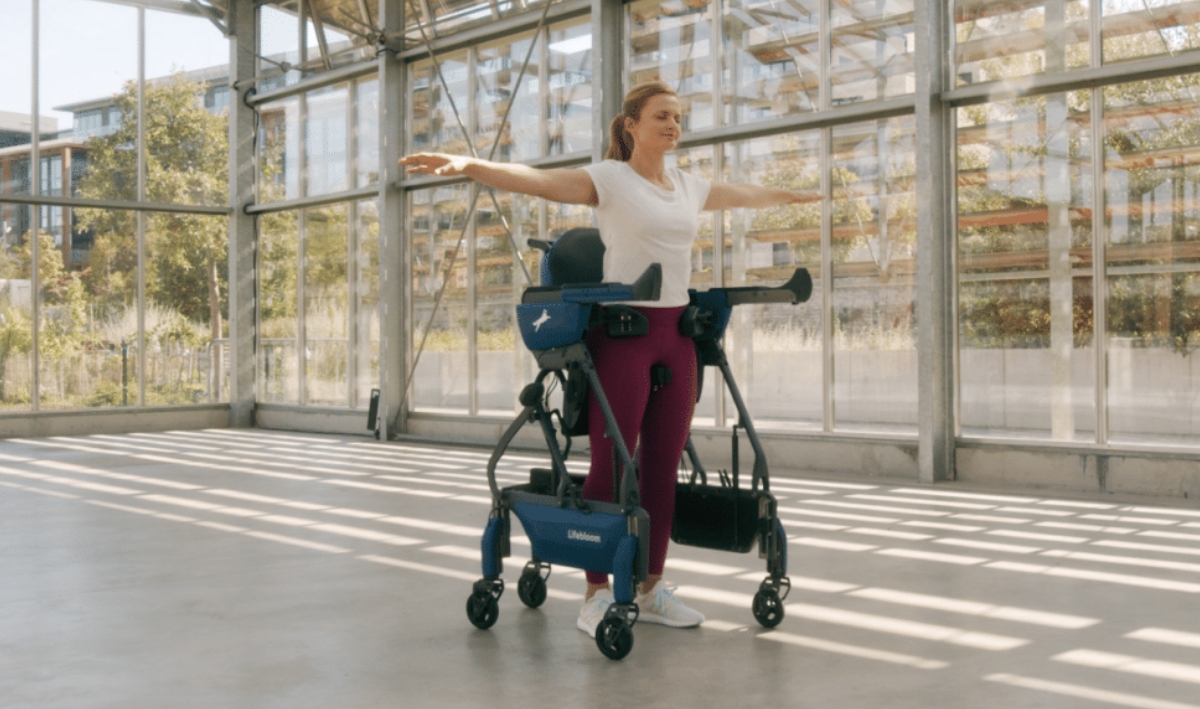
After certain stroke cases, walking becomes part of intensive rehabilitation. To regain this ability, the French company Lifebloom has developed a device that combines the functions of a wheelchair and those of an exoskeleton. In practice, the device is marketed as an alternative to the traditional wheelchair when a walker no longer suffices.
Relearning walking without the risk of a fall
When the after-effects of a stroke worsen or fatigue and muscle weakness set in, the conventional walker can become insufficient, or even dangerous. It is therefore essential to secure mobility and preserve patients’ autonomy. Some existing devices are useful depending on the problems encountered, for example a lack of balance, the “foot drop” phenomenon, or the inability to walk.
In this context, the Lifebloom company innovated with its device named Oxilio. As the manufacturer explains on its website, the device combines the functions of a standard wheelchair and those of an exoskeleton. Initially, the patient is seated as in a normal chair, except that this chair can transform to adopt an upright posture. Once upright, the Oxilio mechanism—a form of anti-gravity assistance—will lighten the patient’s weight by up to 80%.
Note, the Oxilio is not intended to teach the patient how to walk again. Nevertheless, it offers assistance that makes it possible to relearn walking without the risk of a fall, thereby reducing anxiety. For the patient, it is a way to increase attempts at walking without the presence of a caregiver.
An exoskeleton that is part of an interconnected ecosystem
Beyond anti-gravity assistance, this is also a case of
active control by the body. In other words, the device does not impose the movement. Indeed, the patient must initiate the transfer and the effort of walking with their remaining muscles. There is also an anti-fall safety feature, in the form of side panels supporting the pelvis. In case of knee flexion or loss of balance, the device supports the patient and automatically seats them.
Lifebloom offers a therapy based on an interconnected ecosystem. While the Oxilio exoskeleton focuses on physical mobility, intelligent sensors – pressure, movement and orientation – are also present to ensure real-time posture and activity analysis. Furthermore, everything is connected to a digital care platform, whose role is to compile data to enable remote monitoring of progress. If needed, physiotherapists can adjust rehabilitation parameters.
A device whose deployment has already begun
As revealed by the HandiNova platform in a publication from April 2026, Lifebloom is starting mass production of the Oxilio exoskeleton. Large-scale deployment has already begun in dozens of health facilities, with the possibility of at-home use for individuals. Before its market launch, several tests – notably at the Pitié-Salpêtrière hospital in Paris – demonstrated accelerated rehabilitation effectiveness. This includes a sixfold increase in daily time spent standing compared with traditional methods. There is also a prevention of muscle wasting and an improvement in systemic functions thanks to verticalization – such as better digestion and stimulation of blood circulation.
Finally, people who have difficulty walking after a stroke are not the only ones targeted by the exoskeleton. Indeed, the device should also contribute to functional rehabilitation of patients with neurodegenerative diseases, such as multiple sclerosis or Parkinson’s disease. The same holds for elderly individuals facing loss of autonomy, resulting in deficits of strength or balance.
