
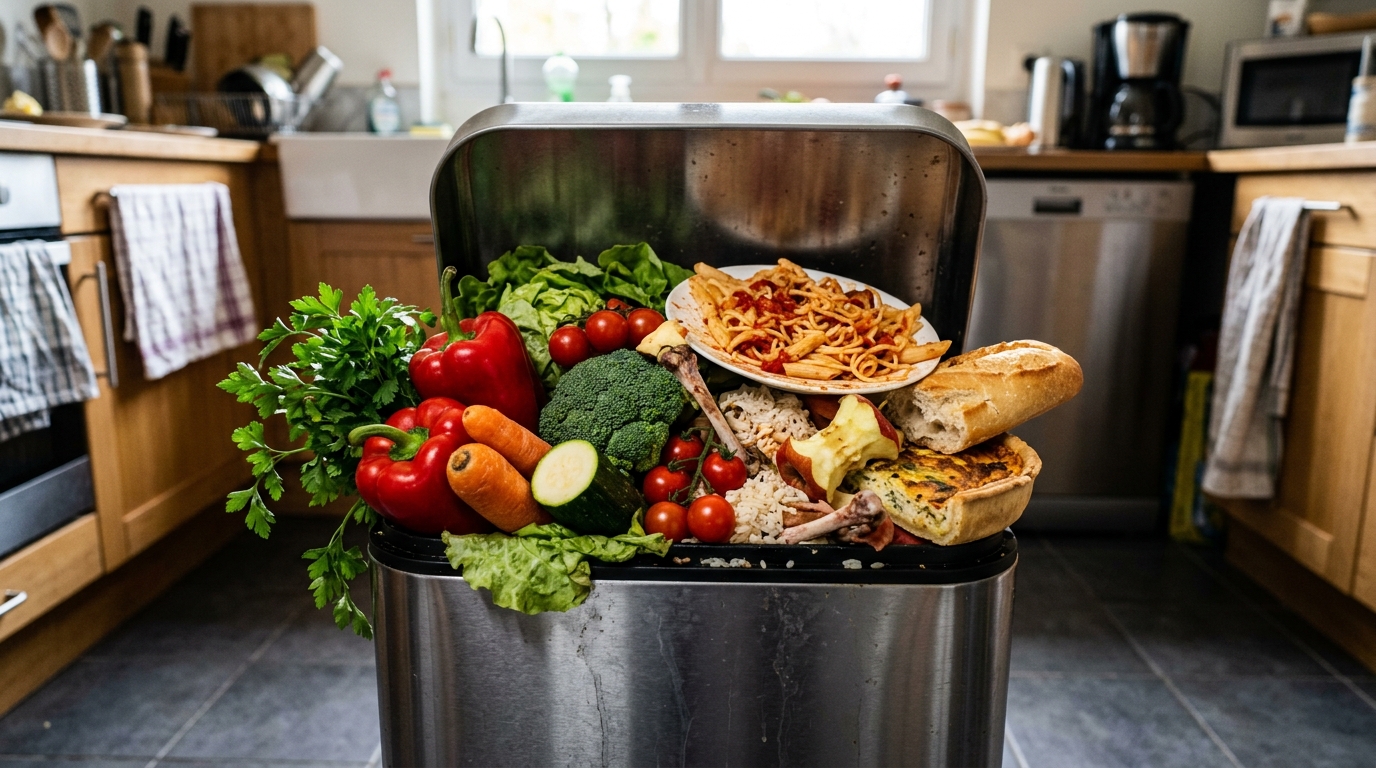
On one side, a promise etched into law for a decade. On the other, a reality that hardly budges, year after year. Between them, a figure that makes the mind reel: 142 kilos. That is the amount of food the average French citizen disposes of each year, roughly the equivalent of two adults turned into food waste. As the school year begins and supermarket shelves refill for autumn, the moment is ripe for taking stock of a goal France set long ago: to slash this waste by half by 2025. The countdown is over, and the result is clearly not what was hoped.
- In 2023, every French person threw away 142 kg of food, exceeding the European average of 130 kg.
- France did not meet the AGEC law’s objective of cutting food waste by 50% between 2015 and 2025.
- The European Union now sets a new target to reduce food waste by 30% by 2030.
- 142 kilos per year: the daunting weight of French food waste
- 2025, the year France was supposed to keep its promise
- Why the objective collapsed along the way
- What this failure reveals about our eating habits
142 kilos per year: the daunting weight of French food waste
To grasp the scale of the problem, one must look at the most recent figures available. In 2023, France produced 9.7 million tonnes of food waste, corresponding to the aforementioned 142 kilograms per person. A figure to put into perspective since a portion, about 5.9 million tonnes, concerns non-edible items like peels or bones, which are not strictly waste. Nevertheless: France sits above the European average, estimated at 130 kilograms per person.
This waste isn’t merely a matter of money or morality. It also weighs heavily on the climate. The emissions tied to discarded food account for 4.2 % of the country’s total emissions, a figure on par with entire industrial sectors. Producing, transporting, storing and ultimately discarding food consumes valuable resources for nothing, a ecological paradox that France had specifically aimed to fix.
2025, the year France was to keep its promise
The bet dates back several years. As early as 2016, the famous Garot law laid the groundwork by prohibiting supermarkets from throwing away edible products and obliging them to donate them to charities. This commitment was later reinforced by the AGEC law of 2020, which set a clear objective: halve food waste in distribution and in collective catering between 2015 and 2025. A second milestone, equally ambitious, now targets 2030 for consumption, production, transformation and commercial catering.
On paper, the ambition was laudable and coherent with the climate stakes of the moment. But ten years later, the verdict is unequivocal: France has not achieved this 50% reduction. The Anti-Waste Barometer 2025 confirms this without ambiguity: progress remains well short of the initial promises, despite a real awakening among many sector players.
Why the objective collapsed along the way
The reasons for this failure are not simply a lack of will. According to available data, 29 % of large and medium-sized surfaces report still discarding edible goods several times a week, with 4 % doing so even daily. More broadly, 69 % of large outlets continue to throw away food in good condition, and a third of specialized stores do not even capitalize on their non-food leftovers. These figures starkly clash with the stated intentions, since 90 % of businesses claim to be convinced of their role in combating climate disruption.
Between intentions and actions, several concrete obstacles arise. Logistics remains too complex to efficiently organize donations or discounted resales. A lack of knowledge about current laws also plays a role, with some retailers simply unaware of their obligations. Finally, persistent doubts about the profitability of anti-waste measures continue to deter many initiatives, even as ecological gains are undeniable.
What this failure reveals about our eating habits
Beyond the statistics, this collective failure prompts a reflection on our priorities. It is striking to see certain public funds easily finding a destination, even if questionable, while essential needs go unmet. A recent example illustrates this paradox: around 16 million euros were spent through the Pass Culture to finance escape rooms that were not eligible for the program. Yet this is precisely the amount that food charity associations say they need to meet the demands of French food banks. A moment for contemplation about our collective choices.
In response to this state of affairs, the European Union decided to reassert control. A directive taking effect this autumn sets a new common horizon: reduce 30 % of food waste in shops, restaurants and homes by 2030, with specific targets of 10 % for transformation and 30 % for consumption. It remains to be seen whether this new deadline will fare any better than 2025, or if France will fall back into the same patterns, between well-meaning declarations and stubborn habits.
This missed 2025 deadline may not be a fatal blow, but a useful wake-up call. It reminds us that the fight against food waste is not only a matter of laws but also of supermarket aisles, restaurant kitchens and, ultimately, our own refrigerators. With the 2030 deadline already on the horizon, one question deserves an answer: what are we really prepared to change in our habits to avoid repeating the same failure?
