
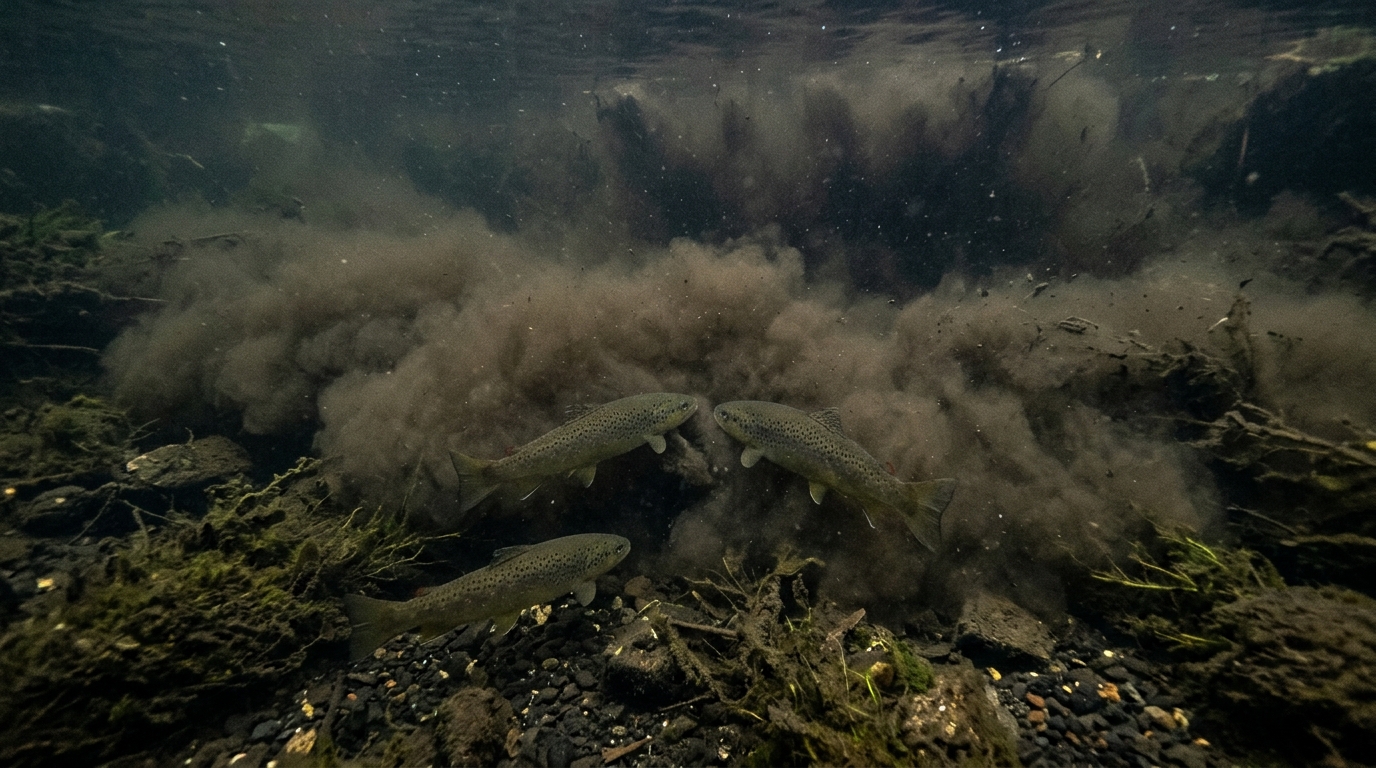
Clogging is that moment when a fine material fills the gaps in soil or a riverbed, preventing water and air from circulating normally. Beneath the turbulent waters of the Durance, this silent phenomenon has persisted for nearly seven decades, and it may well mark the end of an ancient ritual: the brown trout digging its redd in gravel to lay its eggs. Since the Serre-Ponçon dam came online, a fine substance has inexorably accumulated in the riverbed, turning some stretches that were once alive into true aquatic deserts. How did a structure built to tame the whims of an Alpine river end up suffocating, bit by bit, one of the most delicate biological cycles of our waterways?
- Since the Serre-Ponçon dam began operation in 1957, EDF reroutes most of the Durance’s flow, depriving the riverbed of the hydraulic force needed to evacuate fine sediments
- Fine particles clog the gravels of the spawning grounds, hindering oxygen circulation and causing the trout eggs to suffocate before hatching
- The water flushes organized by EDF to clean the riverbed can paradoxically deposit more fine material than they remove, worsening the clogging
- A dam that chokes the river in slow motion
- The act intended to clean, the one that clogged
- Under the gravel, eggs deprived of oxygen
- The Durance, a mirror of a broader French problem
A dam that chokes the river in slow motion
Completed in 1957, the Serre-Ponçon dam still astonishes today with its dimensions: 123.5 meters tall, a reservoir capable of storing 1,272 million cubic meters of water over a catchment area of 3,600 square kilometers. At the time, this colossal facility embodied postwar technical mastery, able to secure water supply and generate electricity for a whole region. But this feat carried a lasting downside: by capturing the bulk of the Durance’s discharge and its Verdon tributary to redirect toward a network of canals and hydroelectric stations totaling 2.2 gigawatts, EDF effectively deprived the river’s historic bed downstream of water.
This shift in the river’s hydrological regime did not merely alter water volumes. It disrupted the way the river transports, deposits, and redistributes sediments. A living river behaves like a natural conveyor belt, carrying gravels, sands, and silts with floods. By diverting the majority of the flow, the development disrupted this mechanism, leaving so-called bypassed reaches without the hydraulic force needed to naturally evacuate the finest particles.
The action meant to clean, the one that clogged
In response to this assessment, EDF now organizes targeted water releases, a kind of flushing designed to artificially remove the fine sediments accumulated in certain stretches of the river. The aim is commendable: to reproduce, in a controlled manner, the cleansing effect of a natural flood. But the Durance is not an ordinary river. Its torrential tributaries drain marls, those soft rocks that crumble easily and release a substantial amount of fine particles. This naturally high sediment load complicates everything.
Paradoxically, even floods, unpredictable and sometimes powerful, do not always suffice to prevent clogging. The scheduled releases, intended to act as corrective measures, can also deposit more fine material than they remove, depending on local conditions. It is precisely this mechanism, year after year since the dam’s commissioning, that has led to a progressive degradation of habitats in the sections deprived of the river’s natural flow.
Under the gravel, eggs deprived of oxygen
That is where the article’s title gains full meaning. The sediment flushes from the Serre-Ponçon dam clog the Durance’s gravel beds and destroy the trout’s spawning zones. To grasp the scale of the problem, it helps to recall how this emblematic river fish reproduces. The female excavates a clean-gravel cup called a redd, where she lays her eggs before covering them. These eggs require a constant stream of water weaving through the gravel to receive the dissolved oxygen essential for their development.
Yet, when fine particles infiltrate between the pebbles, they literally block these invisible microchannels. Water no longer circulates, oxygen can no longer reach the eggs, which end up suffocating before hatching. It’s a bit like trying to breathe through an ever-thicker fabric: at first, air still passes, then, at some point, nothing. To monitor this phenomenon, measuring stations have been installed in zones corresponding to potential redds, with topographic surveys taken before and after each water release, to precisely assess the impact of these operations on substrate quality.
The Durance, a mirror of a broader French problem
The Durance situation is not isolated; it illustrates a broader tension between hydroelectric production and the preservation of aquatic ecosystems. Since 2006, ecological measures concerning the Étang de Berre prevent EDF from returning all of the water diverted from Serre-Ponçon into that pond: the difference is now released directly into the Durance, at Mallemort. This adjustment shows that river managers are gradually seeking compromises between energy imperatives and environmental requirements.
Across France, many waterways equipped with large dams face similar dilemmas: how can we continue to produce decarbonized energy without sacrificing the biodiversity of rivers in a lasting way? The Durance, with its complex hydraulic history and recent scientific monitoring efforts, stands as an open-air laboratory for rethinking the coexistence of energy infrastructures and aquatic life.
Since 1957, the Durance bears the quiet marks of a development designed for humans, not always anticipating the consequences for species relying on its natural course. Sediment releases, measurement stations, and successive regulatory adjustments testify to a genuine, but still fragile, awareness. There remains a question that extends beyond this Alpine river: are we able, decades later, to repair what our infrastructures have patiently disrupted?
