
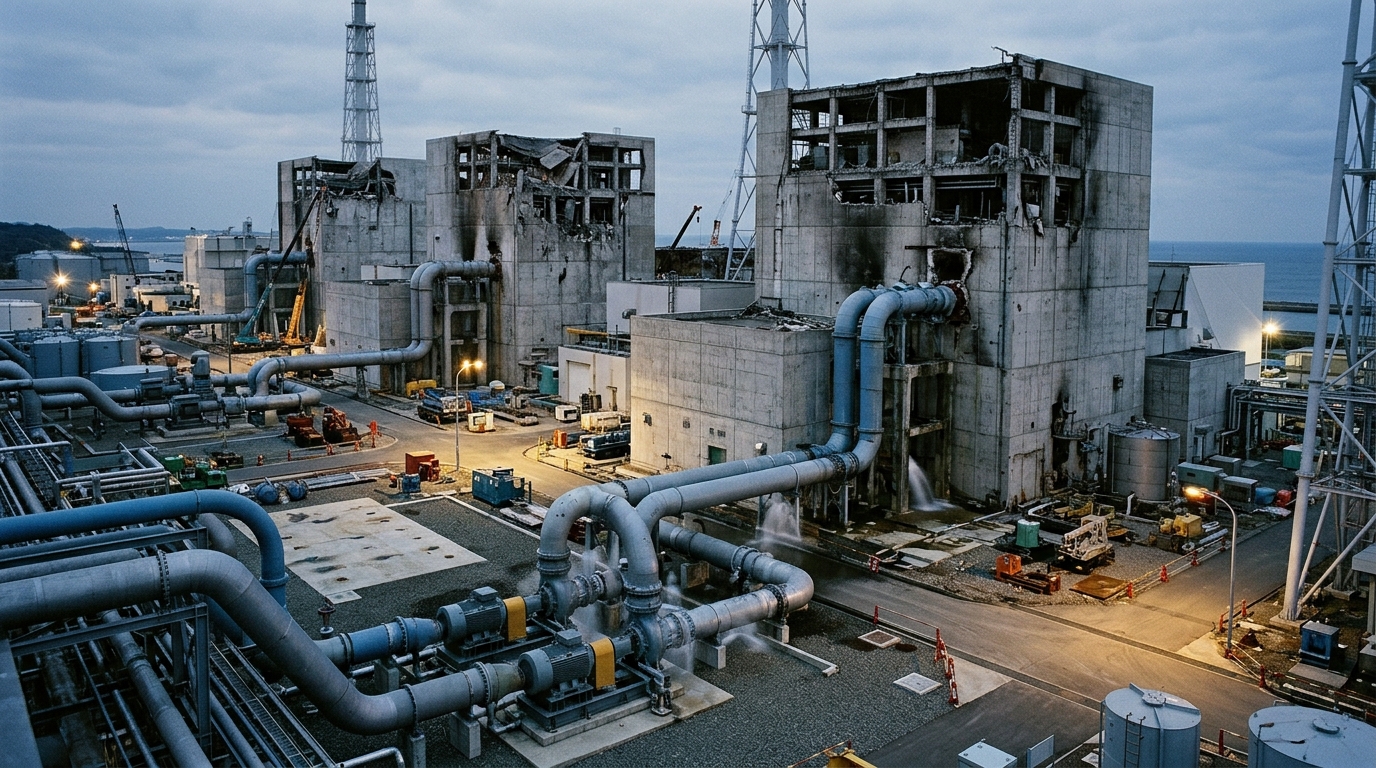
Imagine a bathtub whose tap has been left running continuously for more than a decade, day in and day out, with no possibility of ever closing the water supply or pulling the plug from the bottom. That is roughly the situation that persists today at Japan’s Fukushima Daiichi nuclear power plant. Many people picture the site sealed under a colossal concrete sarcophagus, as was done at Chernobyl. Yet the reality is quite different, and considerably more intricate. In the summer of 2026, as nature reclaims parts of the evacuated zones, the reactors’ interiors still demand constant attention, with water volumes that can be staggering to contemplate.
- Unlike Chernobyl, no definitive concrete confinement was ever placed over the Fukushima Daiichi reactors.
- Approximately 150 m³ of water are pumped daily to cool the melted fuel, producing contaminated water that must be filtered and stored.
- More than 1,000 tanks hold this treated water, and the molten fuel (corium) has never been fully located or removed, halting any decommissioning efforts.
- Why the myth of the concrete sarcophagus doesn’t fit reality
- 150 m³ per day: the reactors’ unquenchable thirst that refuses to run dry
- Over 1,000 tanks: the puzzle of a site that literally overflows
- The phantom fuel: the missing piece that blocks any decommissioning
Why the myth of the concrete sarcophagus doesn’t fit reality
In the collective imagination, a nuclear catastrophe always ends with a giant slab of concrete locking down the site for centuries, like a lid placed on a boiling pot. That’s the scenario that was applied to Chernobyl, with the construction of a first sarcophagus and then a massive metal arch designed to contain radioactive materials over the long term. But Fukushima Daiichi never underwent such treatment, and for a fairly simple reason: unlike Chernobyl, no definitive confinement has ever been placed over the damaged reactors.
The three most severely damaged reactors, which experienced partial or complete core meltdowns in 2011, remain open structures, partially exposed to the sky, where teams still intervene regularly to monitor, inject water, and attempt to prepare the removal of fuel that has, to this day, never been successfully completed. The site more closely resembles a sprawling industrial worksite under constant strain than a sealed tomb. This fundamental difference helps explain why, fifteen years after the event, the situation remains an evolving, open file.
150 m³ per day: the reactors’ insatiable thirst that refuses to dry up
The figure is striking: around 150 cubic meters of water are injected each day into the three damaged reactors. To picture this quantity, imagine about sixty standard bathtubs filled to the brim, every day, without exception since March 2011. This water isn’t poured in at random: it is used to continually cool the residues of molten fuel that continue to emit heat, even fifteen years after the accident.
Without this ongoing watering, the temperature inside the confinement enclosures could rise dangerously, risking the rekindling of uncontrolled reactions. The injected water becomes laden with radioactive particles after coming into contact with the fuel, turning it into a liquid that cannot simply be discharged back into the environment without prior treatment. This contaminated water must be recovered, partially filtered, and stored, creating an endless loop that feeds another equally vertiginous problem.
More than 1,000 tanks: the puzzle of a site that literally overflows
All this cooling water does not vanish on its own. It must be stored somewhere, and that is where Fukushima Daiichi presents its most striking face: a veritable forest of metal tanks. Today there are more than 1,000, lined up against one another across several hectares, forming an industrial landscape that sits somewhere between a refinery and a giant warehouse.
Each of these tanks holds treated water from which a portion of the radioactive elements has been removed, yet it still contains traces of tritium, a radioactive isotope of hydrogen that is particularly difficult to filter. Managing this colossal stock presents an almost insoluble equation: where to store ever more water in a space that itself does not expand? This physical constraint largely explains the debates in recent years over the gradual, controlled releases of treated water into the sea, a solution that remains controversial but arises directly from the site’s capacity constraints.
The phantom fuel: the missing piece that blocks any decommissioning
If water has been pumped in for so long, it is primarily because there remain, at the bottom of the containment enclosures, masses of molten fuel intertwined with metal structures and concrete. This solidified magma, known to specialists as corium, formed when the cores melted in 2011 and spread unpredictably through the reactors’ foundations. No one knows precisely where each pocket of this fuel phantom is located, nor in what exact form it presents itself today.
Robot crawlers have been sent in to map these inaccessible zones, given the extreme levels of radioactivity, but the molten fuel has never been fully removed. Every attempt runs into new technical obstacles: residual heat, intense radioactivity, limited physical access due to compact debris. As long as this highly radioactive material remains in place, cooling by water remains essential, and the long-awaited concrete lid cannot be seriously considered. This invisible, elusive missing piece is effectively the hostage that dictates the timetable of any decommissioning.
Fifteen years after the catastrophe, Fukushima Daiichi is thus not a site frozen under a protective dome, but a living construction site, where every day brings its share of millions of liters of water pumped, tanks filled, and cautious efforts to pinpoint a fuel that continues to elude capture. Between the day-to-day management of this water flow and the unfulfilled quest for the corium, the Fukushima dossier reminds us that a nuclear disaster does not close with a single architectural gesture, but must be tackled with patience, decade after decade. The question remains: how much longer will these reactors still thirst?
