
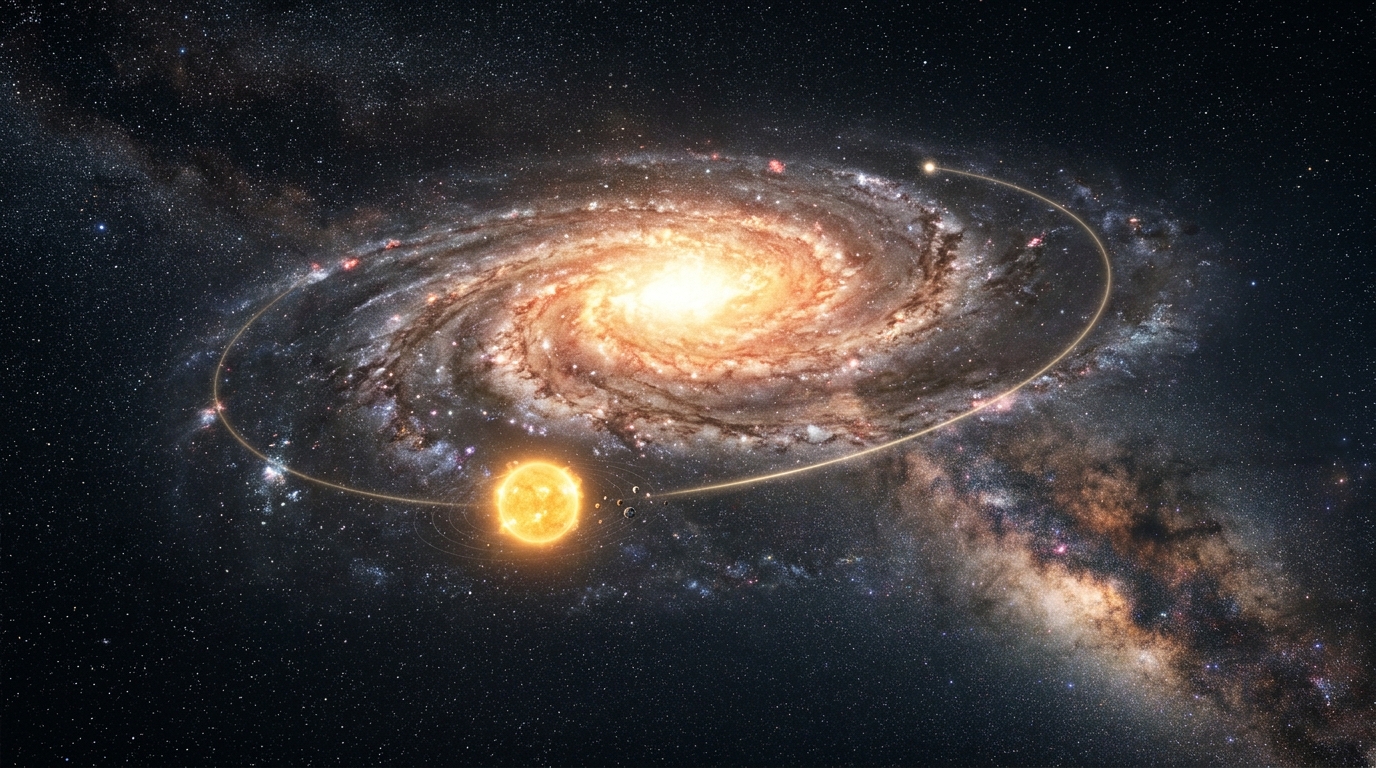
828,000 kilometers per hour. That is the speed at which the Sun, pulling along Earth and the rest of the planets in its wake, races through space right now. A pace that would dizzy any rocket, and yet, at this astonishing cadence, our star has managed to complete only a single full orbit around the center of the Milky Way since the last great dinosaurs set foot on Earth. It profoundly reframes our perspective on time, history, and our tiny place in the vastness of the Milky Way.
- The Solar System travels at about 230 km/s (828,000 km/h) around the center of the Milky Way, a speed that feels imperceptible because the entire system moves as a single block
- A complete orbit around the galactic center, called a galactic year, lasts between 225 and 250 million years
- Since its formation 4.6 billion years ago, the Solar System has already completed roughly twenty orbits around the galactic center
- A dizzying speed that you never see
- The galactic year, a calendar even the dinosaurs did not know
- Why the Milky Way redraws our sense of time
- What this cosmic journey reveals about our place in the universe
A dizzying speed that remains unseen
Sit back, take a moment to look around you: nothing moves, nothing shakes, everything seems perfectly still. And yet, in this very instant, you are streaking through space at a truly unimaginable velocity. The Solar System as a whole, with the Sun at its center and Earth tied to its orbit, travels around the galactic center at about 230 kilometers per second, or those same 828,000 kilometers per hour mentioned earlier.
To put it in perspective, that is nearly 700 times faster than a commercial airliner cruising. At this speed, you could theoretically circle the Earth in a little under two minutes. But this astonishing velocity is never felt, simply because the entire Solar System moves as a single block, with no perceptible acceleration or fixed reference point to measure it. It’s a bit like sitting in a supremely quiet train racing along at full speed: without a window, you’d be unable to tell you’re moving.
The galactic year, a calendar even the dinosaurs did not know
If our star is racing along at a breakneck pace, it nonetheless has a very, very long journey ahead. The Sun orbits the center of the Milky Way at an average distance of roughly 26,000 light-years, and this colossal voyage forms a loop so vast that it takes between 225 and 250 million years to complete. Astronomers have given this duration a name: the galactic year.
In practical terms, this means that the last time the Sun happened to be precisely in the same spot on its galactic orbit, Earth’s continents were arranged in a completely different way, the first dinosaurs were just beginning to appear, and mammals were still tiny, inconspicuous creatures. In other words, in a single galactic year, our planet has witnessed the rise and fall of the dinosaurs, endured several mass extinctions, and then seen the emergence of the human species. And we are only at the very start of a second orbit.
Why the Milky Way redraws our sense of time
In the face of such a scale, our ordinary bearings collapse. A human lifetime, an entire civilization, the history written since the invention of writing: all of this represents only an infinitesimal fraction of a single galactic year. If we condensed this cosmic year into a standard 365‑day calendar year, modern humanity would exist for only a few seconds before midnight on December 31.
This perspective is as dizzying as it is comforting. It reminds us that the upheavals that seem monumental at our scale—geological, climatic, or even civilizational—fit into a galactic timeline where they amount to nothing more than a blink of an eye. The Milky Way, for its part, continues its silent and relentless rotation, indifferent to the empires that rise and fall on the tiny blue planet it carries.
What this cosmic journey reveals about our place in the universe
Beyond the purely mathematical vertigo, this story of the galactic year invites us to rethink our relationship with existence. We live, often without realizing it, aboard a natural spacecraft that has never ceased traveling since the formation of the Solar System, about 4.6 billion years ago. That means the Sun and its planets have already completed roughly twenty full orbits around the galactic center since they came into being.
This realization places our presence on Earth in a context that is both humble and fascinating. We are merely very recent passengers on a journey that began billions of years ago and will continue long after us. Understanding this celestial mechanism also helps us measure how remarkable our existence is, though brief on a cosmic scale, deserving to be observed with wonder rather than taken for granted.
Ultimately, the simple act of lifting our eyes to the sky on an autumn evening takes on a special flavor when we know this contemplation is part of a titanic motion that began with the dawn of the Solar System. The Sun will continue its wild trek through the galaxy long after we have disappeared, and more than 200 million years will pass before it completes its second galactic loop. By then, what new species will have walked the Earth, and what will remain of our passage on this ever-traveling planet?
