
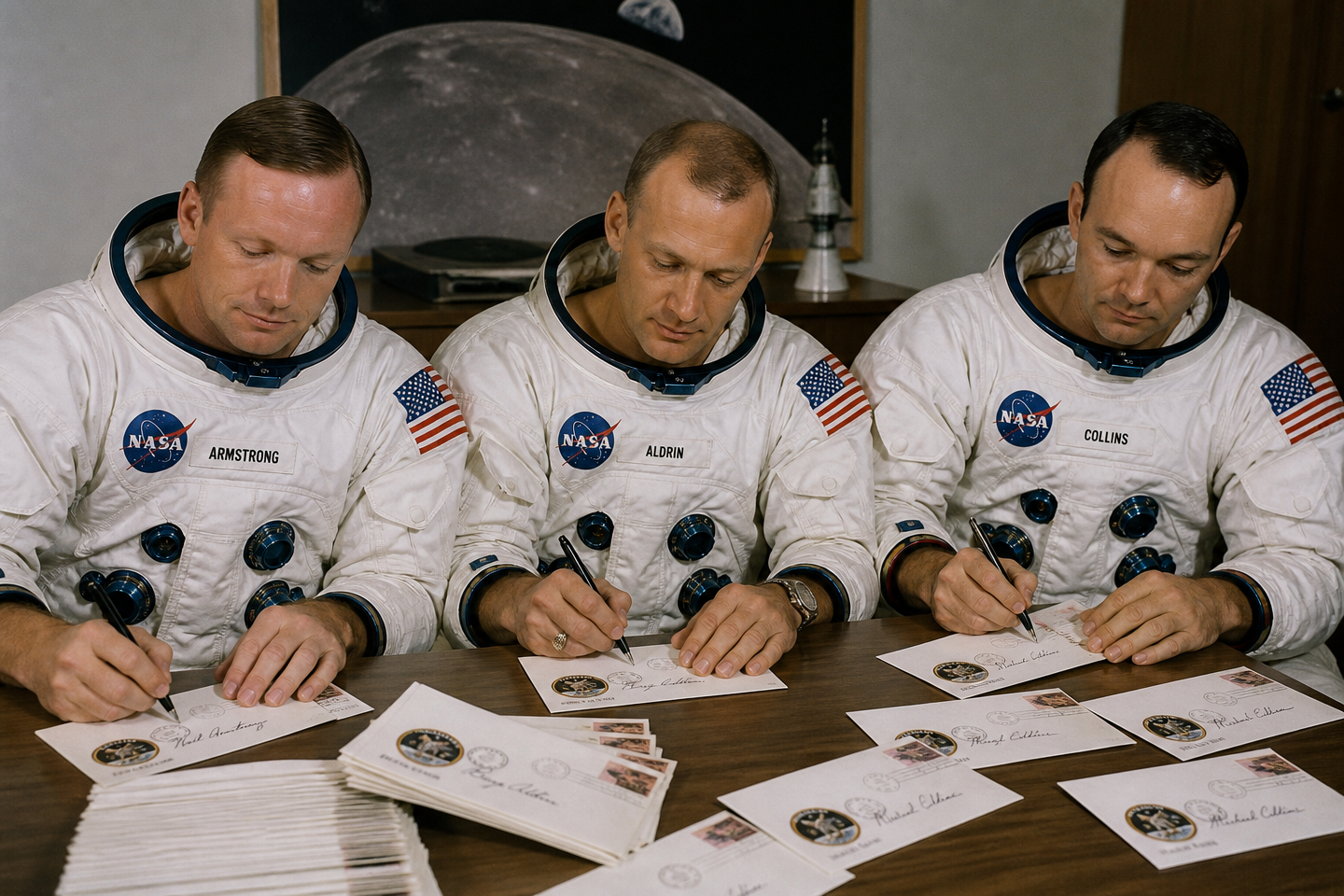
Before each liftoff, Apollo astronauts observed a ritual as discreet as it was vital: they signed hundreds of philatelic envelopes intended for their families. Faced with insurance companies’ outright refusals to cover their lives, these plain pieces of paper literally stood as their sole financial safety net in the event of a tragedy.
- No insurance company was willing to cover Apollo astronauts due to excessive risk, so during the preflight quarantine they signed hundreds of philatelic envelopes intended for their families in case of death.
- The Apollo 15 affair in 1971, where three astronauts sought to commercially resell about a hundred envelopes taken to the Moon, resulted in their permanent removal from spaceflight and the end of the practice.
- Having become collectibles since the 1990s, some of these envelopes have sold for tens of thousands of dollars at auction, Buzz Aldrin himself having sold his in 2023.
- When no insurer would risk a cent on their lives
- The scheme of signed envelopes to protect families
- Apollo 15, the scandal that ended three careers
- Bits of paper that became real treasures at auction
When no insurer would risk a cent on their lives
Becoming an astronaut in the 1960s was an extraordinary feat, yet it came with a very earthly problem: no one wanted to sell them life insurance. As early as 1961, the Mercury Seven—the first American astronauts elevated to national hero status—were denied any conventional life policy. Insurance companies considered space missions far too risky, and their policies explicitly excluded experimental flights, a category into which an Apollo spacecraft fell without argument.
The paradox grew cruel when you look at the numbers: Neil Armstrong, the man who would set foot on the Moon, earned an annual salary of $27,401. A comfortable sum for the era, but far from enough to fund a private policy suited to a profession where survival was far from guaranteed. Families thus found themselves in a dizzying situation: their husband, their father, was about to risk his life for space exploration, with no official financial safety net if tragedy struck.
The scheme of signed envelopes to protect families
This is where a remarkably clever yet little-known practice comes into play. Contrary to popular belief, the envelopes were not signed the night before liftoff but during the preflight quarantine, about a month before launch, at the Kennedy Space Center or the Hilton Hotel in Cocoa Beach. For Apollo 11 alone, the three astronauts signed between 500 and 1,000 envelopes, today known by collectors as insurance covers.
The mechanism was simple yet devastatingly effective. These envelopes, adorned with commemorative stamps from earlier Apollo missions and seals specially created by Houston philatelists, were postmarked by an astronaut who stayed on the ground, often on key dates such as the Moon landing on July 20, 1969. Once signed, they were handed to the families before liftoff. If the mission ended in tragedy, relatives could sell these signed envelopes to support themselves. If all went well, they became mere family mementos. Moreover, the signatures on these envelopes are noticeably neater than those on the astronauts’ other autographs, a detail that betrayed how keenly they understood the stakes.
This informal tradition persisted from Apollo 11 in 1969 through Apollo 16 in spring 1972, before Apollo 17 adopted different designs. Notably, all involved missions returned safely, so no family ever had to sell these envelopes in a hurry to make ends meet.
Apollo 15, the scandal that ended three careers
This practice, tolerated by NASA though never officially approved, eventually ran off the rails with the Apollo 15 mission in 1971. The three astronauts aboard—David Scott, James Irwin, and Alfred Worden—took about a hundred of these envelopes to the Moon’s surface, intending to sell them later to a German dealer. This time, it wasn’t a life-insurance windfall to protect a family, but an unauthorized commercial transaction.
When the affair came to light, the punishment was unequivocal: the three men were permanently barred from any future spaceflight. The incident had a radical effect, simply ending this unofficial practice of signed envelopes, which had protected several astronauts’ families for years without ever causing trouble.
Bits of paper that became real treasures at auction
Yet the story doesn’t end there, and this is where the irony of the tale lies. Conceived at first as a simple safety net in case of death, these envelopes took on a very different dimension starting in the 1990s, when Apollo 11’s insurance covers began to appear on the auction block. Some fetched tens of thousands of dollars, turning what began as a modest financial fallback into genuine collectible items coveted by space-history enthusiasts.
Even more surprising, Buzz Aldrin himself chose to sell some of his covers in 2023, more than half a century after signing them during the prelaunch quarantine for Apollo 11. What was meant to stay tucked away in a family drawer in case of tragedy became a focal point for collectors, proof that even the most modest tricks of the space age can endure through decades and acquire unforeseen value.
From insurers’ distrust of the unknown realm of space to auction houses eagerly bidding for these relics, the story of Apollo’s insurance covers reveals far more than a mere administrative anecdote. It highlights the ingenuity of men and women facing a total legal and financial void, forced to craft their own safety net. A clever workaround that, in hindsight, speaks volumes about the audacity of an entire generation of space pioneers. One playful question remains: how many of these envelopes still lie forgotten in attics, waiting to be rediscovered?
