
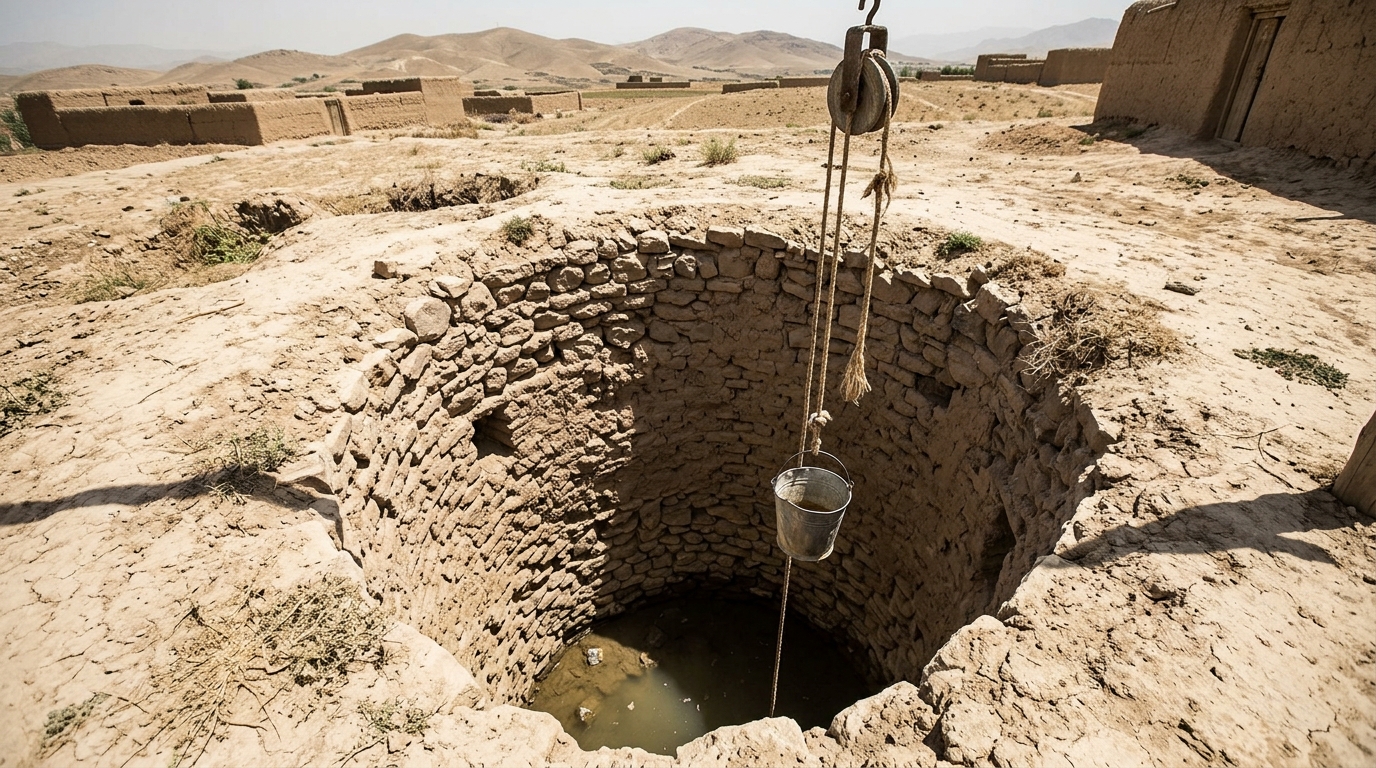
Imagine waking up every morning facing a choice between doing the dishes and filling a canister for the day. For hundreds of thousands of households in Kabul, this dilemma is not a hypothetical scenario: it is daily life. And the reason for this growing scarcity does not stem from a dramatic drought or armed conflict, but from a quieter, almost invisible phenomenon beneath the surface: beneath the Afghan capital, the groundwater aquifer is literally collapsing, year after year, without anyone sounding the alarm in time. How could a city of several million people drain its own freshwater reservoir without seeing it coming?
- Kabul’s groundwater, overexploited by more than 100,000 unregulated boreholes, drops by about three meters per year.
- Nearly one-third of the city’s wells are already dry, a situation worsened by a population that has grown to about six million without adequate hydraulic infrastructure.
- The depletion of the aquifer is already causing subsidence, leading to ground collapse and cracks in some buildings.
- Kabul sits atop a reservoir that recedes by three meters per year, and no one saw the drop coming
- One hundred thousand wild boreholes for a single aquifer that no longer replenishes
- One in three wells already silenced
- A capital city of six million that digs faster than it drinks
- When the very ground beneath the city begins to sink
- Kabul running out of water before time runs out
Kabul sits atop a reservoir that recedes by three meters per year, and no one saw the drop coming
Beneath the dusty streets of Kabul lies a floodplain valley that for decades supplied most of the city’s drinking water. This underground reservoir, fed by snowmelt and the occasional rainfall, functioned a bit like a natural sponge capable of absorbing water and then returning it as the seasons changed. But this sponge is now drying out much faster than it recharges. The water table falls by roughly three meters each year, a pace far from trivial when one recalls that a groundwater basin typically takes decades, if not centuries, to replenish naturally.
Cent mille forages sauvages pour une seule nappe qui ne se renouvelle plus
Facing a failing public network, Kabul residents took matters into their own hands in the most direct way possible: digging their own wells. Today there are estimated to be more than one hundred thousand boreholes, often unregulated, that penetrate the city’s soil. Each household, each business, every small workshop able to do so hires a driller to install a private pump. The problem is that this anarchic spread of extraction points is like drilling into the same bottle of water with hundreds of straws at once: everyone draws their share, without coordination, until the bottle empties far more quickly than it would with a single opening.
Un puits sur trois déjà réduit au silence
This overexploitation has a price, and it is already being paid. Nearly a third of the city’s wells would now be dry, unable to draw even a drop since the water table has sunk below the depths of their installations. For the families affected, the consequence is immediate: they must drill deeper, which is costly, or turn to private tanker trucks whose water prices soar. This situation primarily hits the poorest households, those who cannot afford to drill again or to pay for water that has, ironically, become almost as precious as water in a desert.
A capital city of six million that digs faster than it drinks
A few decades ago, Kabul counted only a few hundred thousand residents. Today, the city houses nearly six million, a population boom that has never been matched by adequate hydraulic infrastructure. The urban water supply network, already fragile after decades of conflict, covers only a fraction of real needs. The result: demand for water soars while the natural supply remains fixed to the whims of the local climate. This mismatch between a growing population and a stagnant resource is perhaps the fundamental cause of the subsidence observed beneath the ground, or rather beneath the feet of Kabul’s inhabitants.
Quand le sol lui-même commence à s’affaisser sous la ville
What is less widely understood is that emptying a groundwater aquifer does not merely dry up wells: it can literally cause the ground to sag. When the water filling the voids between sediment grains disappears, the geological layers compact, a phenomenon known as subsidence. Some neighborhoods in Kabul are already showing signs of settlement, with cracks appearing in buildings and infrastructure becoming more fragile. It’s a little like removing, one by one, the cushions supporting a mattress: gradually the entire structure buckles with no easy way to restore it.
Kaboul à court d’eau avant même d’être à court de temps
The most troubling aspect of this story is the speed with which everything unfolded. Experts who monitor groundwater worldwide know that a depletion rate of three meters per year places Kabul among the capitals most at risk globally in terms of water stress. Without radical changes in resource management, without curbing unregulated boreholes, and without massive investment in alternatives like rainwater harvesting or wastewater treatment, the city could simply run out of usable water in the near future. The countdown, quiet, is already ticking beneath the feet of six million people.
The tale of Kabul’s aquifer illustrates how an environmental crisis can unfold far from scrutiny, meter by meter, well by well, until it becomes irreversible. It also reminds us that water, a resource often treated as guaranteed, remains one of the most fragile when poorly managed in the face of a booming population. The question extends far beyond Afghan borders: how many other major cities around the world are already living the same scenario without realizing it?
