
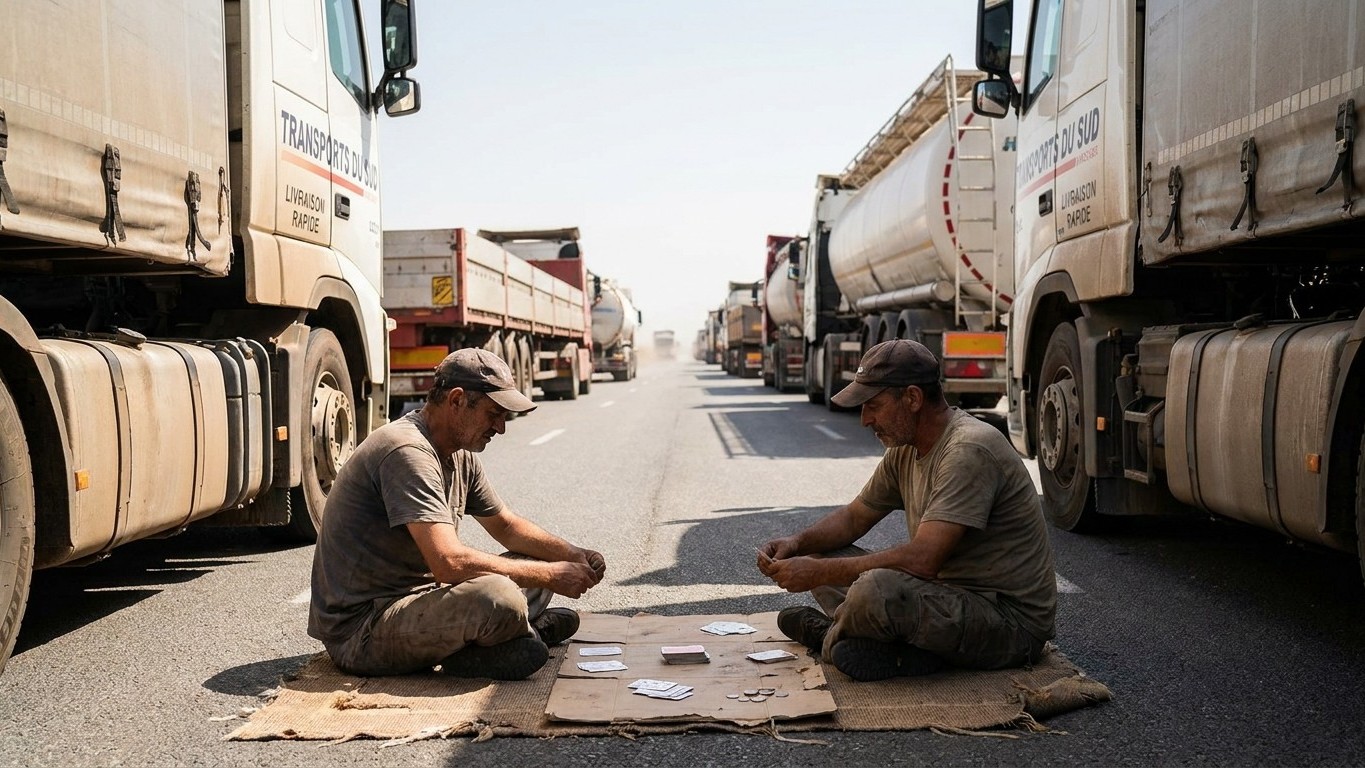
On August 14, 2010, National Highway 110, linking Beijing to Inner Mongolia, became a stagnant ribbon of metal. This traffic jam stretched for roughly 100 kilometers, trapping tens of thousands of cars and trucks for 12 days (August 14–26, 2010). The images circulating in the international press at the time showed lines of trucks frozen in the sun, drivers seated on the asphalt, playing cards laid out between two wheels. Twelve days of waiting on a road intended to connect two points in a matter of hours. The word “traffic jam” suddenly seems too weak to describe the scene.
Key takeaways
- A Chinese highway turned into a gigantic parking lot: what exactly happened?
- For twelve days, thousands of drivers faced the unimaginable — how did they survive?
- The bottleneck disappeared as quickly as it formed, but questions remained unanswered
A Project Started at the Worst Moment, Coal Trucks in Excess
The giant breakdown did not fall from the sky. It resulted from an almost absurd combination of two separate decisions. The root of the bottleneck appeared to be a sharp rise in heavy truck traffic heading toward Beijing, along with roadworks that began five days later and would not finish before mid-September 2010. Authorities began repairs on an already saturated route, without waiting for the tide of trucks to subside.
And this flow came predominantly from coal. That day, many trucks were transporting coal from northern mining regions toward Beijing. The capital, in the throes of growth, was consuming fossil energy and increasingly relying on Inner Mongolia’s deposits to feed itself. Add to this a road that had never been calibrated for this level of traffic: the volume at that moment exceeded the road’s intended capacity by about 60%. The result is like applying fluid dynamics to asphalt: too many trucks, too slowly, on a roadway half-shrunk by construction. The traffic jam did not merely form; it was built, day after day, like a champagne cork being forced in rather than removed.
Twelve Days of Ordinary Life on a Road at a Standstill
Face with total immobilization, the drivers had little choice but to organize themselves. Many slept in their cabs, turning their heavy trucks into makeshift bedrooms set right in the middle of the line. To pass the time between advances of a few hundred meters, some pulled out playing cards right there on the roadway, perched on the blistering August asphalt. A scene nearly routine, except that it repeated for almost two weeks.
The standstill gave rise, almost automatically, to a parallel economy. Local shops surrounding the highway sold various goods — cigarettes, water, and instant noodles — to the stranded drivers at inflationary prices, water costs having been multiplied tenfold and instant noodles by three. Nearby villagers did not miss the opportunity: they moved back and forth between the immobilized vehicles, bags of groceries in hand, selling at steep prices what they could scavenge from their stores. Some drivers, desperate, actually left the line to walk to the nearest village and then returned to their places, only marginally farther ahead than when they had departed.
A Disappearance as Mysterious as the Bottleneck’s Birth
On August 25, a team from Agence France-Presse went up National Highway 110 to assess the extent of the damage. To their surprise, they traversed more than 200 kilometers without encountering a major traffic problem, even though the works claimed to be the cause were still underway. The colossal bottleneck that had paralyzed the region for eleven days, by contemporaneous tallies, essentially vanished without warning. A station attendant interviewed on the spot summed up the situation with a disarming sentence: “The situation has improved recently, but I don’t know why.”
The underlying causes hadn’t vanished along with the traffic. The works continued until mid-September, and coal trucks kept pouring toward Beijing, driven by a demand for energy that showed no signs of weakening. It is precisely this persistence of the structural problem that pushed, the following year, Chinese authorities to revise road policy: new weight limits for heavy vehicles and stricter penalties were introduced to prevent such a scenario from repeating on the country’s main arteries. The coal, meanwhile, began a gradual shift to rail, a change that gradually eased pressure on roads never designed to absorb such a deluge of trucks.
Sources: fr.wikipedia.org | lesaviezvous.net
